
It is a Tuesday and a $40 Meta ad promo just filled six new-client IV slots. The chairs are full, the day felt like a win. Then you look a month later and five of those six never came back. You spent real money to acquire a single visit each, delivered the drip at cost, and broke even at best. The problem is not the ad. You were buying visits when you should have been buying clients, and you had no number that told you the difference.
Here’s the honest answer up front: to know what a wellness client is worth, multiply the average value of one visit by how many times they come in a year by how many years they stay, then subtract your true cost to deliver. That is client lifetime value (LTV). A one-and-done IV client in 2026 is worth roughly a single $216 ticket, often less than it cost to acquire them. A client who rebooks or joins a membership is worth $1,800 to $5,200 over twelve months and multiples of that over their lifespan. The whole game is moving clients from the first number to the second. This guide gives you the formula, a fill-in worksheet, the exact message that does the moving, and the math run three ways. Every figure carries a source.
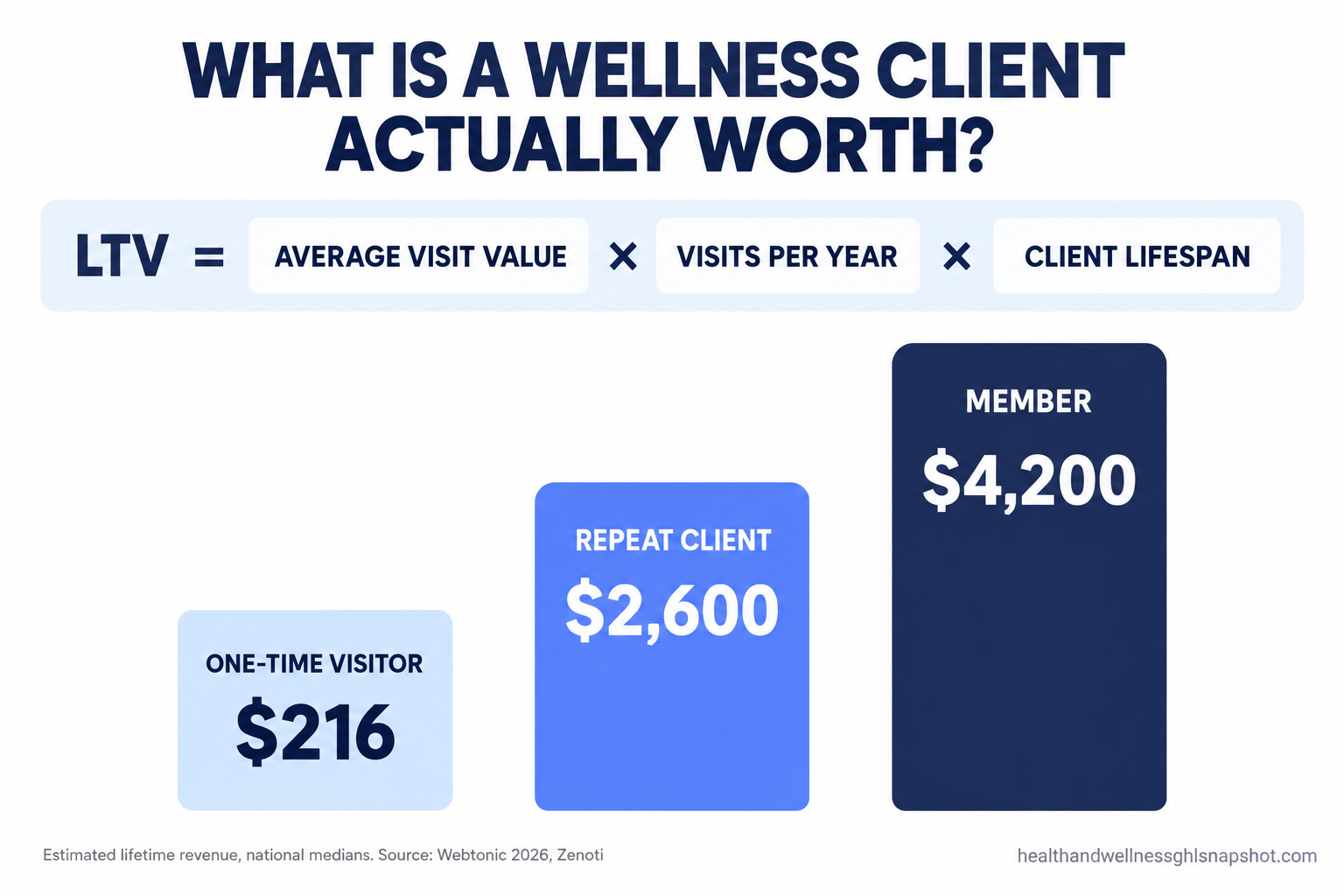
Table of contents
- Why not knowing your LTV is costing you money right now
- The LTV formula, built for a mixed clinic
- Calculate it in six steps (and how each one breaks)
- Steal this: the fill-in LTV worksheet and the rebook message
- Run the math three ways
- The compliance lines that touch your LTV
- Common objections, answered honestly
- Frequently asked questions
Why not knowing your LTV is costing you money right now
Most clinic owners track revenue and chair-time, and almost none track lifetime value. That gap is where the money leaks, because nearly every decision you make, from an ad budget to a front-desk hire to whether to launch a membership, is secretly a bet on what a client is worth over time. If you do not know the number, you cannot tell a good bet from a bad one.
Revenue is not spread evenly across clients. Returning guests, only 42 percent of clients, drive around 80 percent of revenue (Zenoti 2025 Benchmark, via Webtonic). A small group of high-LTV clients funds the clinic, and the rest barely cover their own cost. Now look at what you pay to get them. A new patient costs between $162 and $648 to acquire once you count intake drop-off, no-shows, and onboarding (Foundry CRO data, via Webtonic). So if a client walks in once, gets their $216 drip, and never returns, you likely lost money on them. You just do not see it, because the single visit looked like revenue. LTV turns that invisible loss into a number.
The LTV formula, built for a mixed clinic
Here is the formula. Four inputs, and it is not complicated.
LTV = average visit value × visits per year × average client lifespan (years)
That gives lifetime revenue. For lifetime profit, the number that matters, multiply by gross margin and subtract acquisition cost:
Net LTV = (lifetime revenue × gross margin) − acquisition cost
The twist for an IV, injectable, and membership clinic is that you do not have one kind of client. You have at least three, each with wildly different inputs:
- The one-time visitor. Comes once for a hangover drip before an event. Visits near 1, lifespan near zero. LTV barely clears the cost of the bag.
- The repeat à la carte client. Comes back a few times a year but has committed to nothing. Decent LTV, fragile, because nothing holds them.
- The member. Pays monthly, visits more, stays longer. Members are retained about 35 percentage points better than non-members and spend roughly 2.5 times more (CorralData 2026, via Webtonic). The point of the clinic is to make more of them.
The chart below shows the gap. These are modeled estimates built from the cited per-visit and frequency figures, so treat them as the shape, not a promise.
Estimated lifetime revenue per client type, national medians. Modeled from a $216 average visit value (Zenoti median ticket, via Webtonic) applied to one visit, to six visits a year for two years, and to a member across an 18-month lifespan. Your inputs will differ.
Calculate it in six steps (and how each one breaks)
Here is the method, in order. Each step has one common way it goes wrong, and those failures are where most clinics lose the number.
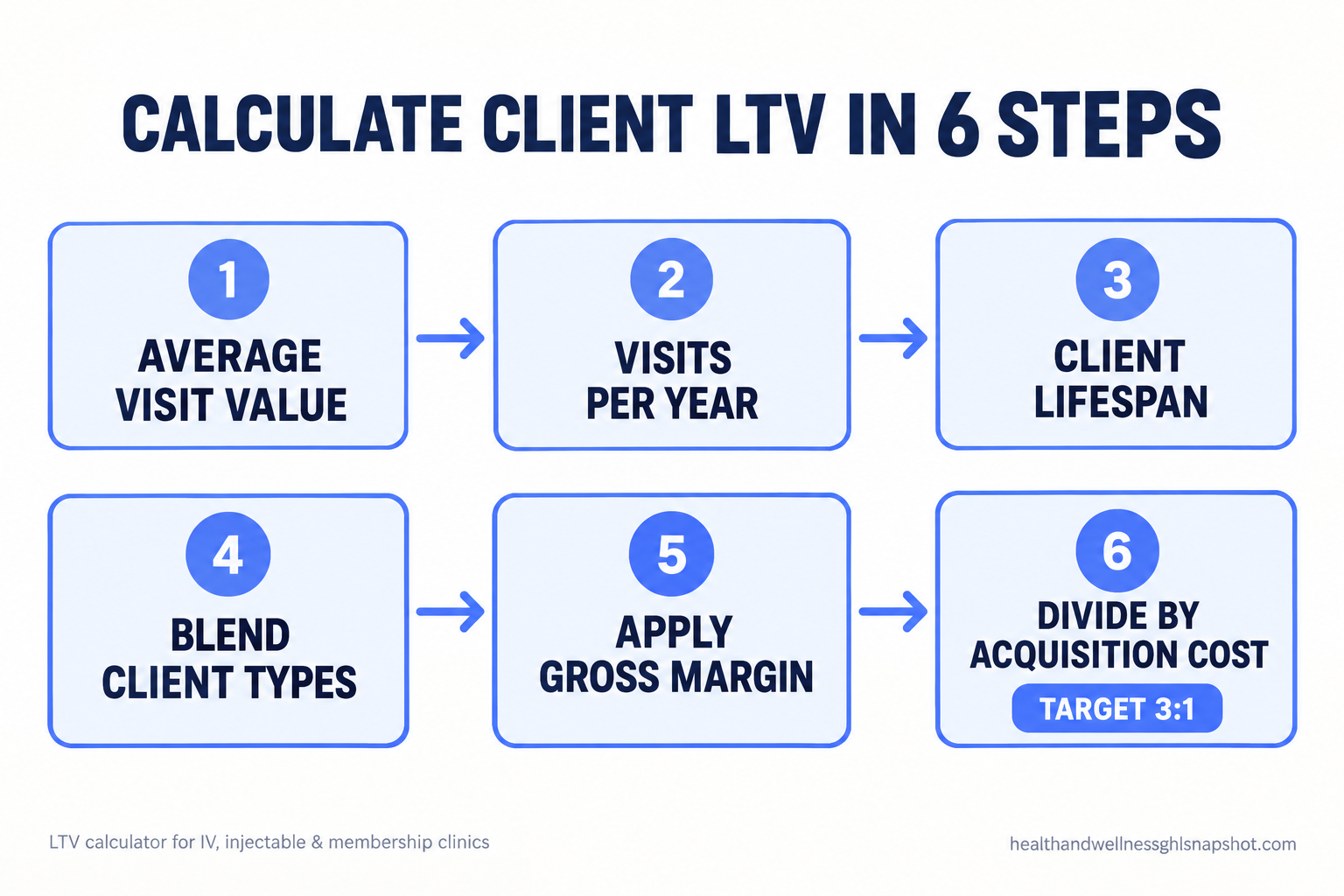
Step 1: Find your average visit value
Pull your last 90 days of transactions and divide total service revenue by number of visits. Do not guess from your menu price, because add-ons and discounts move the real figure. Nationally the median ticket is about $216, rising to $484 at the 90th percentile (Webtonic).
How it breaks: you use your headline price instead of your real average. A clinic that advertises $99 drips but sells mostly $250 add-on packages understates its LTV. Use what actually hit the account.
Step 2: Count visits per year, per client type
This is the input most owners have never measured. In your booking software, count how many times each client from a twelve-month-old cohort came back, and average it inside each group. The first return is the hinge. Only about 45 percent of first-time clients at an average practice come back for a second visit, while top-decile practices hit 70 percent (Boulevard 2023 Salon Industry Client Retention Report, via Webtonic).
How it breaks: you average across all clients and get a number that describes nobody. A clinic with 400 one-timers and 100 members has a meaningless blended frequency. Segment first, always.
Step 3: Estimate average client lifespan
Lifespan is how long, in years, a client keeps coming before they churn. A client who churns at 40 percent a year has a lifespan near 2.5 years. Members live longer because the monthly charge creates inertia. Industry data shows only 46.4 percent of clients returned year over year (CorralData 2026, via Webtonic), so most à la carte lifespans are short unless you extend them.
How it breaks: you assume everyone stays for years because your regulars are the ones you see. The clients who left after one visit never show up in memory, so your gut is always too high. Pull the cohort.
Step 4: Blend the three client types into one number
Weight each type by how many you have. If 60 percent of your clients are one-timers worth $216, 30 percent are repeats worth $2,600, and 10 percent are members worth $4,200, your blended lifetime revenue per acquired client is about $1,330. That blend is what you can afford to spend on the next client, almost always lower than owners expect.
How it breaks: you quote your best client’s LTV as if it were typical. The member worth $4,200 is real, but if only one in ten becomes one, budget against the blend.
Step 5: Convert revenue to profit with your true margin
Lifetime revenue is not money in your pocket. Multiply by gross margin. IV therapy typically runs a 50 to 80 percent gross margin before overhead (Pabau), with supplies around $40 and nurse labor around $35 per session (American IV Association). Recurring members also cost 2.9 percent plus 30 cents per charge (Stripe), every month.
How it breaks: you treat revenue as profit and overspend on ads. A $1,330 blended revenue LTV at 60 percent margin is $798 of gross profit. Spending $600 to acquire that client looked fine against revenue and is a near-wash against profit.
Step 6: Divide profit LTV by acquisition cost and judge it
Divide gross-profit LTV by what it costs to acquire a client. The widely used floor is an LTV-to-CAC ratio of at least 3:1 (Webtonic). Below 3:1 you are buying growth you cannot sustain. Above 5:1 you may be underspending.
How it breaks: you never calculate it, so you cannot tell whether to scale an ad or kill it. The chart below shows net lifetime profit per client type after a $200 acquisition cost. The one-time client bleeds.
Net lifetime profit per client after a $200 acquisition cost, at a 60 percent gross margin, using the modeled revenue above. A one-and-done client acquired through paid ads can finish underwater. Margin: Pabau. CAC: Webtonic.
Steal this: the fill-in LTV worksheet and the rebook message
Copy this into a note or a spreadsheet and fill in your own numbers. It takes fifteen minutes with your booking software open.
CLIENT LIFETIME VALUE WORKSHEET (per client type)

A. Average visit value ($)            = total 90-day service revenue ÷ visits
B. Visits per year (#)                = count returns for a 12-month cohort
C. Average client lifespan (years)    = 1 ÷ annual churn rate
D. Lifetime revenue ($)               = A × B × C
E. Gross margin (%)                   = (price − supplies − clinical labor) ÷ price
F. Gross-profit LTV ($)               = D × E
G. Acquisition cost ($)               = ad spend ÷ new clients won
H. LTV : CAC ratio                    = F ÷ G        (target 3:1 or better)

Run this three times (one-timers, repeats, members), then blend by
your client mix for the number you budget ads against.
The highest-value thing this worksheet reveals is that frequency (line B) is the lever you control most cheaply. You do not need a price increase to double a client’s LTV. You need them to come one or two more times, and the cheapest way is a rebook sequence that fires automatically after every visit, because clients who rebook within 24 hours cancel at about 4 percent versus 37 percent for one-at-a-time bookers (Zenoti, via Webtonic). Here is the copy. Steal it and swap in your clinic name.
That third message is where LTV compounds, because it routes a repeat client toward a membership without a hard sell. Membership-tracked clients carry 35 to 45 percent higher LTV (Webtonic), so every repeat you convert is a permanent step up in worth. The full conversion path is in turning one-time IV clients into members.
Run the math three ways
The formula is the same for every clinic. The inputs are not. Here is LTV run for three operator profiles.
| Input | Solo IV bar | Two-location clinic | Larger multi-service group |
|---|---|---|---|
| Average visit value | $150 | $260 | $420 |
| Visits per year (blended) | 2.5 | 4 | 5 |
| Average lifespan (years) | 1.5 | 2.5 | 3 |
| Lifetime revenue | $563 | $2,600 | $6,300 |
| Gross margin | 65% | 60% | 58% |
| Gross-profit LTV | $366 | $1,560 | $3,654 |
| Acquisition cost | $180 | $250 | $400 |
| LTV : CAC | 2.0 : 1 | 6.2 : 1 | 9.1 : 1 |
The solo IV bar has a problem hiding in plain sight. A 2.0:1 ratio is below the 3:1 floor, so paid acquisition is barely working. The fix is not more ad spend, it is frequency. Lift blended visits from 2.5 to 4 a year with a rebook sequence and lifetime revenue jumps to about $900, clearing 3:1 without spending another ad dollar.
The two-location clinic at 6.2:1 is a signal to spend more on acquisition, not less. A ratio that high usually means the clinic is under-marketing. The risk is a front desk that cannot keep up, its own operational trap.
The larger multi-service group at 9.1:1 is leaving growth on the table. When LTV so far outruns acquisition cost, the constraint is capacity, not money, so reinvest the margin into memberships and retention.
The pattern holds at every size: the lever is rarely price or more ads. It is frequency and lifespan, the two inputs a follow-up system moves for almost nothing.
The compliance lines that touch your LTV
LTV math quietly pushes owners toward two risks: aggressive health claims to drive repeat visits, and GLP-1 programs to lift average value. Both need a guardrail.
Health claims. When you chase frequency, the temptation is to promise outcomes. Do not. The FTC has warned roughly 700 weight-loss and wellness marketers and sent formal letters to IV-therapy companies over immune and COVID claims. Copy that says a drip “boosts immunity,” “melts fat,” or “detoxes” needs competent and reliable scientific evidence or it has to be softened (FTC Health Products Compliance Guidance). Your rebook texts are marketing and are in scope. Sell the experience, not a cure.
GLP-1. Semaglutide and tirzepatide lift average client value fast, but the shortage justification is gone. The FDA declared both shortages resolved in December 2024 and February 2025 and wound down mass compounding through mid-2025 (FDA Drug Shortages). In 2026, “there’s a shortage” is no longer a lawful reason to compound, so GLP-1 revenue in your model must rest on compliant sourcing.
HIPAA. A pure cash-pay IV bar may fall outside HIPAA, but it still owes state privacy and breach-notification duties, and the moment you bill insurance or share records with a lab you are covered. Never let an automation assume the exemption. Full picture in the 2026 marketing compliance guide.
Common objections, answered honestly
“My clinic is too small to bother with LTV math.” Backwards. A small clinic has the least room for error, so knowing which clients make money matters more, not less. The solo bar above was quietly running paid ads at a loss, and the worksheet would have caught it.
“Won’t this take days to calculate?” No. It runs in about fifteen minutes if your booking software exports transactions. The only slow part is counting return visits for a cohort, a report you pull once a quarter. It need not be perfect, just roughly right and segmented by client type.
“I already know my regulars are valuable.” You know your regulars. You do not know your blend, and the blend is what you budget against. The one-timers who cost you money are invisible precisely because they left, so your gut overstates the typical client’s worth.
Frequently asked questions
What is a good client lifetime value for a wellness clinic in 2026?
It depends on your services and client mix. As a benchmark, the median 12-month client LTV at a med spa is about $1,800, rising to $5,200 at the 90th percentile (Webtonic 2026 data). What matters more than the raw figure is the LTV-to-CAC ratio: aim for at least 3:1.
How do I actually calculate client lifetime value?
Multiply average visit value by visits per year by average client lifespan in years for lifetime revenue, then multiply by gross margin and subtract acquisition cost for net lifetime profit. Run it separately for one-time, repeat, and member clients, then blend by your mix.
Why is a one-time IV client often unprofitable?
Acquiring a new patient costs between $162 and $648 once you count intake drop-off and no-shows (Foundry CRO via Webtonic), while a single $216 drip at a 60 percent margin yields about $130 in gross profit. If they never return, you spent more than you earned.
What is the fastest way to raise client lifetime value?
Increase visit frequency, not price. One or two extra visits a year moves LTV more than a price increase, and an automated post-visit rebook sequence is the cheapest way to do it. Clients who rebook within 24 hours cancel at about 4 percent versus 37 percent for one-at-a-time bookers (Zenoti via Webtonic).
How much more valuable is a membership client?
Membership-tracked clients carry 35 to 45 percent higher LTV, are retained about 35 percentage points better than non-members, and spend roughly 2.5 times more (Webtonic and CorralData 2026 data). Converting repeat clients into members is the biggest structural lift to LTV at most clinics.
What LTV-to-CAC ratio should I aim for?
At least 3:1, ideally 3:1 to 5:1. Below 3:1 your acquisition is not sustainable, so fix frequency and lifespan before spending more on ads. Above 5:1 usually means you are underspending and could profitably buy more clients, if your schedule can absorb them.
So go back to that Tuesday. Six new IV clients, five gone within a month. With the worksheet in hand, that promo stops being a mystery: the ad worked at bringing people in, the follow-up failed at keeping them. The fix was never a bigger ad budget. It was the rebook text that should have fired two hours after each of those six left the chair. Know what a client is worth, build the one system that moves the number, and the math works for you.