
It’s 10:15 on a Tuesday. You’ve got a line running in a client on a Myers’ cocktail, a weight-loss consult waiting in room two, and your phone is buzzing in your scrub pocket for the third time in ten minutes. You can’t answer it. Your hands are gloved and you’re watching a flow rate. By the time you’re free, there are two missed calls, an Instagram DM asking if you take walk-ins, a text that just says “hi are you open today?”, and a voicemail you already know you won’t get to until after close. Every one of those is a person who wanted to give you money this week.
Here is the honest answer up front: your front desk can’t keep up because a clinic is the worst possible place to answer a phone. You’re mid-procedure when it rings, you’re a solo owner or a two-person team, and the people trying to reach you now live on four different channels at once. It is not a staffing problem you can hire your way out of at a small clinic. It is a routing problem, and routing is exactly what software is good at. Small practices miss roughly one in four of their calls during busy and after-hours windows (Solutionreach), and most of those callers don’t leave a message, because only about 19% of Americans even answer a cellphone call from an unknown number, let alone wait on hold (Pew Research Center). This guide walks the seven-stage front-desk system that catches every contact, with the exact copy you can steal and the way each stage breaks when you skip it.
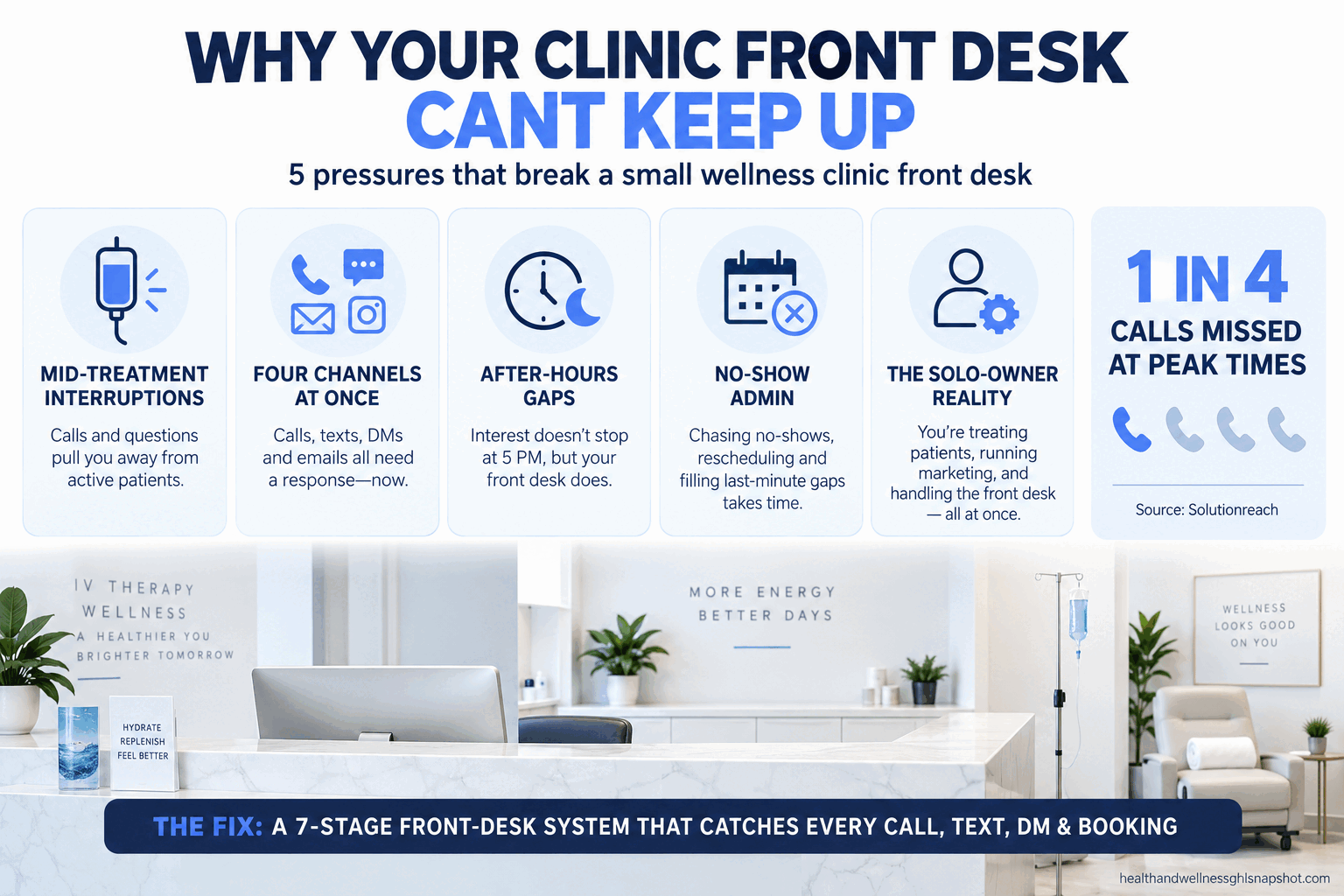
Table of contents
- What a drowning front desk actually costs you
- Why your front desk can’t keep up (the five pressures)
- The seven-stage front-desk system
- What a solo bar, a three-location clinic, and a larger med spa each run
- The compliance rules front-desk automation triggers
- Common objections, answered honestly
- Frequently asked questions
What a drowning front desk actually costs you
Every missed contact is a booking you already paid to create. You ran the ad, you earned the referral, you built the Instagram following. Then the call came in while you were placing a line, and it went nowhere. Solutionreach estimates a small one-to-five-location practice takes 30 to 60 calls a day and misses about a quarter of them at busy and after-hours times (Solutionreach). Call it 10 missed calls a day. Even if only two of those were new clients, you just lost two.
The reason those missed calls don’t come back to you is simple human behavior. Pew Research Center found that only 19% of Americans generally answer a cellphone call from an unknown number (Pew Research Center). So when you call that missed number back an hour later, you’re the unknown number now. Four out of five times, they don’t pick up. The person didn’t wait for you. They searched “IV therapy near me,” found another clinic that answered, and booked.
Now put real money on it. A single IV drip visit runs you somewhere around $150 to $250. A weight-loss client on monthly injections is worth several hundred dollars a month. And a membership client, the kind that keeps your schedule full, can be worth well over $1,500 across a year. Returning patients already make up about 70% of med spa visits (AmSpa), so a front desk that loses first contacts is choking off the exact relationships that would have become your base.
Illustrative value of a single new client by what they book, from a one-off $200 IV drip to a $149/month membership kept for a year. Figures are simple arithmetic to show the shape of what one missed call can be worth, not a guarantee. Every one of these starts with a contact your front desk either caught or dropped.
This is not a small-dollar problem across the industry either. The average med spa location generated about $1,398,833 in 2024, up from $1,307,587 in 2023 (AmSpa), and the IV hydration segment alone is projected near $3.0 billion in 2026 at a 9.2% CAGR (Grand View Research). The clinics winning that money aren’t the ones with the best drip menu. They’re the ones that answer.
Why your front desk can’t keep up (the five pressures)
Before the fix, name the problem honestly. Your front desk isn’t failing because your staff is slow. It’s failing because five pressures hit at the same time, and no human on a small team can absorb all five. If you only read one table in this guide, read this one. The seven stages later map straight onto these five pressures.
| The pressure | What it looks like in your clinic | Why a human alone can’t win it |
|---|---|---|
| Mid-treatment interruptions | The phone rings while you’re placing a line or drawing up an injection | You physically cannot answer, and the caller won’t wait |
| Four channels at once | Calls, texts, Instagram DMs, and web chat all land in different places | Nobody can watch four inboxes while treating a client |
| After-hours gaps | People search and book at 8pm and on weekends | Your desk is empty exactly when buying intent peaks |
| No-show admin | Confirming, reminding, and rebooking eats the day | Manual reminders get skipped the moment things get busy |
| The solo-owner reality | You are the clinician, the owner, and the receptionist | There is no one else to hand the phone to |
Notice what is not on the list: “my team doesn’t care.” That’s almost never it. The common failure is structural. The work arrives in a shape a person can’t catch, at the moment a person is busiest. A busy Tuesday doesn’t need a harder-working receptionist. It needs the routine parts of the front desk to run on their own so the human parts get the attention they deserve.
Here’s the other thing worth sitting with. The channels your clients actually prefer are the ones your phone-first desk handles worst. In a Phreesia survey of nearly 14,000 patients, 48% preferred a text message for appointment reminders, versus 29% for a phone call and 21% for email (Phreesia). Your clients want to text. Your front desk is built to call. That gap is the whole problem in one picture.
How patients want to be reminded about appointments, from a Phreesia survey of nearly 14,000 patients (Phreesia). Note the flip: for canceling or rescheduling, 64% still preferred a phone call, so a good system does both.
The seven-stage front-desk system
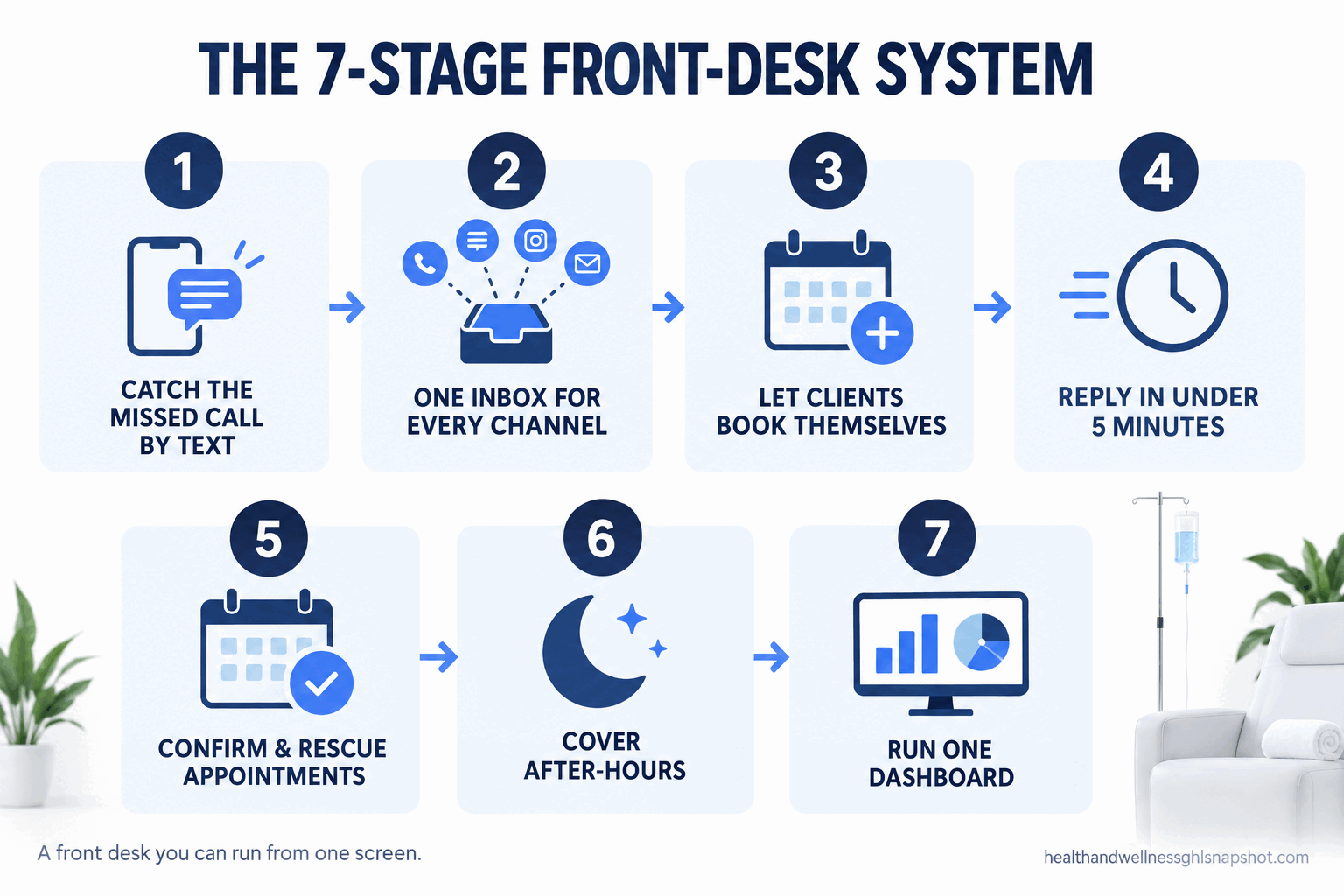
A front desk that keeps up is seven stages working as one loop. Each stage takes a specific job off a human and gives it to a workflow, so your team only touches the parts that genuinely need a person. Below is each stage, the real copy you can lift, and the way it breaks when you skip it. This is the same operational muscle behind our missed-call text-back playbook and our speed-to-lead guide, tied together into one system.
Stage 1: Catch the missed call with an instant text
A missed call is only lost if you let it sit. The single highest-return thing you can build is a text that fires automatically the second a call goes unanswered. The caller’s phone buzzes while they’re still thinking about you, before they’ve dialed the next clinic. You’re not asking them to wait for a callback. You’re reaching back out on the channel they prefer anyway.
How it breaks: you rely on voicemail and a callback list. The caller never leaves a message, you call back an hour later as an unknown number, they don’t answer, and the booking is gone. The full build is in our missed-call text-back guide.
Stage 2: Pull every channel into one inbox
You can’t watch four inboxes while treating a client, so stop trying. Calls, texts, Instagram DMs, Facebook messages, and web-chat questions should all flow into a single conversation view. One place to look. One place to reply. When a client who texted last week sends an Instagram DM today, it’s the same thread, so nobody answers them twice or not at all.
How it breaks: the DM sits unread for two days because nobody opened Instagram, the web-chat question goes to an email address you check on Fridays, and the text thread lives on a personal phone that goes home with whoever’s off today. Scattered channels guarantee dropped contacts. One inbox is the fix, and it’s also what makes everything downstream possible.
Stage 3: Let clients book themselves
The fastest front desk is the one that isn’t in the loop at all. A real online booking link, shared in every text and on every page, lets a client pick a slot without a single phone call. This is not a nice-to-have. It’s the release valve for the whole system, because the booking that never becomes a phone call never gets missed.
How it breaks: you make people call to book during the exact hours you’re too busy to answer. Remember the research split here. Patients happily text and self-serve for simple actions, but in the Phreesia data 64% still wanted a phone call for canceling or rescheduling (Phreesia). So let them book themselves, and keep a human easy to reach for the messy stuff.
Stage 4: Reply to new leads in under five minutes
A new lead is a timer, not a to-do. Someone who fills out your form or asks a question on Instagram is at peak interest for a few minutes, then it fades fast. Harvard Business Review found firms that contacted a lead within an hour were about 7x more likely to qualify it than those who waited one more hour, and more than 60x more likely than those who waited a day (Harvard Business Review). For a clinic, “within an hour” is the gap between two appointments. The only way to win it is to not depend on you being free.
How it breaks: the form notification lands in an email you read after close. By then the lead has booked somewhere that answered in two minutes. Speed is not about being rude or robotic. It’s about being there while the door is still open. Our speed-to-lead playbook has the full automation.
Stage 5: Confirm, remind, and rescue every appointment
The booking is only real if they show up, and the front desk is where shows are won. An automated confirmation at booking, a reminder the day before, and a morning-of text do more for your schedule than any staff member hand-dialing a confirm list. And when someone does miss, an automatic rescue text the same day recovers a chunk of them before the slot is gone for good.
How it breaks: reminders are the first thing to get skipped on a busy day, so no-shows climb, and a no-show in this niche isn’t cheap. Vendor estimates put the cost of a single missed medical appointment around $200 (Curogram), and that’s before the empty chair time. The complete reminder-and-recovery build is in our no-show reduction playbook.
Stage 6: Cover after-hours without staying up
Your clients search and book when they’re off work, which is when your desk is empty. Evenings and weekends are prime buying windows, and an empty front desk during them is a leak with a schedule. The fix isn’t a night-shift receptionist. It’s an auto-responder that acknowledges every after-hours message instantly, answers the handful of questions people always ask, and drops the booking link so they can self-serve while you sleep.
How it breaks: the 8pm inquiry gets your first human reply at 9:30 the next morning. By then they’ve booked elsewhere. An instant after-hours acknowledgment plus a self-booking link captures the intent at the moment it peaks.
Stage 7: Run one dashboard so nothing falls through
A system you can’t see is a system you don’t trust. The last stage ties the other six together: one pipeline view showing every new contact, where it came from, and what it needs next. A new lead waiting on a reply. A booked client who hasn’t confirmed. A no-show that needs a rescue text. When it’s all on one board, the gaps are obvious, and the human part of your front desk spends its time on the few conversations that actually need a person.
How it breaks: without a single view, you’re back to memory and sticky notes. The lead nobody replied to is invisible until they’re gone. The dashboard is what turns six separate automations into a front desk you can actually run.
What a solo bar, a three-location clinic, and a larger med spa each run
The seven stages are the same. How much of each you turn on depends on your size. Running the whole thing at full tilt on day one is how people get overwhelmed and quit. Here’s the honest version for three real clinic shapes.
The solo RN running an IV bar. You are the clinician and the front desk, so your priority is the stages that work while your hands are full. Turn on missed-call text-back (Stage 1), self-scheduling (Stage 3), and appointment reminders (Stage 5) first. Those three alone recover most of what you’re losing, because they cover the exact moments you can’t pick up the phone. Add the unified inbox (Stage 2) next so the Instagram DMs stop piling up. Skip a heavy after-hours setup until volume justifies it. A simple auto-reply is plenty.
The three-location hormone and weight-loss clinic. Now you have staff, which means your problem shifts from “nobody can answer” to “contacts fall between people and locations.” Your highest-value stages are the unified inbox (Stage 2) and the dashboard (Stage 7), because they stop the “I thought you were handling that” failures across a team. Run instant lead replies (Stage 4) hard, since you’re likely spending on ads and leaking the leads. Route each location’s calls and texts into the same system so a client is never told “that’s a different office.”
The larger med spa with a front-desk team. You’re not short on people. You’re short on consistency and after-hours coverage. Use the system to standardize: every lead gets the same under-five-minute reply, every appointment gets the same reminder cadence, and the dashboard (Stage 7) becomes your manager’s single source of truth. Stage 6, real after-hours coverage, earns its keep here because your ad spend runs 24/7 and your evening inquiries are high-ticket. The automation isn’t replacing your team. It’s making sure a busy Saturday looks exactly like a slow Tuesday to the client.
The compliance rules front-desk automation triggers
The second your front desk starts texting, three rules apply, and this niche is watched closely. None of them are hard to follow. All of them are expensive to ignore.
SMS consent (TCPA and 10DLC). Automated texts are business messaging. US carriers route them through A2P 10DLC brand and campaign registration, and health-related messaging draws heavier filtering than retail, so registration matters more here. Capture explicit opt-in when someone books or fills out a form, include a clear opt-out in your first message, and honor STOP instantly. The missed-call text-back is fine, because someone calling you is a reasonable basis to text back, but keep the opt-out in it anyway. Our HIPAA-aware SMS guide covers the consent language in detail.
HIPAA, with a cash-pay nuance. If you bill insurance or share information with covered partners like labs or referring physicians, you’re a covered entity and your texts need to be handled accordingly. A pure cash-pay IV bar with no insurance billing may sit outside HIPAA, but you still owe state privacy and breach-notification duties, and you should never assume the exemption. The safe move: keep automated texts about logistics, not clinical detail. “Here’s your booking link” is safe. Treatment specifics over SMS are not.
FTC health claims. Your front-desk copy is marketing, and the FTC has been active with wellness and IV-therapy marketers over claims like “boosts immunity” or “detoxes.” Keep the automated messages about the appointment, the schedule, and the logistics. Don’t let a reminder text drift into a health promise you’d have to substantiate. Calm and specific beats bold and risky every time.
Common objections, answered honestly
“Won’t clients find the automated texts annoying or cold?” Only if you write them cold. The copy above uses first names, sounds like a person, and always offers a real human. Clients don’t experience a fast, friendly text as automation. They experience it as a clinic that’s on top of things. The annoying version is the one that never texts back at all and makes them chase you.
“I already pay for Boulevard (or Jane, or Mangomint). Doesn’t it do this?” Your booking software handles booking. What it usually doesn’t do is catch the missed call, pull Instagram and web chat into one inbox, reply to a cold lead in under five minutes, and run a pipeline across all of it. Those are front-desk jobs, not scheduling jobs. The two live side by side. We compare the clinical platforms directly in Boulevard vs Mangomint, and the broader market in what med spa software actually costs.
“Do I need to be technical to run this?” No. You need the workflows built once, correctly, and then you mostly watch a dashboard and reply to the conversations that need you. The build is the technical part, and it’s a one-time job. The daily use is just texting people back from one screen.
“Won’t this replace my receptionist? I don’t want to seem like a faceless clinic.” It does the opposite. It takes the robotic parts (the missed-call catch, the reminder, the after-hours acknowledgment) off your receptionist’s plate so they can spend their actual attention on clients in the building and the conversations that need warmth. A good front-desk system makes a two-person clinic feel like a ten-person one, not a bot.
Frequently asked questions
Why does my clinic miss so many calls even though we try to answer?
Because of when they ring, not how hard you try. Calls come in while you're placing an IV line, drawing up an injection, or after you've closed. Small practices miss roughly one in four calls at peak and after-hours times. It isn't an effort problem, it's a timing problem, and the fix is to catch the missed call automatically with a text rather than relying on anyone being free to pick up.
Isn't a missed call fine if we just call them back?
Usually not. Only about 19% of Americans answer calls from unknown numbers, so when you call back an hour later you're the unknown number. Most callers won't pick up and won't have left a voicemail either. They've already moved on to a clinic that answered. An instant text-back reaches them on the channel they prefer, while they're still deciding.
Will automated texts get my clinic in trouble with TCPA or carriers?
Not if you set them up correctly. Automated business texts in the US run through A2P 10DLC registration, and health-related messaging is filtered more heavily, so registration matters here. Capture explicit opt-in at booking or form submission, include an opt-out in your first message, and honor STOP immediately. Keep the content about logistics, not clinical detail.
Does a cash-pay IV bar have to worry about HIPAA for these texts?
A pure cash-pay clinic with no insurance billing may fall outside HIPAA, but it still owes state privacy and breach-notification duties, so never assume the exemption. The safe posture for any clinic is to keep automated texts about scheduling and logistics, and keep treatment specifics off SMS entirely.
How fast do I actually need to reply to a new lead?
As fast as you can, and under five minutes if possible. Harvard Business Review research found replying within an hour made a firm about seven times more likely to qualify a lead than waiting one more hour. For a clinic, the realistic way to hit that is an automated instant reply that offers times and a booking link, so the lead is engaged before you're even free.
Can this work for a solo clinic, or is it only for multi-location med spas?
It's arguably more valuable for a solo clinic, because you have no one to hand the phone to. A solo RN should turn on missed-call text-back, self-scheduling, and appointment reminders first. Those three cover the moments you physically can't answer. Larger clinics lean harder on the unified inbox and the dashboard to keep contacts from falling between staff.
By 5:30 that Tuesday, the picture looks different. The two missed calls got an instant text and both booked themselves, one for a drip Thursday and one for a weight-loss consult. The Instagram DM got answered from the same inbox that holds your texts. The 8pm inquiry from last night already has a reply and a time on the calendar. You didn’t touch your phone mid-treatment once. The front desk kept up, because the routine parts of it ran on their own and left you the parts that needed a person. That’s the whole idea: not a harder-working desk, a better-routed one.
Keep reading: Missed-call text-back for wellness practices · Speed to lead: why a 5-minute reply wins · How to reduce appointment no-shows · HIPAA-aware SMS for wellness
This article is for general informational purposes and is not legal, medical, tax, or compliance advice. Statistics are as published or reported at the time of writing and change frequently; confirm the current figure on each source’s own page before relying on it. Each practice is responsible for its own HIPAA, TCPA, FTC, and state privacy obligations.