
You pick a membership price the way most owners do. A competitor down the road charges $149, so you charge $139 to undercut them. Six months later you have forty members, a tidy-looking $5,560 a month hitting your account, and no idea whether that number is making money or quietly costing you money every time a member books a drip. That is the trap. A membership is not a marketing offer you set by vibe. It is a tiny recurring product with its own cost of goods, its own margin, and its own ways to leak, and if you do not price it on the math, you are running a subscription business on a guess.
Here’s the honest answer up front: to price a clinic membership so it makes money, start from your true cost per included visit (supplies plus clinical labor), set the member price at roughly 70 to 80 percent of your walk-in retail, hold a gross margin floor of at least 50 to 60 percent after that discount, then subtract payment processing and your realistic no-show-but-still-paying rate. Most med spas underprice memberships by 20 to 30 percent because they anchor on a competitor instead of their own cost. This guide gives you the four numbers, a fill-in worksheet, three worked tiers, and the math run three ways. Every figure carries a source.
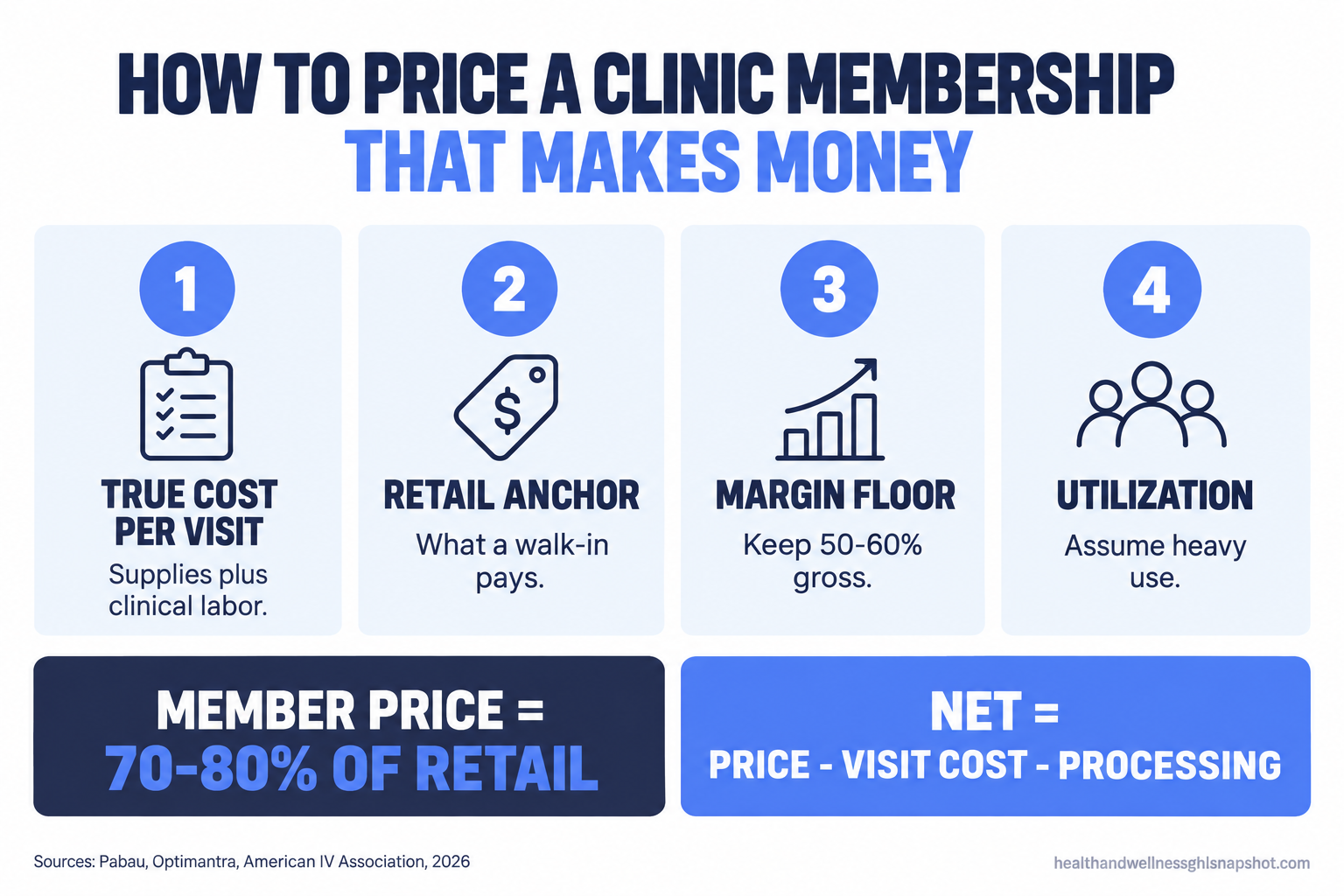
Table of contents
- Why membership pricing is the one number you can’t guess
- The four numbers behind every membership price
- Price it in five steps (and how each one breaks)
- Steal this: the fill-in membership margin worksheet
- Run the math three ways
- The compliance line that touches your pricing page
- Common objections, answered honestly
- Frequently asked questions
Why membership pricing is the one number you can’t guess
A membership compounds. A single mispriced drip costs you once; a mispriced membership costs you every month, times every member, for as long as they stay. That is the whole point of recurring revenue, and it cuts both ways. Price it right and you build a base that smooths out the slow weeks. Price it wrong and you have signed a contract to lose money on schedule.
The money at stake is not small. The average med spa location generates about $1,398,833 in 2024, up from $1,307,587 in 2023 (AmSpa, 2024), and the IV hydration market is growing from roughly $2.8 billion in 2025 to $3.0 billion in 2026 at a 9.2 percent CAGR (Grand View Research). Revenue is shifting toward recurring plans, and vendors estimate memberships now drive 20 to 40 percent of total revenue at practices that run them well (Portrait). That is a large share of your income riding on one price you may have set by copying a sign.
Here is why guessing hurts. Members are not casual buyers. Zenoti’s data puts members at 2.9 times the visit frequency of non-members, spending about 35 percent more per visit (Zenoti). Wonderful for loyalty, brutal for a plan you priced thin, because the people most likely to use every included visit are exactly the ones you are losing the most on. For an RN or NP who opened a clinic to do clinical work, this is the unglamorous afternoon that decides whether the membership funds your growth or slowly drains it.
The four numbers behind every membership price
Before you name a price, you need four numbers. Not a competitor’s price. Yours.
1. True cost per included visit (your COGS). Everything it costs to deliver one included service: the bag and fluid, tubing, catheter, vitamins, prep supplies, the clinical labor to place and monitor the line, plus a slice of overhead and waste (American IV Association). Supplies alone for a vitamin drip commonly land at $15 to $60 per bag, and a worked industry example pegs a session at about $40 in supplies plus $35 in nurse labor (American IV Association). Know your real number, not an average off a blog.
2. Your walk-in retail anchor. What a non-member pays for the same service today. IV sessions commonly run $99 to $299, and med spa menus often sit in the $150 to $400 band (Pabau). The membership price lives below this anchor, and the gap is the member’s reason to join.
3. Your gross margin floor. The percent of each dollar left after the direct cost of delivery. IV therapy typically carries a 50 to 80 percent gross margin before overhead (Pabau); healthy med spas run 60 to 70 percent gross and 15 to 25 percent net after everything else (Optimantra). Pick the floor you will not cross, even to win a signup.
4. Your utilization rate. How many included visits members actually use. Nobody uses 100 percent. The unused portion, often called breakage, is margin in your pocket, but it is not a number you get to set. It swings with your reminder game and your member mix.
Typical gross margin by service, before overhead (midpoints of reported ranges). Sources: Pabau, Optimantra. A membership should land near your blended service margin, not below it.
Price it in five steps (and how each one breaks)
Here is the method, in order. Each step has one common way it goes wrong.
Step 1: Pin your true cost per included visit
Add up supplies, clinical labor at the loaded hourly rate, and a per-visit slice of overhead. For a vitamin IV that is roughly $40 supplies plus $35 labor, call it $75 to $85 all in before overhead (American IV Association). Do this for every service you include.
How it breaks: owners count the bag and forget the labor, the waste, and the rooming and charting time. A cost that looks like $20 is really $75. Cost the whole visit, not the product.
Step 2: Set the retail anchor, then discount to 70 to 80 percent
Start from your real walk-in price. The member price should sit at about 70 to 80 percent of retail, the band agencies recommend so the discount is real enough to join for but not so steep it guts your margin (Portrait). If your IV retails at $175, a member price around $130 to $140 holds the line.
How it breaks: the race to the bottom. You see a competitor at $99, match it, and land at maybe 55 percent of your retail. Now the discount is doing their marketing out of your margin. Most med spas underprice by 20 to 30 percent exactly this way (Portrait).
Step 3: Choose the gross margin floor you will not cross
Run the member price against your Step 1 cost. If a $139 plan includes a visit that costs you $85, your gross margin at full use is about 39 percent, below the 50 to 60 percent floor a healthy clinic holds (Optimantra). Either raise the price, cut the included cost, or add value that costs you little (priority booking, a small add-on discount) instead of another expensive visit.
How it breaks: stacking perks. Owners pile a free drip, 20 percent off add-ons, and a free monthly B12 into one tier to look generous. Each perk has a cost. The tier that wins the most signups can be the one that loses the most money.
Step 4: Model utilization honestly, in both directions
Assume your best members use every included visit and then some. Price the tier so it works at high utilization, not average. Breakage from members who skip is a cushion, not a plan, because your heaviest users visit 2.9 times as often as non-members (Zenoti).
How it breaks: pricing on breakage. “Half of them won’t come anyway” is how gyms price, and it works until the day your most engaged members all show up. If the plan only survives on no-shows, it is not priced, it is gambling.
Step 5: Subtract processing and the failed-payment leak
Every recurring charge pays the processor. At Stripe’s standard 2.9 percent plus 30 cents (Stripe), a $149 charge costs about $4.62. That is small. The real leak is the declined card you never chase: a lapsed renewal is 100 percent of that month gone, and often a silent churn. Build dunning and card-update prompts in from the start; our guide on how to recover failed payments on a wellness membership walks the sequence.
How it breaks: treating failed payments as a footnote. In a recurring business, uncaught declines are one of the biggest quiet losses, and they are almost entirely recoverable with automation.
Steal this: the fill-in membership margin worksheet
Copy this into a notes app or a spreadsheet and run every tier through it before it goes on your pricing page. Fill the blanks with your real numbers.
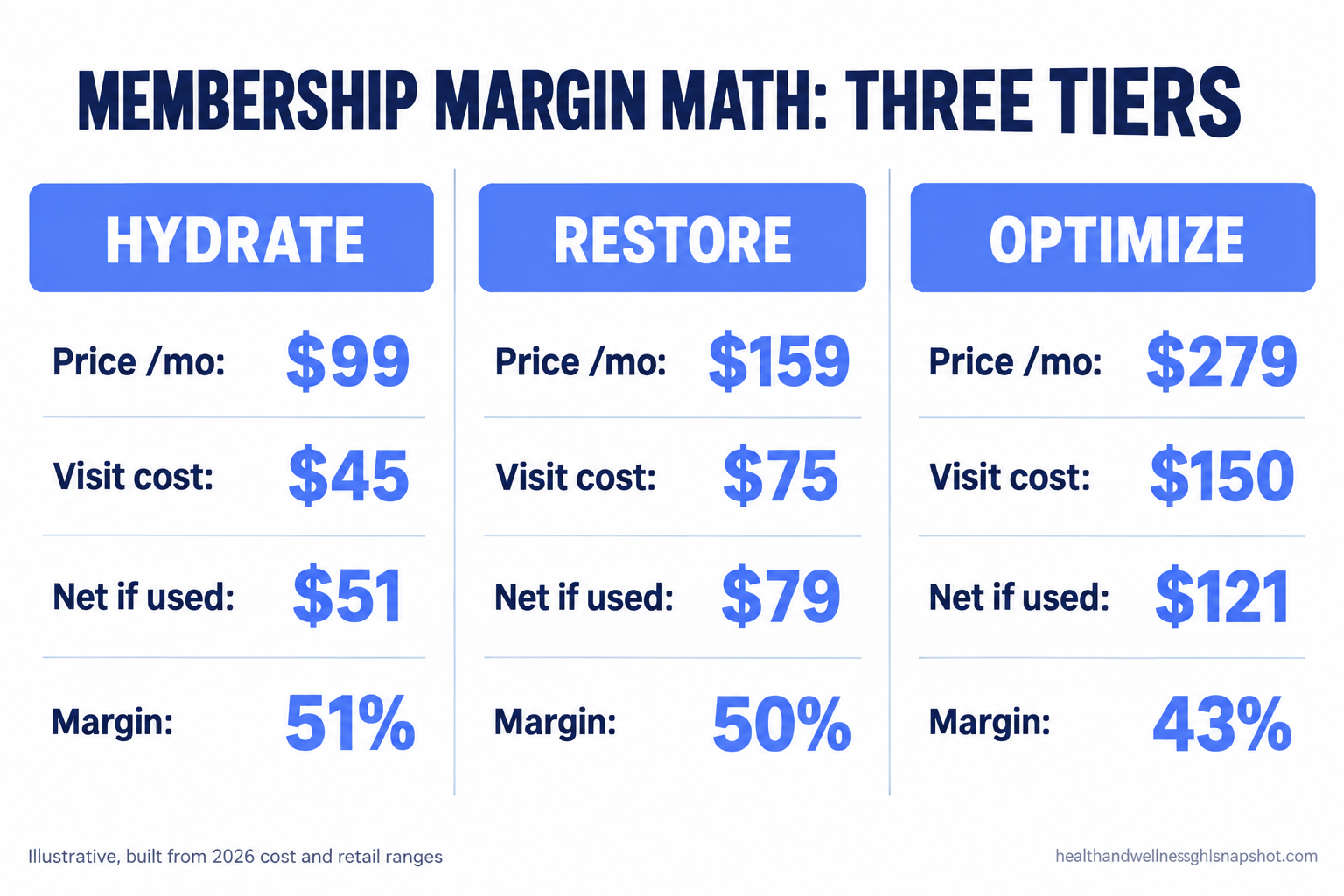
Here is the worksheet run on three illustrative tiers for an IV and injectable clinic, built from the ranges cited above. Your numbers will differ; the structure is what you steal.
| Tier | Price / mo | Included | Visit COGS (full use) | Processing | Net at full use | Net if member skips |
|---|---|---|---|---|---|---|
| Hydrate (entry) | $99 | 1 basic hydration IV (retail $120) | $45 | $3.17 | $50.83 (51%) | $95.83 |
| Restore (core) | $159 | 1 vitamin IV (retail $175) + 10% off add-ons | $75 | $4.91 | $79.09 (50%) | $154.09 |
| Optimize (premium) | $279 | 2 IVs or 1 IV + 1 injectable booster (retail ~$340) | $150 | $8.39 | $120.61 (43%) | $270.61 |
Read the last two columns together. Every tier clears a roughly 50 percent net at full use except the premium, which dips to 43 percent because it bundles the priciest visits. That is the signal to lift Optimize to $299, trim what it includes, or accept the thinner margin. The “if member skips” column is your cushion, and shows why the entry tier is often your most profitable: cheap to deliver, and plenty skip. These are illustrative figures, not a quote. Run your own costs.
Monthly economics of one illustrative $159 “Restore” member at full utilization, built from the COGS and processing figures above (American IV Association, Stripe). Net margin ~50% before shared overhead.
Run the math three ways
The same worksheet lands in very different places depending on your shape. Here is the honest math for the three clinics this site is built for.
Scenario 1: solo cash-pay IV bar, one RN, no injectables
You run lean, so overhead per visit is low and your COGS is mostly the bag and your own time. A single “Restore”-style tier at $149 with one vitamin IV works well here, because your labor is your own and breakage is high in a drop-in model. The risk is the opposite of a big clinic’s: you can price too high and stall signups. Keep one or two simple tiers at 75 percent of a $175 to $199 retail, and let volume do the work. Thirty members at a true $70 net is $2,100 a month of margin before you open the door. For the billing mechanics without an expensive module, see how to run a membership without a $300 add-on.
Scenario 2: RN or NP-owned hormone and weight-loss clinic, two to three providers
Now labor is a paid provider’s loaded hour, charting is longer, and some visits touch prescribing. Your COGS climbs, so the 70 to 80 percent discount band matters more, not less. Build a ladder where the entry plan is a high-margin, low-cost hook (a monthly vitamin shot or basic IV) and the premium plan carries the costlier services at a price that still clears your floor. Do not put an injectable or prescribing visit in a cheap tier to look competitive; that inverts your margin fast. Watch net margin, not revenue, because a busy injector clinic can post big top-line numbers on thin profit. Target the 15 to 25 percent net the healthy benchmarks show (Optimantra), tracked per tier.
Scenario 3: small multi-location or group clinic
Across two or more sites, breakage is less predictable and your worksheet has to assume higher use. This is where membership revenue share reaches the top of the 20 to 40 percent band (Portrait), which makes a 5 percent pricing error a five-figure annual mistake. Standardize tiers so a member can use any site, model at full utilization, and treat failed-payment recovery as a dedicated system. The software is its own cost line; our 2026 teardown of what clinic software actually costs shows why some owners move the billing and nurture layer onto a platform they own once instead of renting a membership module per seat.
The compliance line that touches your pricing page
Your membership page is marketing, and in this niche marketing copy carries real liability. Three lines deserve a lawyer’s eye.
Watch the health claims on every tier name and benefit. The FTC has warned roughly 700 weight-loss and wellness marketers and sent letters to IV-therapy companies over immune and COVID claims (FTC). A tier called “Immunity Boost” or a line that says a drip “melts fat” or “detoxes” needs competent and reliable evidence or softening. Describe what the service is, not what you cannot prove it does.
Do not lean on the GLP-1 shortage to justify compounding. The FDA declared the semaglutide and tirzepatide shortages resolved in late 2024 and early 2025, so “shortage” is no longer a valid compounding justification in 2026 (FDA). If a weight-loss membership includes a compounded injectable, your copy should not imply it equals or cheaply replaces the brand-name drug.
HIPAA is not automatic, and the dunning texts matter. If you bill insurance or share protected health information with a lab or referring physician, you are likely a covered entity and need a Business Associate Agreement with anything that touches patient data (HHS). A pure cash-pay IV bar may fall outside federal HIPAA but still owes state privacy duties. And because every membership runs on recurring texts, health-related SMS draws heavier carrier filtering, so 10DLC registration and clean consent matter more here than in retail. Our SMS automation feature handles the consent gating, and the HIPAA-aware SMS guide covers the rest.
Common objections, answered honestly
“My competitor charges $99. Won’t I lose signups if I price higher?” Maybe a few, and they are often the wrong members. A price set to beat a competitor ignores your cost, which may be nothing like theirs. Compete on the member experience, the reminders, the priority booking, not on being the cheapest drip in town. The clinic racing to $99 is usually the one quietly losing money on its heaviest users.
“Isn’t breakage basically free money? Why not price thin and bank on no-shows?” Because the members who show up are your best customers, at 2.9 times the visit rate of everyone else (Zenoti). Breakage makes a well-priced plan better. It is not a foundation. A plan that only survives on people forgetting to use it collapses the month they remember.
“Can I just copy a tier I saw online instead of running the worksheet?” Copying a tier copies someone else’s cost structure, labor rate, and market, none of which are yours. The worksheet takes an afternoon and it is the difference between a membership that funds growth and one that drains it. The retention benchmarks post shows what that recurring base is worth over a lifetime once priced right.
“What if I already priced wrong and have members on the old plan?” Grandfather current members for a set window, announce new pricing with real notice, and add value so the change feels like an upgrade, not a grab. Raising a price is survivable; running a loss forever is not. Just do not surprise people, and route the change through a clear, consent-respecting message sequence.
The bottom line
Go back to that $139 price you set to undercut the clinic down the road. Now you can check it. Cost the included visit, hold it against your retail, clear your margin floor, model your heaviest members, and subtract the processor and the declines you will chase. If the number survives all five, publish it with confidence. If it doesn’t, you just found a leak before it cost you a year. Price a membership on the math, not the neighbor, and the recurring revenue does what it is supposed to do: it pays you first, every month, busy week or slow. To see how much of the billing, renewal, and recovery can run on a platform you buy once instead of rent per seat, book a quick demo and compare it against the module you pay for now.
Frequently asked questions
How much should a med spa or IV therapy membership cost in 2026?
Price it from your own cost, not a competitor. Common entry tiers run $89 to $159 a month for one included IV, with premium tiers $199 to $300-plus for multiple visits or an injectable. The right number sits at about 70 to 80 percent of your walk-in retail and clears a gross margin floor of at least 50 to 60 percent after you cost the full visit, including labor.
What is a good profit margin on a clinic membership?
Aim for the same gross margin as your core services, roughly 50 to 70 percent before overhead, and a net margin in the healthy med spa band of 15 to 25 percent after everything else. If a tier's margin at full member utilization falls below your floor, the price or the included services are wrong.
How do I calculate the true cost of an included IV visit?
Add supplies (bag, fluid, tubing, catheter, vitamins, prep items), clinical labor at the loaded hourly rate for the full rooming-to-discharge time, and a per-visit slice of overhead. A typical vitamin IV runs roughly $40 in supplies plus $35 in labor, so cost the whole visit at $75 or more, not just the bag.
Is membership breakage (members who pay but don't come) safe to price around?
No. Breakage lifts the margin of a plan that already works, but you cannot build the price on it. Members are your most frequent visitors, at about 2.9 times the rate of non-members, so your heaviest users use every included visit. Price each tier to survive at high utilization and treat breakage as a cushion.
How much do payment processing and failed payments cost a membership?
Processing is small, about 2.9 percent plus 30 cents per charge on Stripe's standard rate, roughly $4.62 on a $149 plan. The bigger cost is an uncaught declined card: a lapsed renewal is 100 percent of that month lost, not 3 percent, and often a silent cancellation. Build automated dunning and card-update prompts from day one.
Should I include injectables or prescribing visits in a cheap membership tier?
Be careful. Injectables and prescribing visits carry higher cost and, for weight-loss drugs, real compliance exposure. Putting them in a low-priced tier to look competitive is the fastest way to invert your margin. Keep the entry tier a high-margin, low-cost hook, and carry the costlier services in a premium tier priced to clear your floor.
This article is for general informational and operational purposes and is not legal, medical, tax, or compliance advice. Prices, margins, and market figures are as published or reported at the time of writing and vary by market and supplier; confirm your own costs and each source’s current figures before setting prices. Each practice is responsible for its own HIPAA, TCPA, FTC, FDA, and state-licensing obligations.