
You launched the membership because a friend with a busier clinic swore by it, and the first month felt like a win. Twenty people signed up at the front desk in three weeks. Then the second charge ran, and the cancel texts started. Not angry ones. Polite ones. “Hey, I love you guys, just need to pause for a bit.” By the end of month two you are back to roughly the head count you started with, wondering if memberships even work for a clinic your size.
Here is the honest answer up front: members do not quit at month two because your service is bad. They quit because month one felt like a charge instead of a result. Nobody welcomed them, nobody reminded them to actually come in, and the only time your name showed up in their phone was the day their card got hit. Early churn is an onboarding problem, not a pricing problem, and it is fixable with a six-stage system that runs on autopilot. The membership marketing benchmark for first-year renewals sits at just 74%, versus a median 84% for members past year one (Marketing General Inc.), and in fitness, members who visit fewer than four times in their first month cancel about 80% of the time (Jeri Commerce). This guide walks the six stages that close that gap, with the real copy you can steal and the way each stage quietly breaks.
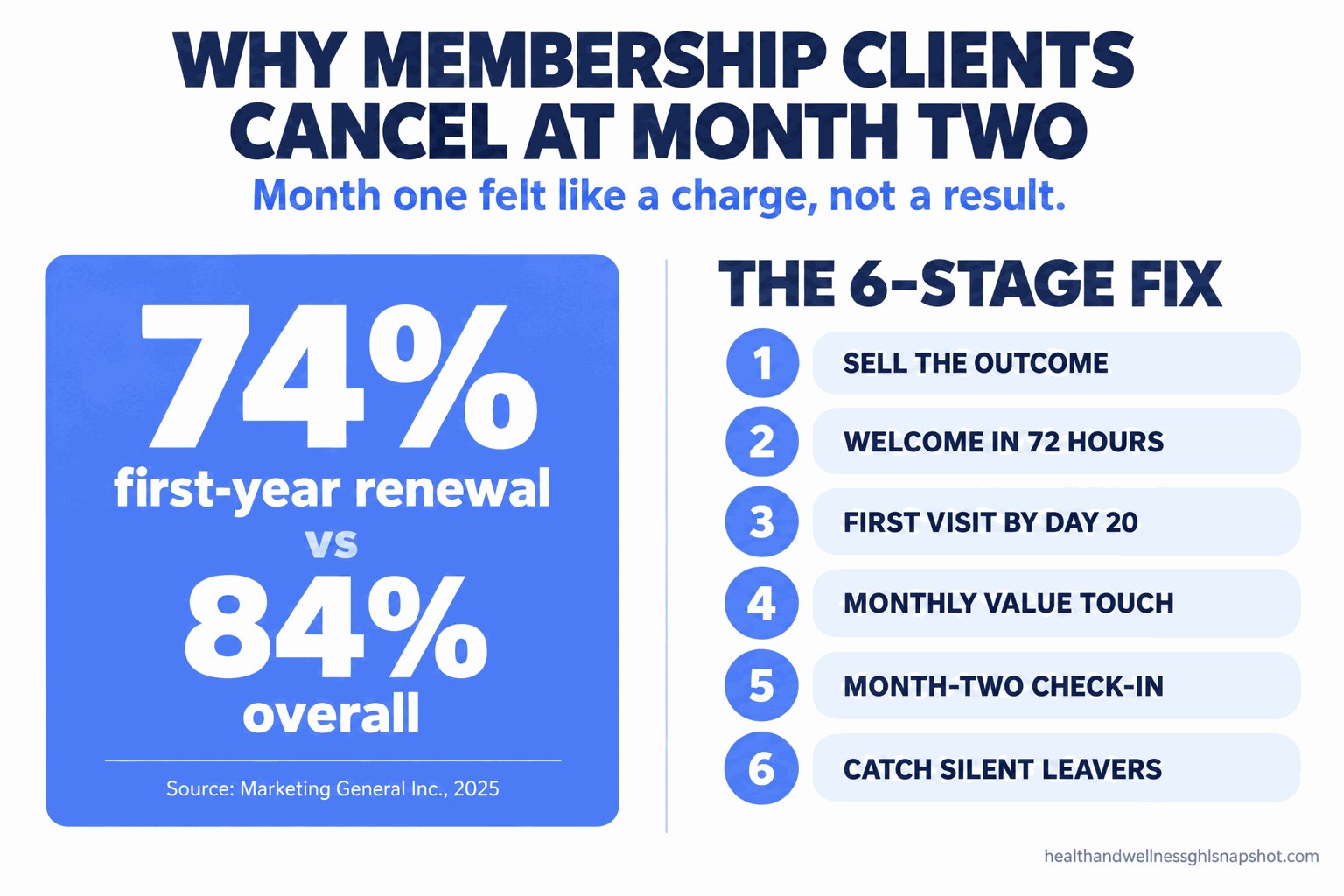
Table of contents
- What the two-month cliff actually is
- What early churn really costs your clinic
- The five reasons members quit at month two
- The six-stage retention system
- What a solo bar, a three-location clinic, and a larger med spa each run
- The compliance rules early-retention texting triggers
- Common objections, answered honestly
- Frequently asked questions
What the two-month cliff actually is
The cliff is real and it is predictable. Across membership organizations, the median renewal rate is about 84%, but members in their first year renew at only 74% (Marketing General Inc.). That ten-point spread is your two-month cliff in a single number. The people leaving are not the seasoned members who know exactly what they get. They are the new ones who signed up on a feeling and never built a habit before the money started feeling abstract.
Your clinic’s version shows up around the second charge because the first charge is emotional and the second is not. When someone joins at the front desk right after a great IV drip or their first weight-loss injection, the first month’s fee feels like paying for the thing they just loved. Thirty days later, if they have not been back, the second charge arrives with no memory attached. It reads as a subscription they forgot to cancel, so they cancel it.
Usage is the tell, and it is measurable early. Fitness is the closest public benchmark to a cash-pay wellness membership, and it is blunt: members who come fewer than four times in their first month cancel roughly 80% of the time (Jeri Commerce). A drip membership is not a gym, but the psychology is identical. Two visits and the value is obvious; zero visits and the only thing they have experienced is the bill. And this is your best revenue leaking: AmSpa reports returning patients make up about 70% of med spa visits (AmSpa), so a membership that fails in month two is losing the exact customers who were supposed to become your base.
What early churn really costs your clinic
A member who quits at month two is not a small loss, because you paid full acquisition price for two payments of value. You ran the ad, filled the appointment, and spent the chair time, then the relationship ended right as it was about to become profitable. Take a common weight-loss or IV membership at $149 a month. A member who cancels after two charges is worth $298. The same member kept for a year is worth $1,788, and for two years, $3,576. Everything past month two is where the margin lives, because the cost to win them is already spent.
Illustrative revenue from one member on a $149/mo membership, by how long they stay. Figures are simple arithmetic to show the shape of lifetime value, not a guarantee. The acquisition cost is the same in every column.
Now add the members who never actually decided to leave. A large share of subscription cancellations are not decisions at all, they are declined cards. Recurly projected failed payments would cost subscription businesses about $129 billion in 2025 (Recurly), and involuntary churn commonly runs a fifth to two-fifths of total churn. So some of the members you counted as “cancelled at month two” simply had an expired card and no system chasing it. They would have stayed. Nobody asked.
The cash-pay wellness space is big enough that these leaks matter in real dollars. The average med spa location generated about $1,398,833 in 2024, up from $1,307,587 in 2023 (AmSpa), and the IV hydration segment alone is projected near $3.0 billion in 2026 at a 9.2% CAGR (Grand View Research). The owners winning that market are the ones whose members are still paying in month eight. We put real numbers on that repeat behavior in our wellness client retention benchmarks.
The five reasons members quit at month two
Before the fix, name the failure. Almost every month-two cancel traces to one of five causes, and each one has a visible early signal and a specific counter. If you only read one table in this guide, read this one, because the stages later map directly onto these five.
| Why they quit | The early signal | The fix |
|---|---|---|
| They never came back after signing up | Zero visits by day 20 | Force a first booking with a nudge (Stage 3) |
| The membership felt like a bill, not a benefit | You only text them on charge day | Monthly value touch that is not a charge (Stage 4) |
| They forgot what they were even paying for | No welcome, no “here is how to use this” | 72-hour welcome and onboarding (Stage 2) |
| Their card silently failed | A “cancel” with no complaint attached | Failed-payment recovery, not instant cutoff (Stage 6) |
| They oversold themselves at the counter | Buyer’s remorse text in week two | Sell the outcome and set expectations at signup (Stage 1) |
Notice what is not on the list: “my service was not good enough.” That one is rare, and when it happens the member tells you plainly. The common cancels are quiet, and quiet cancels are almost always about the space between visits, not the visit itself. That is good news, because the space between visits is exactly what automation fills.
The six-stage retention system
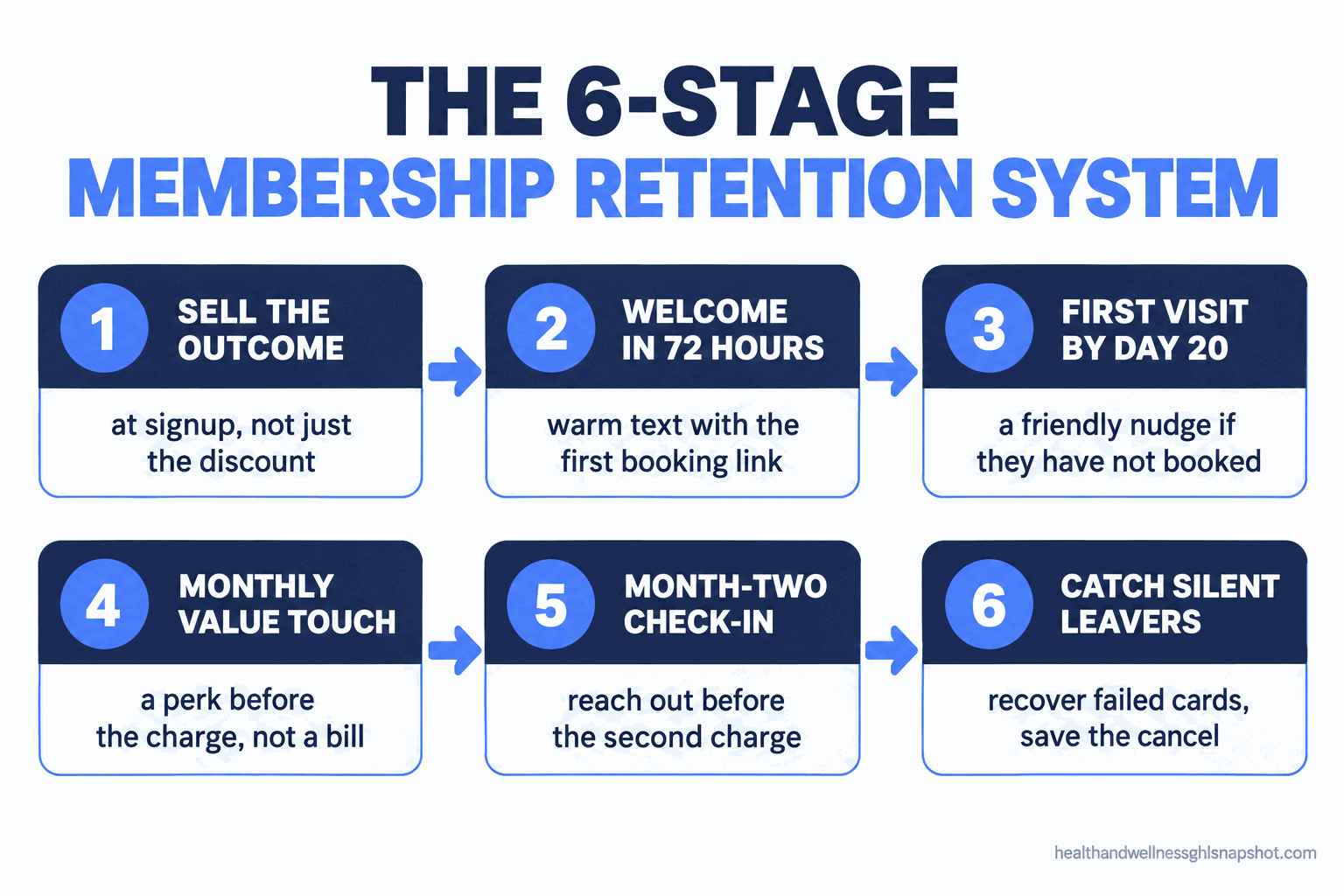
A membership that keeps people is six stages working as one loop. Miss the welcome and month one goes silent. Miss the month-two check-in and a fixable doubt becomes a cancel. Below is each stage, the real message copy you can lift, and the way it breaks when you skip it. This is the same retention muscle behind our 21-day renewal pre-warm, tuned for the fragile first sixty days of a new member.
Stage 1: Sell the outcome at signup, not just the discount
A member who joins for a discount cancels for a smaller one somewhere else. The counter pitch that retains is about the result they are building, not the dollars they save this month. “You mentioned you want steady energy through the week, so let’s get you on a monthly drip and I’ll make sure you actually come in” beats “it’s cheaper if you subscribe.” The first sets an expectation of visits. The second sets an expectation of savings, and savings do not create a habit.
How it breaks: the desk closes the sale on price alone, the member joins expecting to save money rather than to show up, and when they do not show up they feel like they are wasting money and quit. Price gets the yes; the outcome keeps the member. Frame both, and lead with the outcome. We go deeper on structuring the offer itself in how to price wellness coaching packages.
Stage 2: Welcome them within 72 hours, like a real person
The first 72 hours decide whether the membership feels like a relationship or a transaction. The moment billing succeeds, a warm welcome should go out that does one job: tell them exactly how to book their first included visit. Not a receipt. Not terms and conditions. A human note that makes the next step obvious. This is where you also confirm they know they can text you back and reach an actual team.
How it breaks: the software sends a cold receipt and nothing else, so the member’s first post-purchase experience is a transaction confirmation, and silence after that reads as “they got my money and moved on.” A warm welcome inside three days is the cheapest retention you will ever buy.
Stage 3: Get them in the door before day 20
A member who has not used the membership by day 20 is already halfway to canceling. The whole game in month one is turning one purchase into two visits, because two visits make the value undeniable before the second charge arrives. If they have not booked by mid-month, a gentle nudge should go out that removes every ounce of friction. Do not ask them to think. Offer them a slot.
How it breaks: you send the welcome, then wait for them to come back on their own. Busy people do not. They mean to book, life fills the calendar, and the next thing they notice is charge number two for a service they have used exactly once. The nudge is not pushy; it is the reminder they would have thanked a friend for.
Stage 4: Give them a reason to open the text every month that is not a bill
Recurring revenue is a relationship, and a relationship that only shows up to collect money feels like a landlord. Once a month, before the charge, your name should land in their phone attached to something good: their credit is ready, a member-only perk is live, a genuinely useful tip. The charge that follows a value message feels earned. The charge that arrives cold feels like a trap they forgot to close.
How it breaks: the only contact a member gets is the payment notification, so the membership slowly reframes in their mind as an expense with no face. Land the value touch a few days before the charge and the sequence flips: value first, then a charge that feels fair. Get the timing backwards and every month you train them to resent the bill.
Stage 5: Run the month-two check-in before they run the cancel
The second charge is the danger zone, so get ahead of it with a check-in that invites honesty. A few days before the second payment, reach out like a coach, not a collections desk. Ask how it is going, remind them what they have access to, and make it easy to raise a concern with you instead of with the cancel button. Most doubts at this point are small and fixable, but only if the member says them out loud to you first.
How it breaks: you say nothing before the second charge, the member has a small unspoken doubt, the payment hits, and the doubt plus the charge tip them into canceling without a conversation. A check-in a few days early turns a silent exit into a fixable chat. This is the retention version of getting to the client first, the same principle as speed to lead, applied to a member you already have.
Stage 6: Catch the silent leavers before they count as cancels
Some of your month-two “cancellations” never decided to leave, their card just failed. Cards expire, get reissued after fraud, or bounce on a bank hold, and if nothing chases the failure the member is gone without ever choosing to go. Treat a decline as an admin hiccup, not a cancellation. Retry on a schedule, and text the member like you are doing them a favor, because you are.
And when a member genuinely does want out, make it graceful. Offer a pause instead of a full cancel, honor the cancel promptly either way, and ask one question about why. A pause often becomes a return, and the reasons you collect are your roadmap for the next round of month-two churn. A member who leaves feeling respected is one you can win back later, which is the whole premise of our client reactivation and win-back system.
How it breaks: you cut access the instant a card declines, a loyal member with an expired card gets locked out, and a fixable hiccup becomes a real cancel plus a bad taste. Retry first, ask second, restrict last.
What a solo bar, a three-location clinic, and a larger med spa each run
The six stages are identical at every size. What changes is how much you automate versus staff, and how much revenue the leak represents. The chart below shows illustrative annual revenue recovered by cutting month-two churn roughly in half at three clinic sizes, to make the point that the same fix is worth wildly different money depending on your book.
Illustrative annual revenue recovered by halving early churn: members saved multiplied by monthly fee across the extra months they stay. Solo assumes ~8 members saved at $99, three-location ~18 at $129, larger med spa ~25 at $199. Examples to show scale, not guarantees.
Solo cash-pay IV bar or acupuncturist. You are the front desk and the provider, so you cannot chase members by hand and see patients too. Automate the whole sequence: the 72-hour welcome, the day-14 nudge, the monthly touch, and the failed-payment recovery all fire on their own, and you just handle the human replies. Even saving eight members a year from an early quit is real rent money, and it costs almost nothing to run.
Three-location RN or NP owned clinic. Now the enemy is inconsistency. Location three welcomes members differently than location one, or not at all, and your churn rate quietly varies by front desk. Standardize all six stages so every new member gets the identical welcome, nudge, check-in, and recovery, and route replies to whoever is working. At this size the month-two check-in alone protects a serious chunk of recurring revenue.
Larger med spa with a medical director. You likely run a full EHR and point-of-sale, and you should keep them. The question is which layer owns the member relationship. Nurture, monthly touches, check-ins, and recovery can live inside an expensive all-in-one tier, or on a platform you own once and control. At a few hundred members, a one or two point retention gain is worth more than the software bill, so own the layer that touches the member. We break down where those platform costs hide in what med spa software actually costs in 2026, and the case for owning the layer in running a clinic membership without a $300 add-on.
The compliance rules early-retention texting triggers
The moment you automate member texts and recurring charges, three rules apply. None of them are hard, but skipping them turns a retention win into a liability.
SMS consent and 10DLC. Every membership text is business messaging, which US carriers route through A2P 10DLC brand and campaign registration, and health-adjacent messaging draws heavier carrier filtering than retail. Capture explicit opt-in at signup, honor STOP instantly, and register your brand and campaign before you send a single automated message. Read HIPAA-aware SMS for wellness practices first, and let the consent gating in our SMS automation feature handle the opt-in and opt-out plumbing so you are not tracking it by hand.
FTC health-claim substantiation. Your retention copy is marketing, and the FTC has been active with wellness and IV-therapy advertisers over unsupported claims. Keep the value touches about the experience and the perk, not about curing anything. “Members get 15% off add-ons this month” is safe. “Your monthly drip boosts immunity and melts fat” is the kind of claim that needs competent and reliable scientific evidence or it should be softened. When in doubt, describe what the visit is, not what you promise it does to their body.
Auto-renewal law, which is moving fast right now. You are enrolling people in a plan that charges until they cancel, a “negative option.” The FTC’s federal Click-to-Cancel rule was vacated by the Eighth Circuit in July 2025 (Sidley), but that is not a green light: the FTC reopened negative-option rulemaking in early 2026 (Kirkland & Ellis), and state auto-renewal laws kept tightening, with New York’s updates effective November 2025 (Inside Privacy). The safe posture never changed: disclose the price and cadence clearly before you charge, get a real yes at signup, and make canceling easy. Stage 6’s graceful cancel is compliance, not just kindness. HIPAA is conditional too: if your clinic bills insurance or shares protected health information with a covered entity like a lab or referring physician, a Business Associate Agreement likely applies to any tool touching that data (HHS); a pure cash-pay bar may sit outside federal HIPAA but still owes state privacy duties. Keep clinical detail out of marketing texts either way.
Common objections, answered honestly
“Won’t all these texts annoy my members?” Not at this cadence. The whole system is one welcome, one or two first-visit nudges if they have not booked, one value message a month, one check-in before the second charge, and messages only when a payment fails. That is the level of attention a member of a premium clinic expects, not spam. Annoyance comes from random blasts, not a tight sequence tied to real events, and every message carries an opt-out.
“Isn’t this just papering over a service problem?” If the drips or injections were bad, members would tell you and leave after the first visit, not the second charge. The month-two pattern is a between-visits problem: people who liked the service but never built the habit. That is exactly what a welcome, a nudge, and a check-in fix. If your check-in replies do start surfacing real complaints, listen, but that is not what usually shows up.
“I already pay for booking software with ‘retention’ features. Why build this?” Use them, if they actually fire the six stages on the right triggers and you can edit the copy. Many built-in tools send a generic receipt and call it onboarding. The test is simple: does a new member automatically get a warm welcome in 72 hours, a nudge if they have not booked by day 14, and a check-in before the second charge? If not, the feature exists in the brochure, not in your members’ phones.
“Do I need to be technical to set this up?” No, but someone has to wire the billing and booking events to the messages once, connecting “first charge succeeded” to the welcome and “no visit by day 14” to the nudge. After that it runs itself and you manage exceptions. If that is not how you want to spend a weekend, that is what a done-for-you install is for.
The bottom line
Go back to those polite cancel texts at the end of month two. They were never really about your service. They were about a member who paid, felt a little forgotten, got charged again, and did the math on a habit they never built. The fix is not a bigger discount or a better drip. It is the six stages that fill the space between visits: sell the outcome, welcome them fast, get them in before day 20, touch them monthly with something that is not a bill, check in before the second charge, and catch the silent leavers whose cards just failed. Run that loop and your first-year renewal stops looking like 74% and starts looking like the members who have been with you for years. To see the whole sequence already built, book a quick demo and watch a new member walk through it end to end.
Frequently asked questions
Why do so many members cancel right after the second charge?
Because the first charge feels emotional, paid right after a service they loved, and the second one feels abstract if they have not been back. A member who used the membership once or not at all in month one experiences the second payment as a subscription they forgot to cancel. Getting them in the door twice in the first month, plus a check-in before the second charge, is what flips that.
How many times should a new member visit in the first month?
At least twice, and ideally more. The closest public benchmark, from fitness memberships, shows members who visit fewer than four times in their first month cancel about 80% of the time. For a wellness clinic, two early visits usually make the value obvious enough that the second charge feels earned rather than surprising.
Is early membership churn a pricing problem or an onboarding problem?
Almost always onboarding. Members who leave over price usually never join, or say so directly. The quiet month-two cancels are people who liked the service but never built a habit between visits. That gap is fixed with a welcome, a first-visit nudge, a monthly value touch, and a pre-second-charge check-in, not with a lower price.
How much of my cancellation number is actually failed cards?
More than most owners think. A large share of subscription cancellations are involuntary, caused by expired or reissued cards rather than a decision to leave, and failed payments were projected to cost subscription businesses about $129 billion in 2025. A retry schedule plus a friendly payment-update text recovers members you would otherwise count as churn.
Do membership retention texts need SMS consent?
Yes. Membership messages are business texting, which US carriers route through A2P 10DLC brand and campaign registration, and health-related messaging faces heavier filtering. Capture explicit opt-in at signup, honor STOP immediately, and keep the copy about the experience and perks rather than health claims that need scientific substantiation.
Is it still legal to auto-charge a membership every month in 2026?
Yes, if you follow negative-option and state auto-renewal law. The FTC's federal Click-to-Cancel rule was vacated in July 2025, but the FTC reopened rulemaking in early 2026 and state auto-renewal laws kept tightening. The safe posture is unchanged: disclose price and cadence clearly before charging, get real affirmative consent at signup, and make canceling easy.
This article is for general informational purposes and is not legal, medical, tax, or compliance advice. Statistics are as published or reported at the time of writing and change frequently; confirm the current figure on each source’s own page before relying on it. Each practice is responsible for its own HIPAA, TCPA, FTC, state auto-renewal, and licensing obligations.