
You booked a long weekend months ago, the first real time off since you opened the clinic. Two hours into the drive, the texts start. Can the new weight-loss patient move to Thursday? Is the hormone client’s refill ready? Someone found you on Instagram and wants pricing. A card on file just declined and nobody knows what to do. You pull over at a gas station and spend forty minutes running your clinic from the passenger seat, because you are the only person who can answer any of it. That is not a staffing problem. It is a design problem, and the design is you.
Here is the honest answer up front: your clinic can’t run without you because every important decision, message, and dollar routes through one person, and that person is you. The fix is not a bigger front desk or working harder. It is moving the repeatable work, the lead replies, the reminders, the follow-ups, the billing nudges, the review asks, out of your head and onto a system that runs the same whether you are in the drip room or on a beach. You keep the clinical decisions and hand off the admin. This piece names the six places your business routes through you and gives you the messages that do the talking when you can’t.
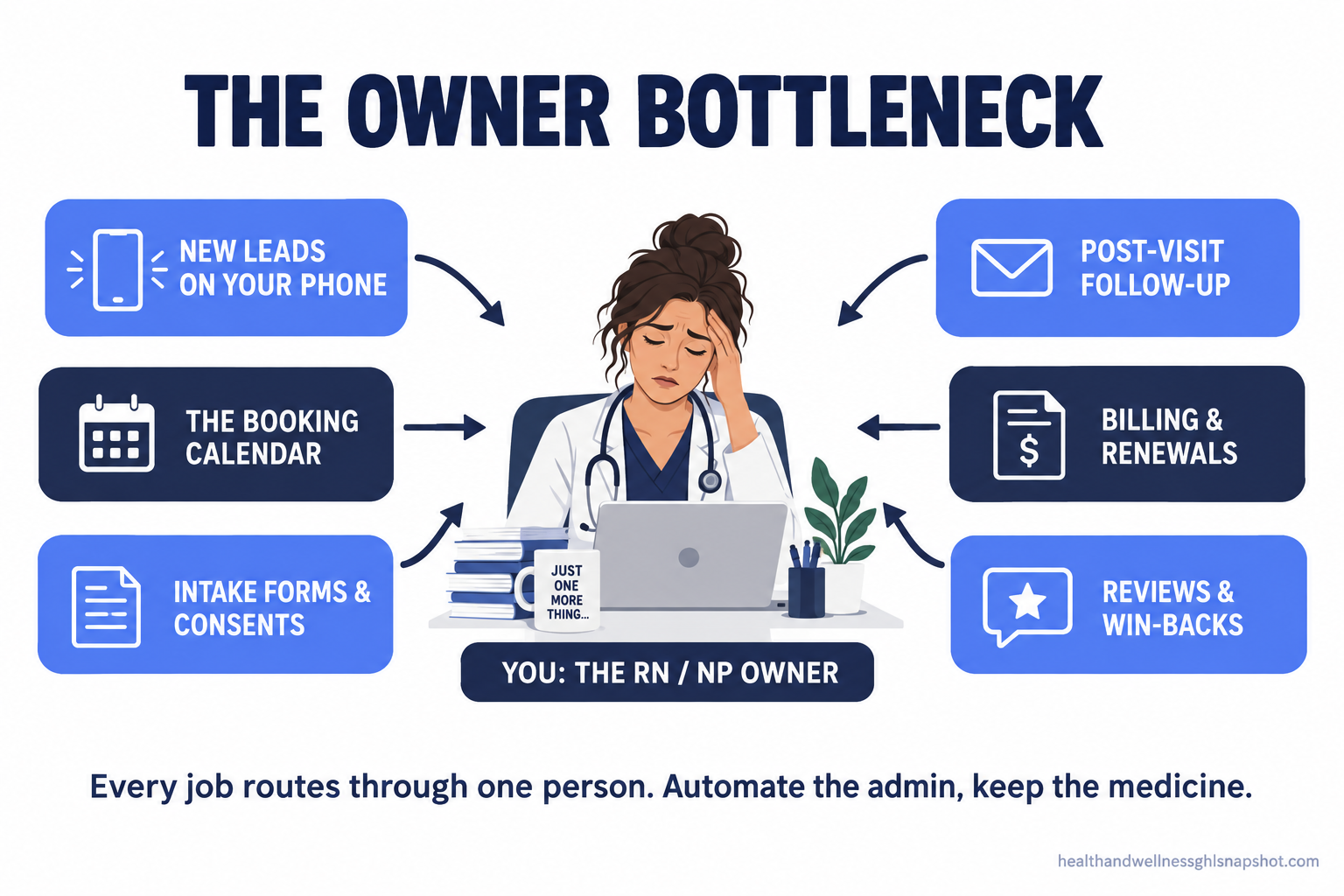
Table of contents
- The owner bottleneck, in one sentence
- What being the bottleneck actually costs you
- The six places your clinic runs through you
- The one thing you should never automate away
- Three clinics, three versions of the trap
- Steal this: the messages that replace you
- The compliance rules
- Common objections, answered honestly
- Related reading
- Frequently asked questions
The owner bottleneck, in one sentence
A bottleneck is the narrowest point in a pipe, and everything upstream waits for it. In a clinic, you are the narrow point: the lead can’t get a reply until you see it, the patient can’t rebook until you check the calendar, the renewal can’t process until you remember it. The work is not hard. It is routed to one desk, and that desk closes when you leave the building.
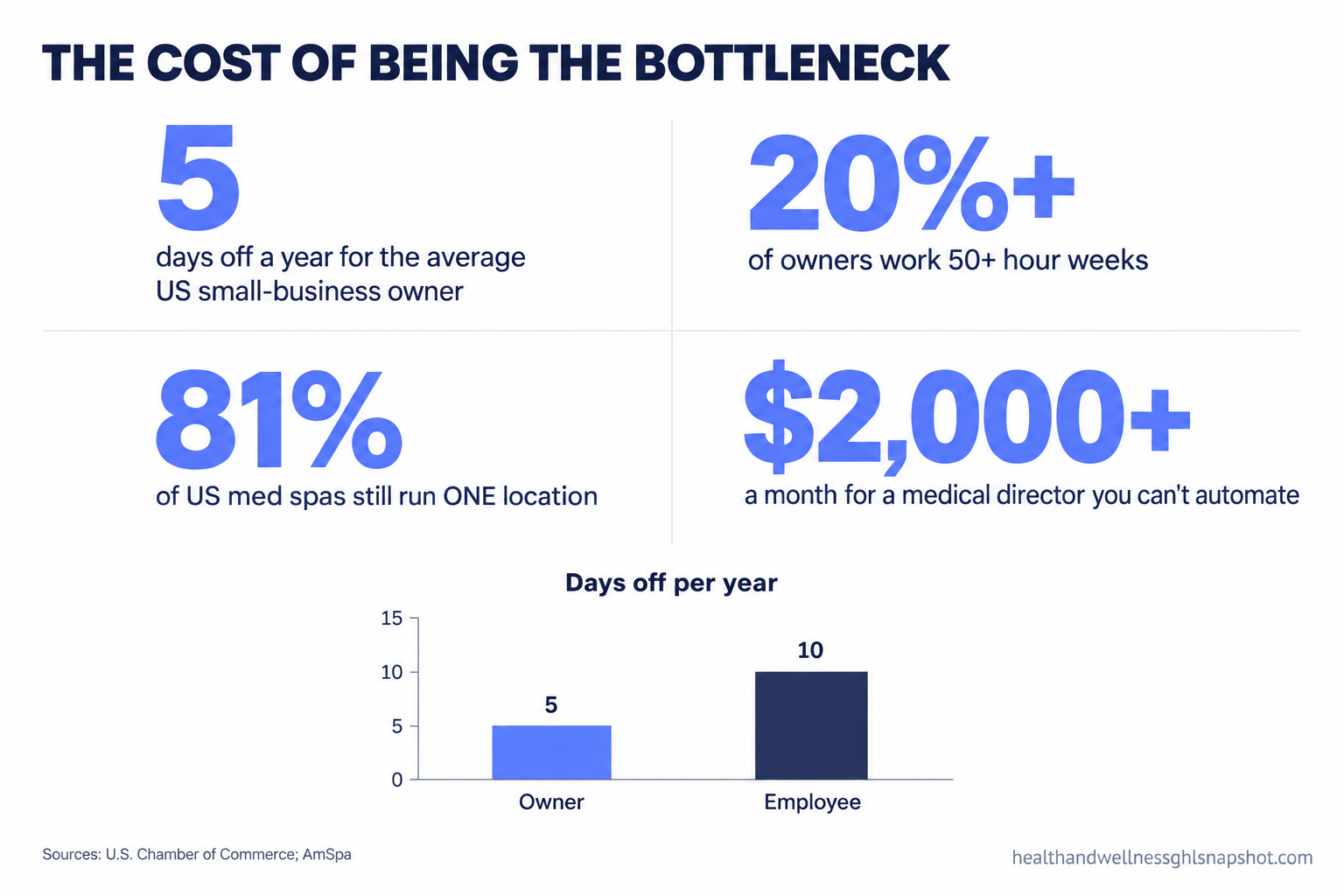
Most owners here walk into this because they are clinicians first. An RN or NP opens an IV bar or a hormone practice because they are excellent at the care, and the care genuinely needs them. So they do that part beautifully and pick up every other job too, because there is nobody else yet. The follow-up texts, the booking changes, the payment chasing. None of it needs a license, and all of it lands on the licensed person anyway. The busier you get, the tighter it pulls, so the reward for growing is more admin on the one person who can least afford it. That is why clinics here so often stall at one site. About 81% of US medical spas still run a single location (American Med Spa Association). You can’t open a second room when the first only works because you are standing in it.
What being the bottleneck actually costs you
The first cost is your time. More than one in five US small-business owners work over 50 hours a week, and owners take roughly five days off a year against about ten for an employee (U.S. Chamber of Commerce, via NRCA). In a clinic, much of that is not clinical. It is the admin tail: the evening replying to DMs, the Sunday reconciling who owes what, the stuff that does not need your license.
The second cost is money you never see leave, because it never arrives. When the person answering leads is also running drips, leads wait, and a reply that takes hours loses the booking to whoever answered first. Same with the renewal you forgot to pre-warm and the declined card nobody chased. These are quiet losses, a few hundred dollars at a time, which is why a busy clinic can still be unprofitable.
The third cost is the ceiling. A clinic built around one person is capped at the hours that person can work. You cannot clone yourself, so until the repeatable work runs without you, every growth plan ends at the same wall. The average med spa location now does about $1.4 million a year (AmSpa), and the ones that get there are rarely the ones where the owner still personally texts every patient.
The six places your clinic runs through you
Almost every owner bottleneck lives in one of six spots. None need your clinical judgment, and all currently wait on you.
| Where it routes through you | How you feel it | What it needs instead |
|---|---|---|
| New leads hit your personal phone | You reply hours late, between patients | Instant auto-reply from one shared inbox |
| Only you can work the calendar | Reschedules pile up until you touch them | Online booking plus self-serve reschedule |
| You chase every intake form | Patients show up with nothing filled in | Automated intake sent and nudged on booking |
| You follow up after every visit | Follow-up happens when you remember | Timed post-visit sequence per service |
| Billing and renewals live in your head | Cards decline, renewals slip quietly | Recurring billing with auto recovery |
| Reviews and win-backs are a sticky note | You mean to, you never get to | Triggered review asks and lapsed-client nudges |
1. Every new lead lands on your personal phone. A prospect DMs your Instagram, fills out your form, or gets voicemail, and that inquiry sits until you personally see it, which during a shift is hours. By then the lead has messaged two other clinics. The fix is a single shared inbox across every channel that fires an automatic text back within seconds. A classic study found the odds of qualifying a lead were far higher at five minutes than at thirty (Harvard Business Review). That first reply does not need you, it needs to exist. See routing leads into your calendar and the missed-call text-back playbook.
2. Only you can work the calendar. Every reschedule flows to you because you know the room, the tech’s hours, and the medical director’s schedule. Handing it to a front-desk person without rules just moves the bottleneck one seat over. The fix is online self-booking with the rules baked in: which services need a consult first, how much buffer a drip needs, which provider sees which visit type. If the phones are the pressure point, that is its own article: when the front desk can’t keep up.
3. You chase every intake form and consent. The patient booked, but the form and medication history are blank, so you lose the first ten minutes of the visit to paperwork. The fix is automated intake sent the moment someone books, with a reminder if it is not done 24 hours ahead. The patient arrives prepped and the consent is on file, which protects you too, because a complete, timestamped consent matters later. Mechanics: paperless, HIPAA-aware intake.
4. You personally follow up after every visit. You know the IV client should return in three to four weeks and the weight-loss patient needs a check-in before the next injection, so you try to remember to text each one. On a good week you catch half. The fix is a timed post-visit sequence per service: a same-day thank-you, a check-in a few days later, and a rebooking nudge as the benefit fades. That is the difference between a client who drifts and one who rebooks, the point of turning one-time IV clients into members.
5. Billing and renewals live in your head. You remember, roughly, who is on a membership and when it renews, and you run cards by hand. When one declines you find out days later and have to chase it. A membership rarely cancels dramatically; the card just declines and the client is gone without deciding to leave. The fix is recurring billing that charges on schedule, retries a failed card, and sends a card-update link on its own. Pair it with a renewal pre-warm sequence. More: recovering failed payments.
6. Reviews and win-backs are a sticky note you never reach. Asking happy clients for a Google review helps, and lapsed clients can be won back with one good message, but both are always less urgent than the patient in front of you, so both never happen. The fix is a triggered review request after each completed visit, routing happy clients to Google and catching unhappy ones privately, plus a win-back sequence that reaches out when someone hasn’t visited in 60 or 90 days. Neither needs you in the loop.
The one thing you should never automate away
Everything above is admin. It feels risky to hand off because it sits so close to the part you genuinely cannot delegate: the clinical decision. So be precise about the line.
You keep every call that requires your license. Whether a patient is a candidate for a GLP-1. The dose. The contraindication you catch in the history. The scope-of-practice judgment about what you can do without a collaborating physician. That line differs by state. Right now 27 states plus Washington, D.C. grant nurse practitioners full practice authority, while the rest require a collaborative or supervisory agreement, especially for controlled substances (American Association of Nurse Practitioners). In a reduced-practice state you are even more of a clinical bottleneck by law, all the more reason to get the non-clinical work off your plate.
US jurisdictions by nurse practitioner practice authority: 27 states plus Washington, D.C. grant full practice authority; the remaining 23 states require a collaborative or supervisory agreement. Where you sit on this map shapes how much clinical work only you can legally do. Source: AANP State Practice Environment.
The medical director is the other piece you cannot software your way out of. If you run a med spa model with a contracted MD or DO, that oversight is a real cost, roughly $2,000 to $10,000 a month depending on your state and arrangement (InHouse). Automation just makes sure every dollar of that clinical time goes to clinical work, not to reminding a patient to fill out a form. Who can own the clinic at all also varies by state, covered in whether a nurse practitioner can own a med spa in 2026. The rule: automate the messages around the medicine, never the medicine itself.
Three clinics, three versions of the trap
The solo RN IV bar. You are clinician, front desk, biller, and marketer, so the bottleneck is total: nothing happens when you are not there. Start with the instant lead reply and the post-visit rebooking sequence. Those two recover revenue you lose every shift and buy you your first real time off since opening.
The two-to-three-provider hormone or weight-loss clinic. You have a front desk and an injector or two, but you are still the final answer for anything non-routine, so your team interrupts you constantly. Your win is rules and routing: self-booking with guardrails, automated intake, and billing that recovers failed cards on its own. You go from switchboard to the person who handles only genuine clinical exceptions.
The multi-location clinic. Three sites, and the bottleneck has multiplied. Each location reinvents its follow-up, every manager texts clients differently, and you have no single view of which renewals are at risk. Your move is standardization: one set of sequences every location runs identically, one inbox, one billing and renewal engine. This is where the owner finally stops being operationally necessary and starts being an actual owner.
Steal this: the messages that replace you
A message can do the talking when you can’t, as long as it is good. None of the copy below makes a clinical claim. Each is the admin wrapper around a decision you already made. Adjust the details and get consent before you text anyone.
Instant lead auto-reply (fires within seconds of any inquiry):
Hi [name], thanks for reaching out to [clinic]! You’re in the right place. A team member will follow up shortly. In the meantime, see openings and book here: [link]. Reply STOP to opt out.
Missed-call text-back (fires when a call goes unanswered):
Hi, this is [clinic], sorry we missed you! We’re likely with a patient. Text us what you need and we’ll reply as soon as we’re free, or grab a time here: [link].
Post-visit follow-up (same day, after an IV or injection):
Hi [name], great to see you today. Drink plenty of water and go easy the rest of the day. Most clients feel their best coming back every 3 to 4 weeks, want me to hold your next spot? [link]
No-show rebook (fires the day of a missed appointment):
Hi [name], we had you down for today and missed you. No problem, life happens. Here’s the link to grab a time that works better: [link]. Let us know if you’d like a hand.
Failed-payment recovery (fires on a declined card):
Hi [name], heads up, your card on file for your [clinic] membership didn’t go through this month. Quick fix, update it here and nothing lapses: [link]. Thanks!
Review request (a day or two after a completed visit):
Hi [name], it was a pleasure seeing you at [clinic]. If you have 30 seconds, we’d be grateful for a quick review, it genuinely helps others find us: [link]. And if anything was less than great, reply here first so we can make it right.
Every one ends on a next step and an easy out. That is what makes them read like service instead of spam, and why they beat you doing it by hand: they go out at the right moment, not whenever you remember.
The compliance rules
Getting the admin off your plate does not get the responsibility off your plate. Two lines to respect before you turn any of this on.
SMS consent and carrier registration. You need express written consent before texting a patient for anything beyond a direct reply, and that language belongs on your intake and booking forms. US business texting also runs through 10DLC registration, and healthcare-adjacent messaging draws heavier carrier filtering, so registering properly keeps reminders from silently going undelivered. Always include a clear opt-out. Details in HIPAA-aware SMS for wellness practices.
HIPAA is not automatic, and not optional to think about. If your clinic bills insurance or shares protected health information with covered partners like labs or referring physicians, you are a covered entity, and your automations need a business associate agreement with your software. A pure cash-pay IV bar may fall outside HIPAA, but you still owe state privacy and breach-notification duties, so never assume the exemption.
Common objections, answered honestly
“My clients want to hear from me personally. Won’t automation feel cold?” The clients who matter want a fast, reliable experience far more than a hand-typed text they waited two days for. Your warmth is the visit and the care. Automation covers the logistics you were doing late at night anyway, and doing worse because you were tired. Done right, clients can’t tell which texts are automated, and the ones they can tell are better because they arrive on time.
“I don’t trust software with medical information.” Good, keep that instinct. It is exactly why the rule is automate the admin, never the medicine. You are not handing a machine your clinical judgment, only the reminders, scheduling, and billing that never needed a license. Choose software that will sign a business associate agreement if you are a covered entity.
“I’m not technical, and I don’t have time for a project.” The reason you are the bottleneck is that you have no time, so a six-month build is not the answer. A system already built for this niche and installed for you means you turn sequences on, not code them. If even that is too much, the first delegation move is a person: a trained virtual assistant who runs the system while you stay clinical.
“I already pay for Jane or Boulevard. Isn’t this handled?” Most clinical platforms do one slice well and leave the rest to you. They book and chart, but the instant cross-channel lead reply, the win-back, the failed-payment recovery, and the review routing are usually not included, or are costly add-ons. The test: do the six bottlenecks above run without you today? If three still wait on your phone, they are not handled.
Related reading
- Why your wellness clinic is busy all day and still not making money
- When the front desk can’t keep up with calls, texts, and bookings
- How to route Instagram, Facebook, and Google leads into your booking calendar
- Turn one-time IV and injectable clients into members
- Failed payment recovery for wellness memberships
Frequently asked questions
Why can't my wellness clinic run without me?
Because the business was built so every lead, booking, follow-up, payment, and review decision routes through one person. The work is mostly admin that does not need your clinical license, but it waits on you because no system handles it. The fix is to move the repeatable work onto automation so it runs whether or not you are in the building, while you keep the clinical decisions.
What parts of a wellness clinic can I automate safely?
The admin around the medicine: instant replies to new leads, online booking and self-serve rescheduling, intake and consents, timed post-visit follow-ups, recurring billing with failed-card recovery, renewal reminders, and review and win-back requests. What you never automate is the clinical decision itself, candidacy, dosing, diagnosis, or scope-of-practice judgment. A message that reminds someone to book is admin; one that implies a dose or diagnosis is not.
How do I stop being the bottleneck if I'm a solo operator?
Start with the two sequences that recover the most revenue while you are busy: an instant lead auto-reply so inquiries do not go cold during a shift, and a post-visit follow-up that rebooks clients on schedule. Those two cover the moments you cannot be in two places at once. You do not need a large system to begin.
Does automating patient texts create HIPAA or TCPA problems?
It can if you skip the basics. Get express written consent before texting beyond a direct reply, include a clear opt-out, and register for 10DLC so healthcare-adjacent messages get delivered. If you bill insurance or share protected health information, you are a covered entity and need a business associate agreement with your software. A cash-pay clinic may fall outside HIPAA but still owes state privacy duties.