
It is a Tuesday afternoon and a client just floated out of your clinic after a $180 NAD+ drip. “That was amazing, I feel like a new person,” she said at the door. She paid cash, tipped your nurse, and left glowing. And in all likelihood you will never see her again. Not because she was unhappy. Because nothing you built reaches back out to her, so the next time she thinks about an IV she is as likely to Google a competitor as she is to remember your name.
That client was worth $180 to you. The same client on a membership is worth closer to $2,000 a year, visits far more often, and refers her friends. This post is how you close that gap on purpose: the full six-stage system for turning a one-time IV, injectable, or vitamin-shot client into a committed member, built for the RN or NP who owns the clinic and has no marketing team. You get the real text copy to lift, the timing that works, and the way each stage quietly breaks so you can skip the mistakes.
Table of contents
- What a one-and-done client actually costs you
- The six-stage post-visit conversion system
- Stage 1: Build a membership worth joining
- Stage 2: Make the offer at the chair, not in an email
- Stage 3: The same-day thank-you and soft invite
- Stage 4: The day-7 value nudge
- Stage 5: The day 14 to 21 membership ask
- Stage 6: The day-45 win-back
- Run it for your size: solo, three-location, med-spa
- The compliance lines to respect in 2026
- Objections owners raise
- Frequently asked questions
What a one-and-done client actually costs you
A one-time client is a large loss hiding as a win, because the cost of getting her in the door is the same whether she comes once or forty times. You paid for the ad, the post, or the Google listing that brought her in. If she pays once and disappears, that acquisition cost sits on a single $180 visit. If she becomes a member, it spreads across a year of visits and your margin on every visit after the first climbs.
The industry trend makes this urgent. Across medspas, new-guest visits declined about 11% on a same-store basis in 2025, while membership sales grew 13% year over year (Zenoti 2026 Benchmark, via Zenoti). Fewer new people are walking in, and they cost more to reach, so the clinics that are growing are the ones squeezing more lifetime value out of each client they already treated. A benchmark of more than 100 aesthetics and medspa brands found the median practice grew revenue 19.2% year over year, roughly three times the industry average of about 6%, and the practices pulling ahead were the ones with strong membership and retention (CorralData H1 2026, via AmSpa).
The gap between a walk-in and a member is bigger than most owners guess. Members in that same analysis spent 2.5 times more than non-members, and in Zenoti’s data members visit 2.9 times more often than non-members (Zenoti). Retention tells the same story.
Retention rate at one multi-location aesthetics chain: members vs non-members (%). Source: CorralData H1 2026 Aesthetics Industry Benchmark, via AmSpa.
Run your own number. A single IV or injectable visit averaging $180, bought 1.5 times a year, is worth about $270. The same client on a $149-a-month membership is worth $1,788 a year before any add-on, and members buy more add-ons, not fewer. Same client, same first visit. The only difference is whether anything brought her back.
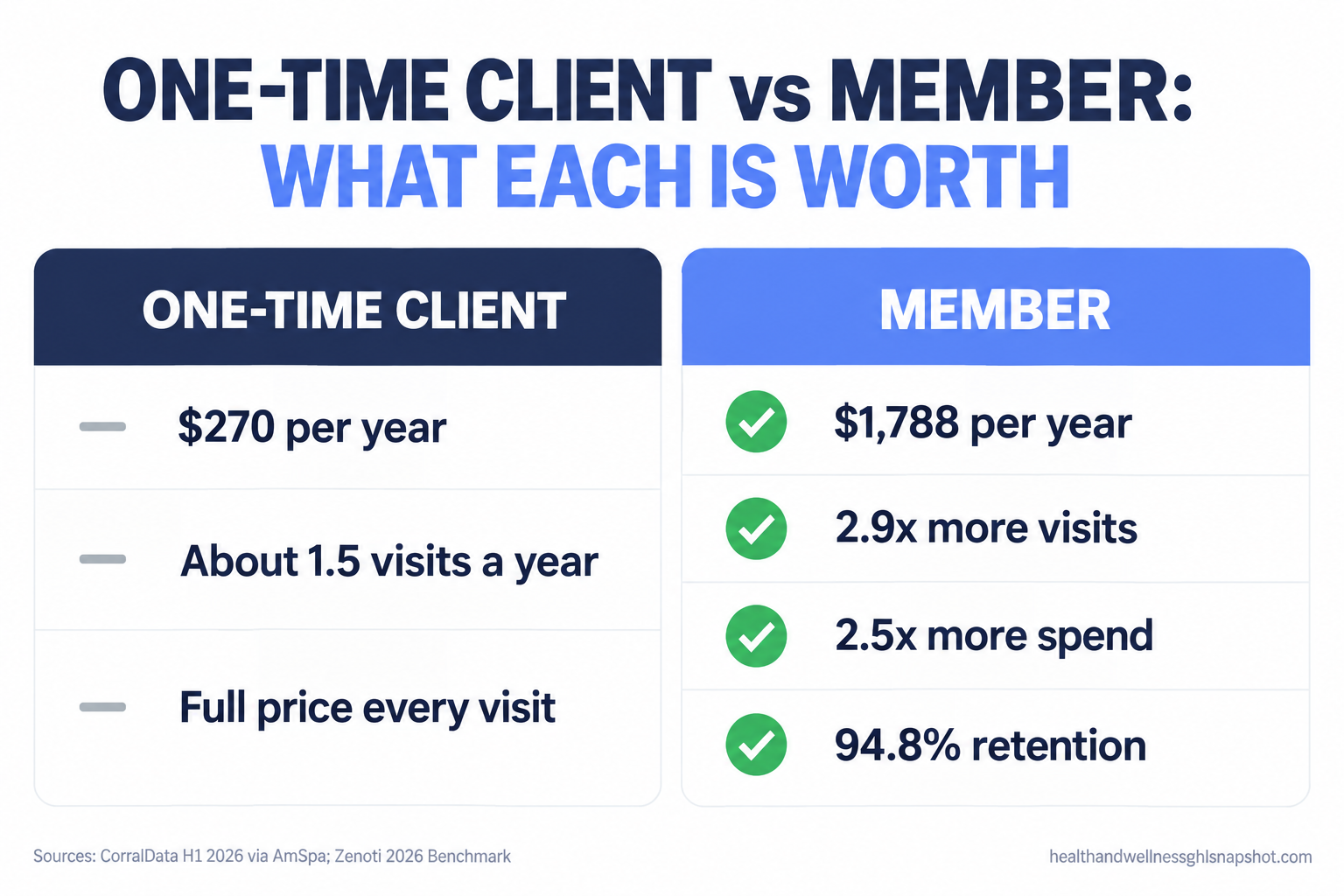
This is why keeping and converting clients beats chasing new ones. The odds of selling again to someone you already have run 60% to 70%, against 5% to 20% for a brand-new prospect (Marketing Metrics, Farris et al., via Semrush), and raising retention by just 5% lifts profit 25% to 95% (Bain and Company via HBR). The medical-aesthetics market has eclipsed $17 billion and grows by more than $1 billion a year (American Med Spa Association), so the demand exists. The leak is the silence between a great visit and the next one.
The six-stage post-visit conversion system
A conversion system is a fixed sequence of touches that starts the moment a first-time client checks out and runs until she is either a member or has been politely let go. It is not a newsletter and not a punch card. It is a handful of well-timed messages, each with one job, that turn “that was amazing” into “same time next month.” The six stages, in order:
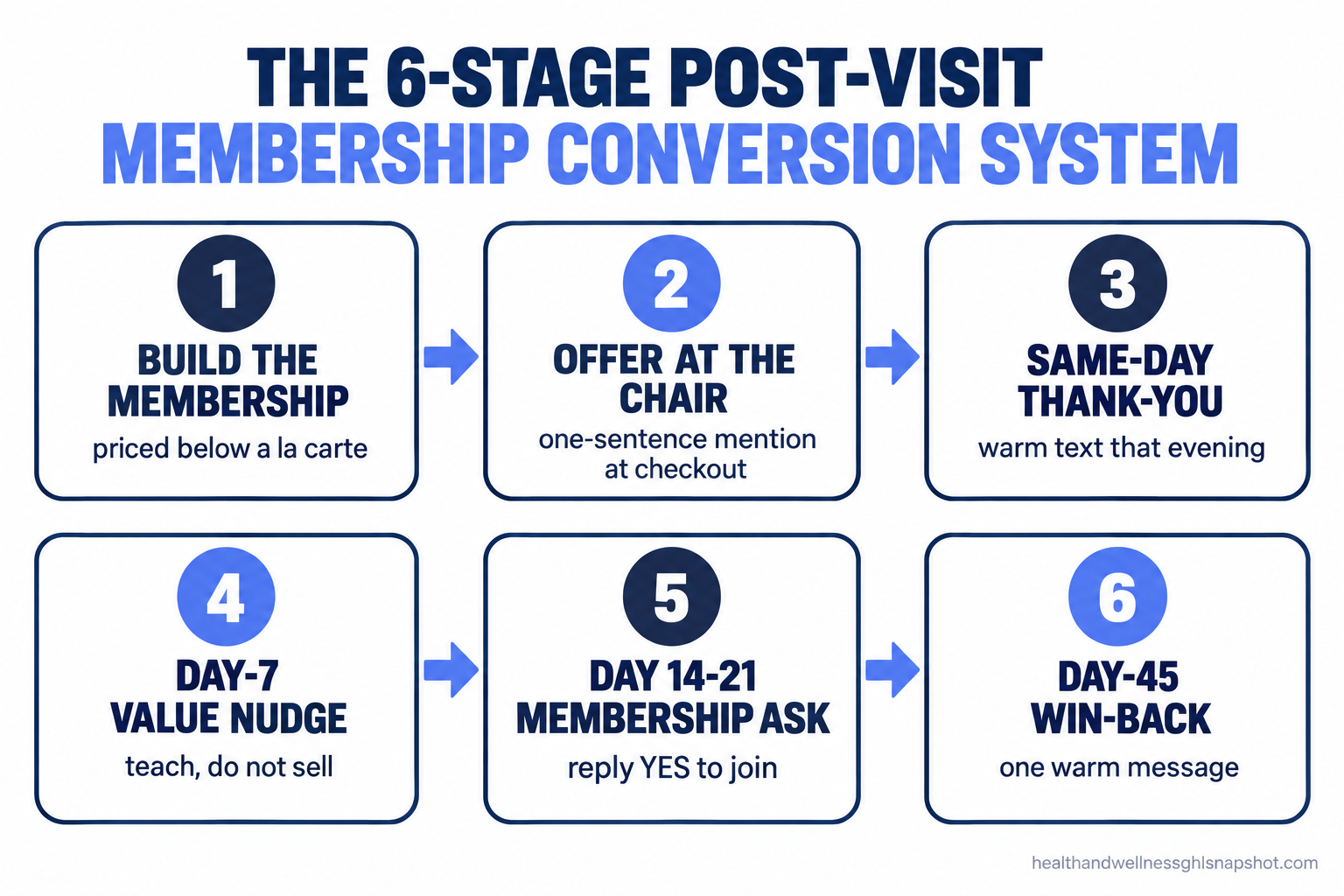
- Build the membership so every message has something real to point at.
- Offer it at the chair, in person, while the client still feels great.
- The same-day thank-you, which keeps the relationship warm and opens the door.
- The day-7 value nudge, which teaches rather than sells.
- The day 14 to 21 membership ask, where the one-time visit becomes a commitment.
- The day-45 win-back, for the client who did not join the first time.
Every stage below has the same three parts: how to set it up, the copy to send, and the failure mode that quietly kills it. Pay closest attention to the failure modes, because almost every owner who says “I tried texting clients and it did nothing” tripped one of them.
Stage 1: Build a membership worth joining
No sequence can sell a membership that does not exist or is not worth having, so the first stage is an offer-design decision, not a message. A client who pays per drip is renting a feeling. A member has bought into a routine with a price that rewards her for showing up. Before you automate a single text, you need a membership that is genuinely a better deal for a regular client than paying a la carte.
For an IV and injectable clinic, the membership that converts best usually bundles a set monthly treatment with perks that make a la carte look foolish. Here is the shape most clinics land on:
Pay-per-visit vs a monthly membership
| Plan | Pay per visit | Monthly membership recommended |
|---|---|---|
| Price | ~$180/visit | ~$149/mo |
| Feature 1 | Full price every single time | One treatment a month plus member pricing on extras |
| Feature 2 | No reason to come back on a schedule | Priority booking and a standing monthly slot |
| Feature 3 | Books only when she happens to think of you | Priced below the a la carte cost of the same visits |
| Feature 4 | Average walk-in returns about 1.5 times a year | Built to turn an occasional visit into a routine |
Setup: price the membership just below what a regular client would spend anyway, so joining reads as the smart choice rather than an upsell. Decide the included treatment, the member discount on add-ons, and whether unused months roll over. The margin math matters here, and it is easy to price yourself into a loss, so work it out before you launch using our med spa membership pricing and margin guide. If the offer is right, the sequence below practically sells it for you.
Failure mode: having nothing to convert anyone into, or building a membership that loses money on every member. If your only product is a single visit, every client is a one-time client by default. And if your membership is priced so generously that heavy users drain your margin, you will grow revenue and shrink profit at the same time. Build the offer, then price it with a calculator, not a gut feeling.
Stage 2: Make the offer at the chair, not in an email
The highest-converting moment to invite a client into a membership is while she is still in the chair feeling great, not three days later in an inbox she never opens. The drip is working, the compliment just left her mouth, and she is as warm toward your clinic as she will ever be. That is when your nurse or front desk makes a simple, no-pressure mention. It does not need to be a pitch. It needs to be one sentence and a card:
“So glad you feel good. A lot of our regulars end up on the monthly membership because it works out cheaper than paying each time and you get priority booking. No rush at all, but I will text you the details later today so you have them.”
That last line is the key. It sets up permission for the text that is coming, which keeps your follow-up on the right side of consent and stops it feeling like a surprise. Hand her a small card so she leaves holding something physical.
Setup: train every provider on the one-sentence mention and make it part of checkout. Capture her mobile number with a clear, unbundled SMS opt-in at intake (more in the compliance section) and tag her as a first-time client so the automated sequence starts on its own. The front desk is where this often falls apart, the same bottleneck we cover in why your clinic’s front desk cannot keep up.
Failure mode: staying silent at the chair and hoping the automation does all the work. A cold text three days later converts a fraction of what a warm in-person mention plus a text converts, because the text is now a reminder of a real conversation instead of an interruption. Say the one sentence out loud. Everything downstream works better because of it.
Stage 3: The same-day thank-you and soft invite
A short, human thank-you the same evening keeps the relationship warm and makes the client feel seen, which is the whole foundation the later ask rests on. It is not a sales message. It is the text a thoughtful provider sends, with the membership mentioned once, lightly, exactly as promised at the chair:
Hi [First name], it is [Provider] from [Clinic]. So glad you came in today, hope you are feeling great tonight. As I mentioned, here is our monthly membership if you want it: [link]. It usually works out cheaper than paying per visit, but zero pressure. Either way, I would love to see you again soon.
Notice it leads with the person, not the product, and the offer is a single link she can ignore or tap. It also does not promise a health result, which keeps you clear of FTC territory. This same-evening warmth is the identical muscle behind a strong client onboarding automation, where the first 24 hours decide whether a new client feels like a patient or a transaction.
Setup: trigger this text off the completed first visit, personalized with her name and provider, sent a few hours after checkout so it lands in the evening. If she taps the link and joins, the sequence stops and a welcome flow begins. If not, she moves to Stage 4.
Failure mode: making it a generic blast or sending it at the wrong time. A “Thanks for visiting Clinic!” template with no name and no provider reads as automated and teaches her to ignore you. Sending it at 6am because your automation ran in the wrong time zone reads as careless. Keep it personal, keep the timing human, and send it from a number she can actually reply to.
Stage 4: The day-7 value nudge
A week after the visit, the client has had time to feel the benefit fade, which makes a value-first nudge the perfect bridge between “that was nice” and “I should make this a habit.” This message does not ask for anything. It gives her a reason to think about coming back by teaching her something useful about her own treatment, then leaves the door open:
Hi [First name], hope your week is going well. Quick tip: most people get the most out of [treatment] when it is a regular rhythm rather than a one-off, since the effect builds over time. If you are thinking about your next visit, members get priority booking and a better rate. Want me to hold a spot for you this month?
The move here is education, not pressure. You are reframing a one-off drip as something that works best on a schedule, which is both true and the exact logic that makes a membership make sense. End with a low-commitment question, because a question gets a reply and a reply restarts the conversation.
Setup: fire this at day 7 only if she has not booked or joined. Route any reply to a real person, because a client who answers “yes hold a spot” is ready to buy and must not hit an auto-responder. If she books a second visit but does not join, that is fine, she is now a two-time client and far more likely to convert at Stage 5.
Failure mode: turning the nudge into a discount blast or ghosting the reply. If every follow-up is “20% off this week only,” you train clients to wait for coupons and cheapen the brand. And a nudge that invites a reply nobody reads is worse than none, because it proves the “want me to hold a spot” was hollow.
Stage 5: The day 14 to 21 membership ask
Two to three weeks out is the window where she has felt the treatment wear off, remembered the in-person mention, and received a helpful nudge, which makes it the moment to make the real ask directly. This is the only message in the sequence that asks for the commitment outright, and it works because everything before it earned the right to ask. Lead with value, make the math obvious, and make saying yes a single tap:
[First name], I wanted to follow up properly. Our monthly membership is $[X] and includes [included treatment] plus member pricing on everything else, which comes out lower than paying per visit once you come more than once. It also locks in priority booking so you are never waiting weeks for a slot. Want me to get you set up? Just reply YES and I will send the link.
Price it below the a la carte total, name the two things clients actually want (savings and priority booking), and make enrollment self-serve so a “YES” triggers the sign-up link instead of a phone call she never makes. When she joins, she enters your welcome and billing flow, and the one-time client is now recurring revenue.
Setup: send at day 14 to 21 only to clients who have neither joined nor been clearly disengaged. When she replies YES, the system sends the enrollment link and starts recurring billing. The billing itself should not require a $300-a-month add-on to your software, which is the exact trap we unpack in running a clinic membership without the expensive add-on.
Failure mode: asking too early, too late, or letting the signup stall on a call. Pitch hard on day one and it feels like a car lot. Wait two months and she has forgotten you. And an ask that ends with “call the front desk to sign up” loses the people who meant to but never found a free minute. Fire it in the window and make joining a two-tap action.
Stage 6: The day-45 win-back
Some clients will not join on the first pass no matter how good your sequence is, and this stage is the difference between losing them and recovering a healthy share for almost nothing. Around 45 days after the visit, a client who never came back is drifting, not gone. A single, warm win-back often recovers more than owners expect, because she liked the visit and simply lost the thread:
Hi [First name], we have missed you at [Clinic]. If you have been meaning to come back, I would love to get you in this month, and if you join the membership now I will waive your first-month [perk] so it is an easy start. Here is my calendar: [link]. No pressure, just wanted you to know the door is open.
For the clearly price-sensitive client, the win-back is where a capped, one-time incentive earns its place, because recovering a lapsed client is cheaper than acquiring a new one. Keep it small and send it once.
Setup: trigger off days since last visit, cap the incentive, and send the win-back a single time; one more attempt weeks later is the most you should try. The deeper cadence lives in our client reactivation and win-back guide, and the churn that hits after a client joins but does not stick is its own problem in why membership clients cancel after two months.
Failure mode: blasting win-backs every week or training clients to wait for the discount. Message a lapsed client five times and you become noise. Attach a coupon to every touch and your regulars learn that disappearing for a month earns them a deal. Send the win-back once, make it warm, and respect the no.
Run it for your size: solo, three-location, med-spa
The six stages are identical for every clinic, but who runs them and how they are staffed changes with your size and ownership model. The framework does not bend. The operations around it do.
The solo RN or NP clinic. You are the provider, the injector, the front desk, and the marketing department, so sending these messages by hand is the first thing that falls off on a busy day. Automation is the only way the system survives a packed schedule. Set all six stages to fire automatically and route only the human moments to your phone: the “yes hold a spot” replies, the “YES” to the ask, and anyone who answers the win-back. Your job shrinks to the conversations that need a person, which is where a dedicated wellness virtual assistant earns its keep covering replies while you are with a client.
The three-location clinic. Now the risk is drift: one location runs warm, consistent follow-up and another forgets the day-7 nudge. Centralize the sequences so every location fires the identical flow, but stamp each client with her home location and time zone so the text names the right clinic at the right hour. One system, one voice, and no per-provider fee multiplying across every seat.
The med-spa with a contracted medical director. If you are a non-clinical owner working under an MD or DO medical director, the conversion sequence is yours to run, but keep the clinical line clean. The automated texts handle logistics, membership offers, and warm check-ins, while anything that touches dosing, a treatment plan, or a medical question routes to your clinical staff, never an auto-reply. That division keeps your marketing automation on the right side of scope-of-practice rules.
The compliance lines to respect in 2026
Automating client texts in a medical-aesthetics clinic means staying inside three lines: FTC health claims, HIPAA and privacy, and SMS carrier rules. The system above is built to clear all three, as long as you know where they are.
FTC health claims. The FTC sent penalty-offense notices to nearly 700 marketers warning that unsupported product claims can draw civil penalties of up to $50,120 per violation (FTC), and it has specifically pressed IV-therapy and weight-loss marketing. So your texts must not promise that a drip “boosts immunity,” “detoxes,” or cures anything. Every message above talks about how the client felt, the rhythm of visits, and the membership, never a guaranteed health outcome. Soften the claim or cut it.
HIPAA and privacy. If you bill insurance or share client data with a lab or referring physician, you are likely HIPAA-covered and need a signed Business Associate Agreement with any vendor touching that data. A pure cash-pay IV bar may fall outside federal HIPAA but still owes state privacy and breach-notification duties, so never assume the exemption. Keep the texts to first names and logistics, never a treatment or a result. Our HIPAA-aware SMS guide goes deeper.
SMS carrier rules. Health-related texting draws heavier carrier filtering than retail, so register for 10DLC, capture a clear and unbundled opt-in at intake, and honor STOP instantly.
Objections owners raise
“Won’t discounting into a membership kill my margin?” Only if you price it wrong. A membership is not a discount, it is a trade: a slightly lower per-visit price in exchange for predictable monthly revenue and far higher lifetime value. Members spend 2.5 times more than non-members overall (CorralData via AmSpa), so even at a lower per-visit rate you come out ahead, as long as you set the price with the margin math rather than a guess.
“My clients like flexibility, won’t a membership scare them off?” Some will always prefer to pay per visit, and that is fine, the membership is for the regulars. The sequence above never forces anyone, it simply makes the better deal obvious to the client who was going to come back anyway. The flexibility-lovers keep paying a la carte; the regulars stop leaving money on the table.
“I already run everything through my booking or charting software.” Your booking tool books and your charting tool charts, but neither reaches out to a one-time client on day 7 to bring her back. Those tools wait for the client to come to them. This sequence goes to the client. It sits alongside your clinical stack and does the one job those tools were never built for, which is why many owners run it on GoHighLevel instead of paying per-provider fees to bolt marketing onto a clinical system.
“Do I need to be technical to set this up?” No, but it has to be built correctly once, because the failure modes above (timing, time zones, consent, routing the human replies, honoring STOP) are exactly what trips a DIY build. Wire the sequences yourself in GoHighLevel, or install a system where all six stages, the copy, and the compliance handling are already built and simply switched on. Either way, once it runs, it runs on its own.
Frequently asked questions
Frequently asked questions
How do I turn a one-time IV or injectable client into a member?
Build a membership that is a better deal for a regular, mention it in person at checkout while the client feels great, then run a short automated sequence: a same-day thank-you, a day-7 value nudge, a direct membership ask around day 14 to 21, and a single day-45 win-back if she did not join. Make enrollment a one-tap link so a 'YES' turns into recurring revenue without a phone call.
When is the best time to offer a membership?
The highest-converting moment is in person, in the chair, right after the treatment while the client feels great. Back it up with a same-day text, then make the real ask around day 14 to 21 once she has felt the benefit fade. Day one alone feels pushy and waiting past a month usually means she has forgotten you.
How much more is a member worth than a walk-in?
A lot. In an analysis of 100+ aesthetics and medspa brands, members spent 2.5 times more than non-members and retained 35 percentage points better, and Zenoti's data shows members visit 2.9 times more often. On a simple clinic example, a walk-in worth about $270 a year becomes a member worth roughly $1,788 a year before add-ons.
Is it legal to text IV therapy clients marketing messages?
Yes, with express consent and the right setup. Capture a clear, unbundled SMS opt-in at intake, register for 10DLC, honor STOP immediately, and keep clinical detail out of the message. If you bill insurance or share data with a lab you are likely HIPAA-covered and need a Business Associate Agreement. Avoid promising a health result to stay clear of FTC rules.
Why are new-client visits getting harder to win?
Across medspas, new-guest visits fell about 11% on a same-store basis in 2025 while membership sales grew 13%, per Zenoti's 2026 benchmark. Paid traffic is more expensive and competition is up, so the growth is shifting from acquiring new clients to keeping and converting the ones you already treated.
What if a client would rather keep paying per visit?
Let her. The membership is for your regulars, not a mandate for everyone. The sequence above never forces a join; it makes the math obvious for the client who was coming back anyway and leaves the occasional visitor free to pay a la carte. You capture the recurring revenue from the regulars without alienating anyone.
Back to that Tuesday client. In the version where the drip was a transaction, “that was amazing” is the last thing you ever hear from her, and she is a $180 memory who books her next IV somewhere else. In the version with the six stages running, your nurse mentioned the membership at the chair, a warm thank-you reached her that night, a helpful nudge found her at day 7, and a clear ask at day 18 turned her into a member worth ten times that single visit. Same client, same drip. The only thing that changed is that this time, something was built to bring her back.