
A San Diego nutrition coach starts her Monday meaning to work on her practice. By 10 a.m. she’s re-sent two intake forms, chased a card that declined, replied to four Instagram DMs, rebuilt a reminder that didn’t fire, and manually texted a client who ghosted last week’s check-in. The programs she actually sells — the coaching, the protocols, the group calls — wait until the admin is cleared. It never fully clears. This is the quiet ceiling most wellness practices hit: not a lack of demand, but a founder who has become the front desk, the marketer, and the CRM administrator all at once.
A GoHighLevel virtual assistant is a trained specialist who runs the software layer of your practice — the scheduling, follow-up, DM replies, reminders, reviews, and workflows — so the highest-value person in the building goes back to seeing clients instead of coordinating them. This is a step-by-step playbook: how to figure out where your hours actually go, what to delegate first, how to hand it off without losing control, and how to keep the whole thing HIPAA- and TCPA-aware. Every statistic below is sourced, and the honest caveat runs throughout — a VA multiplies a system that works; it does not rescue an offer that doesn’t.
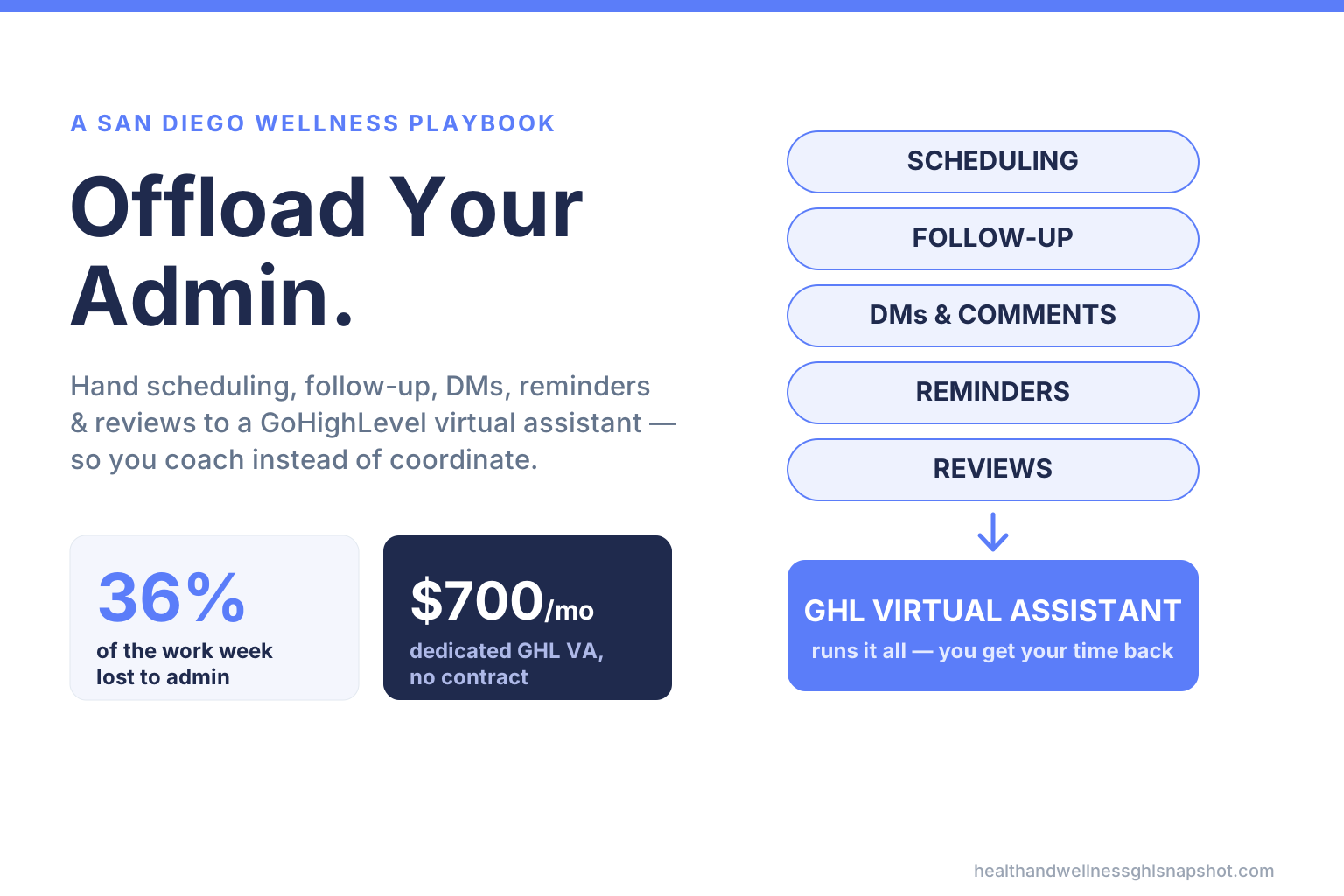
Table of contents
- What a GoHighLevel wellness VA actually does
- Why San Diego wellness owners are drowning in admin
- The 6-step playbook to offload your admin
- What to delegate first (highest ROI to lowest)
- In-house front desk vs a GoHighLevel VA: the honest math
- Keeping it compliant: HIPAA & TCPA guardrails
- Frequently asked questions
What a GoHighLevel wellness VA actually does
A GoHighLevel wellness VA is a trained operator who owns the day-to-day of your practice’s software — so the systems that keep clients booked, engaged, and renewing actually run, without you touching them. It is not a generic “answer my email” assistant. The value is specificity: they know GoHighLevel’s workflows, pipelines, SMS consent gates, and calendars, and they know the cadences a wellness practice lives on.
Concretely, a wellness VA handles the work that eats your week:
- Booking & calendars — keeping availability accurate, confirming consults, and rescheduling no-shows before they vanish.
- Speed-to-lead follow-up — replying to new inquiries fast, across the phone, web form, and DMs, so the intent stays hot.
- DM & comment response — answering Instagram and Facebook messages and comments, qualifying the person, and dropping a booking link.
- Reminders & check-ins — making sure appointment reminders, program check-ins, and milestone nudges fire and get monitored.
- Reviews & reputation — sending post-session review requests, routing happy clients to Google, and flagging unhappy ones privately.
- Workflow upkeep — building and fixing the automations, tags, and pipelines so nothing silently breaks.
Think of the VA as the person who runs the machine, and a done-for-you GoHighLevel snapshot as the machine itself. The snapshot ships the workflows pre-built; the VA operates, monitors, and improves them. You can hire a VA to run a system you already have, or start both together.
Why San Diego wellness owners are drowning in admin
The problem isn’t laziness or bad time management — it’s that a growing wellness practice generates more administrative surface area than one founder can cover while also delivering the service. Every new client multiplies the touchpoints: a booking, an intake, a payment, a reminder cadence, a check-in rhythm, a renewal, a review request. At 15 clients that’s manageable by hand. At 60, across a group program and two channels of inbound, the seams tear.
The data backs up what the calendar already shows. Entrepreneurs spend about 36% of their working week on administrative tasks — invoicing, scheduling, data entry — instead of growth or service delivery (Time Etc, 2024), and 84% of small-business owners say they’ve sacrificed their health, sleep, or relationships to keep the business running (Patriot Software, 2026). For a wellness practitioner whose product is their attention, every hour spent re-keying data or debugging a workflow is an hour not spent coaching — and often an hour of billable capacity simply lost.
Share of a small-business owner’s work week, %. Source: Time Etc (2024).
San Diego sharpens the point. The city is one of the country’s densest wellness markets — functional-medicine clinics, longevity and hormone practices, weight-loss coaches, and integrative studios competing for the same health-conscious clients — and it sits inside a national economy growing at 7.9% a year (Global Wellness Institute, 2026). In a competitive, high-demand market, the practice that answers first and follows up fastest wins the client — and the founder buried in admin is, by definition, answering slowest.
The 6-step playbook to offload your admin
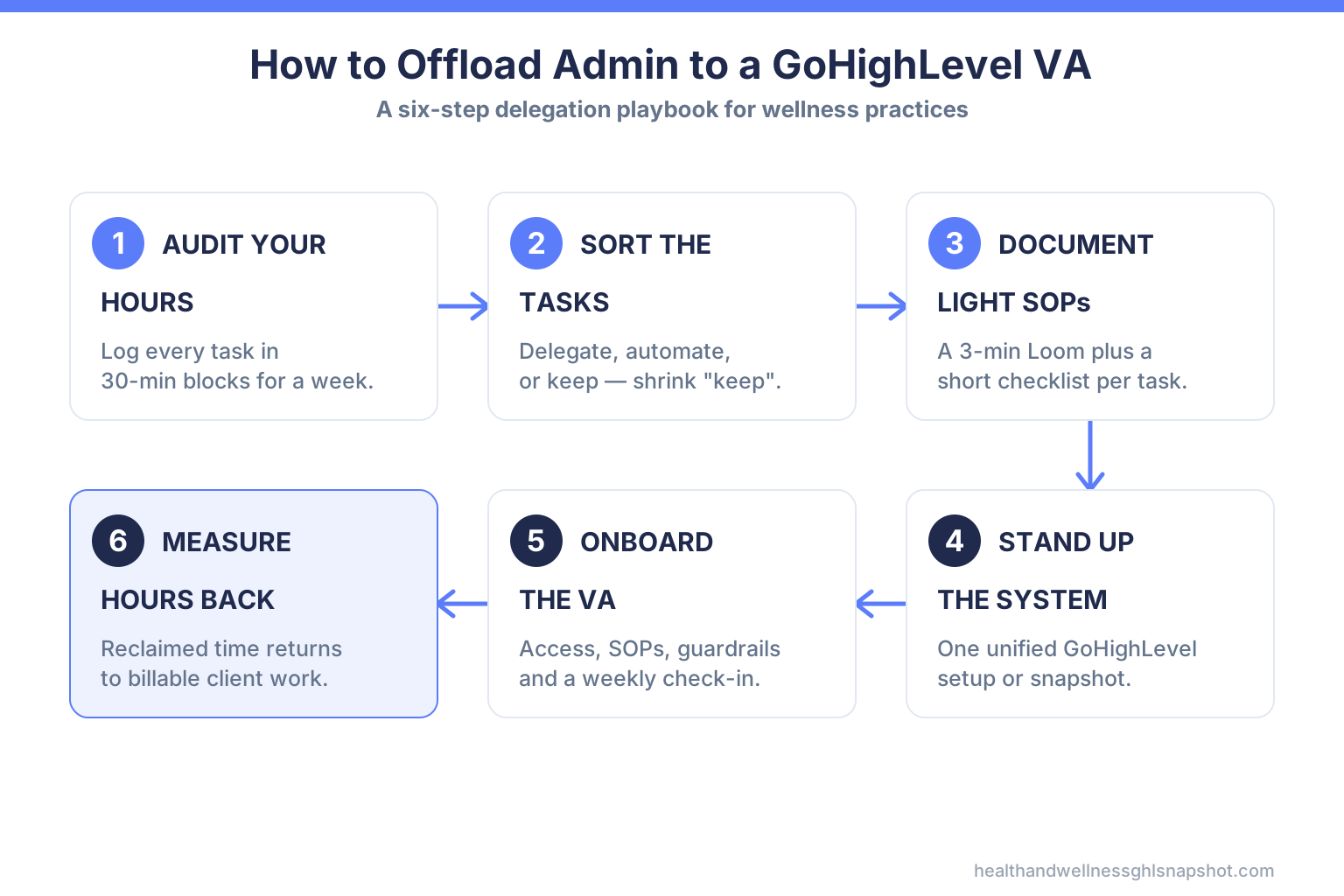
Offloading admin isn’t “hire someone and hope” — it’s a repeatable sequence: see where your time goes, decide what leaves your plate, document it lightly, stand up the system, hand it over with guardrails, then measure what you got back. Here’s the whole playbook.
Step 1 — Audit where your hours actually go
For one week, log every task in 30-minute blocks — booking, follow-up, DMs, payments, intake, reminders, reviews, admin. Don’t estimate from memory; you’ll undercount. Most owners are startled to see how much of the week is coordination rather than coaching. The log is your delegation map: you can’t hand off what you can’t name.
Step 2 — Sort every task: delegate, automate, or keep
Put each logged task into one of three buckets. Automate anything rule-based and repetitive (appointment reminders, review requests, missed-call text-backs). Delegate anything that needs a human but not you (DM replies, rescheduling, workflow monitoring, reporting). Keep only what genuinely requires the practitioner (the actual coaching, clinical decisions, high-trust sales conversations). The goal: shrink “keep” to the work only you can do.
Step 3 — Document light SOPs (a Loom + a checklist)
You don’t need a 40-page manual. For each delegated task, record a 3–5 minute Loom walking through how you do it and write a short checklist. This is the single highest-leverage hour you’ll spend — it’s the difference between a VA who needs constant correction and one who’s autonomous in a week. A good VA service will also help build these with you.
Step 4 — Stand up the system the VA will run
Delegation works best on a unified system. If your tools are scattered across a booking app, a spreadsheet, and three inboxes, consolidate onto one platform first — GoHighLevel unifies calendar, CRM, SMS/email, pipelines, and reviews in one place. A done-for-you snapshot installs the wellness workflows pre-built, so the VA starts operating on day one instead of building from scratch. (If you’re moving off legacy tools, our migration playbook covers the switch.)
Step 5 — Onboard the VA with guardrails
Give the VA access, your SOPs, and clear boundaries: what they can send without approval, what needs sign-off, and the compliance rules (consent language, quiet hours, what never goes over SMS). Set a communication cadence — a shared Slack channel and a weekly check-in beats scattered messages. With our service, a project manager sits in that channel and reviews the work, so quality isn’t on you to police.
Step 6 — Measure the hours (and revenue) you got back
After 30 days, re-run the Step 1 audit. Track three things: hours reclaimed (back to billable work), speed-to-lead (how fast inquiries now get answered), and leakage fixed (no-shows recovered, renewals caught, reviews collected). This is where delegation pays for itself — the point of buying back your time is to reinvest it in the work that actually grows the practice.
What to delegate first (highest ROI to lowest)
If you only hand off a few things this month, hand off the tasks where slowness directly loses money — speed-to-lead follow-up is almost always #1. Not all admin is equal; some of it is quietly deciding whether prospects become clients. Delegate in this order:
| Priority | Task to offload | Why it’s high-ROI | Automate or VA-run |
|---|---|---|---|
| 1 | New-lead follow-up (phone, form, DM) | Every minute of delay drops your odds of qualifying the lead | Both — automate the instant reply, VA works the conversation |
| 2 | Instagram & Facebook DM/comment replies | Inbound wellness leads now start in the DMs; silence sends them to a competitor | VA-run, automation-assisted |
| 3 | No-show rescue & rescheduling | A recovered no-show is revenue you already earned | Automated reminders + VA rescue |
| 4 | Review requests & routing | More recent 5-star reviews win the local search click | Automated, VA-monitored |
| 5 | Intake, payments, reminders | Frees your hands and removes re-keying errors | Mostly automated, VA oversees |
| 6 | Workflow building & upkeep | Keeps the whole machine from silently breaking | VA-run |
The through-line is speed. The odds of contacting a new lead are up to 100× higher, and of qualifying them 21× higher, when you respond within 5 minutes versus 30 (Lead Response Management / MIT, 2007) — yet the average business takes 42 hours to respond and 23% never reply at all (Harvard Business Review, 2011). A VA plus automation collapses that gap to seconds.
How much more likely you are to reach and qualify a new lead by replying in 5 minutes vs 30 minutes (× multiplier). Source: Lead Response Management / MIT (Oldroyd), 2007.
For the deeper mechanics, see our guides on speed-to-lead for wellness practices and Instagram & Facebook DM automation.
In-house front desk vs a GoHighLevel VA: the honest math
A full-time front-desk hire and a dedicated GoHighLevel VA solve overlapping problems, but the cost and skill profiles are very different — and for most growing practices, the VA wins on both. The comparison, laid out plainly:
| Factor | In-house front desk | GoHighLevel wellness VA |
|---|---|---|
| Typical US cost | ~$47,460/yr + taxes & benefits (BLS, 2024) | From $700/mo, no contract (details) |
| GoHighLevel expertise | You train them | Trained specialist, backed by a team |
| Coverage | One person, business hours | Team-backed, plus 24/7 automation |
| Ramp time | Weeks of hiring + training | Matched in ~1 week |
| If they leave | Re-hire and re-train from zero | Replaced free within days |
| Automation know-how | Rare in a generalist hire | Core skill — builds and runs workflows |
| Commitment | Salary, payroll, HR overhead | Cancel anytime |
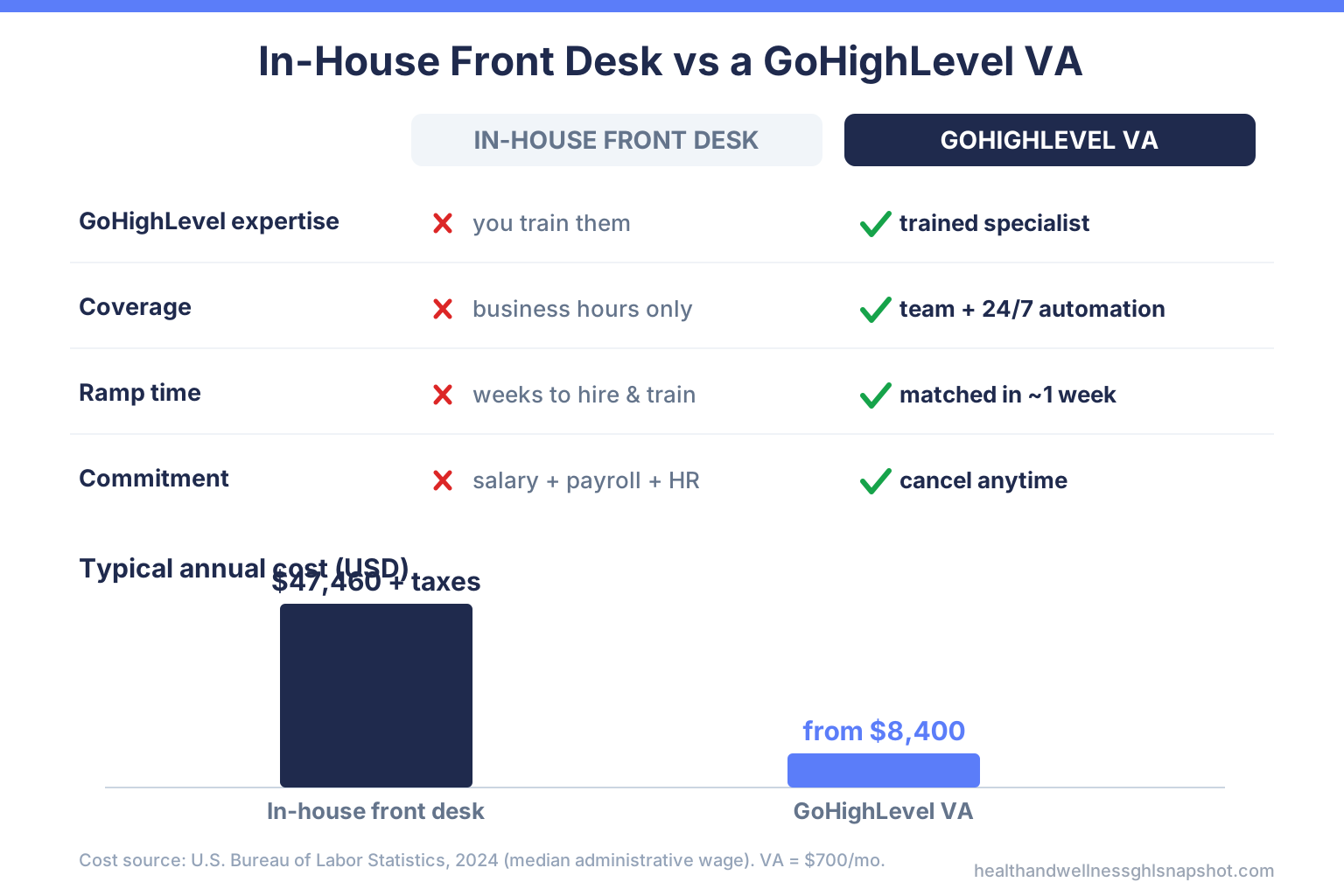
None of this means an in-house receptionist is wrong for everyone — a high-volume clinic with heavy in-person, front-desk needs may want both. But if the job is really “keep my GoHighLevel running and my leads answered,” a specialist VA delivers that skill for a fraction of a fully-loaded salary. We break the staffing question down further in GHL VA vs in-house front desk.
A San Diego coach's Monday, before and after
10 a.m. and she's re-sent two intake forms, chased a declined card, answered four DMs, rebuilt a reminder that didn't fire, and manually texted a ghosted client. The coaching she sells waits behind the admin. Leads from the weekend are still unanswered.
The VA cleared the weekend inbox before she woke up, rescheduled two no-shows, and sent the review requests. Automations fired the reminders. She opens her laptop to a booked calendar and a short PM update — and spends the morning with clients.
Keeping it compliant: HIPAA & TCPA guardrails
Handing admin to a VA in a wellness context means being deliberate about consent, privacy, and what travels over which channel — the guardrails are straightforward, but they’re not optional. A few non-negotiables:
- SMS consent (TCPA). Only text clients who’ve opted in, honor STOP instantly, and respect quiet hours. Consent gates should be built into the workflows so the VA can’t accidentally message a non-consented contact.
- PHI handling (HIPAA-aware). Keep sensitive health information out of insecure channels. A VA operating your system should follow clear rules on what’s discussed over SMS versus a secure portal, and sign a BAA/NDA before access — our VAs are background-checked and NDA-signed before they touch your account.
- Honest health claims (FTC). Marketing copy the VA sends on your behalf must stay within the claims you can substantiate. The VA executes your approved messaging; the clinical and claim responsibility stays with you.
We are not a healthcare provider, and neither a VA nor an automation diagnoses, treats, or advises. The systems are your operational and communication layer, built to be HIPAA-aware; your HIPAA obligations, state licensing, and FTC health-claim compliance remain yours. Used with those guardrails, delegation makes your practice more consistent about consent and privacy, not less — because the rules live in the system instead of in one busy founder’s memory. If you want to see exactly what a wellness VA could take off your plate, book a quick call and we’ll map it to your practice.
Frequently asked questions
Hiring a GoHighLevel wellness VA in San Diego — FAQ
What does a GoHighLevel virtual assistant do for a wellness practice?
A GoHighLevel wellness VA runs the software side of your practice: keeping the calendar accurate and confirming consults, following up fast on new leads across phone, web form, and DMs, answering Instagram and Facebook messages, monitoring reminders and program check-ins, sending and routing review requests, and building and fixing the workflows behind it all. The point is to move the day-to-day coordination off the practitioner so their time goes back to seeing clients.
How much does a wellness VA cost compared to hiring a receptionist?
A dedicated GoHighLevel VA starts at $700/month with no contract, scaling by hours as you grow. A full-time US front-desk or administrative employee earns a median of roughly $47,460 a year before payroll taxes and benefits (U.S. Bureau of Labor Statistics, 2024). For the specific job of running your GoHighLevel and answering leads, the VA delivers trained platform expertise — plus 24/7 automation — for a fraction of a fully-loaded salary, and can be replaced free if the fit isn't right.
Won't training and handing off take more time than it saves?
Upfront, yes — plan on a week of documenting light SOPs (a few short Loom videos and checklists) and onboarding. After that it compounds: every task you hand off returns hours every week thereafter. Most owners recover the setup time within the first month. A good VA service builds the SOPs with you rather than leaving it entirely on your plate, which shortens the ramp.
Is it safe to give a VA access to client health information?
It can be, with the right guardrails. A wellness VA should sign an NDA (and a BAA where applicable), be background-checked before access, and operate under clear rules about what's handled over SMS versus a secure portal — keeping protected health information out of insecure channels. Consent (TCPA) and quiet-hour rules should be built into the workflows themselves. We are not a healthcare provider; your HIPAA and FTC health-claim obligations remain yours, and the VA executes within the boundaries you set.
Do I need a GoHighLevel snapshot too, or just the VA?
They solve different halves of the problem. The snapshot is the system — the pre-built wellness workflows for booking, follow-up, reminders, and reviews. The VA is the operator who runs, monitors, and improves that system. You can hire a VA to run a setup you already have, or start both together so there's a proven machine to operate from day one. Most practices get the fastest results pairing a done-for-you snapshot with a VA to run it.
Written by Anjali Mehta, Wellness Growth Editor. Anjali covers the business of wellness — pricing, delegation, and the operational decisions that decide whether a great practitioner stays small or scales past the founder bottleneck. She has a low tolerance for hype and a preference for honest math. Anjali is a wellness operations and marketing specialist, not a licensed healthcare provider; nothing here is medical, legal, or compliance advice.
Keep reading: GHL VA vs In-House Front Desk (Phoenix) · Speed-to-Lead for Wellness Practices · Reduce Appointment No-Shows · Instagram & Facebook DM Automation (Atlanta)