
It’s 6:50pm. You just capped your last hormone consult, you’re wiping down the drip chairs, and your phone has four new things on it. A DM on Instagram from someone who saw the semaglutide reel: “do you take new patients?” A Facebook message asking your Saturday hours. A Google Business Profile ping: “how much for a Myers’ cocktail?” And a missed call with no voicemail. Four real people who want to give you money, in four different apps, none answered. By the time you get to them tomorrow between patients, two have booked somewhere else.
Here is the answer up front: you don’t have a lead problem, you have a routing problem. The fix is one front door. Every inquiry from Instagram, Facebook, Google, your website, and your phone lands in a single inbox, gets an automatic text reply within seconds, and ends on your booking calendar without anyone at the front desk lifting a finger. The research is blunt about why seconds matter: a Harvard Business Review audit of 2,241 companies found most respond nowhere near fast enough, and firms that reached a lead within an hour were far likelier to qualify it (Harvard Business Review). The follow-on lead-response research put a number on it: qualifying odds about 21 times higher at five minutes than at 30 (via HBR). Below is the whole system, stage by stage, with the exact copy and the places it quietly breaks.
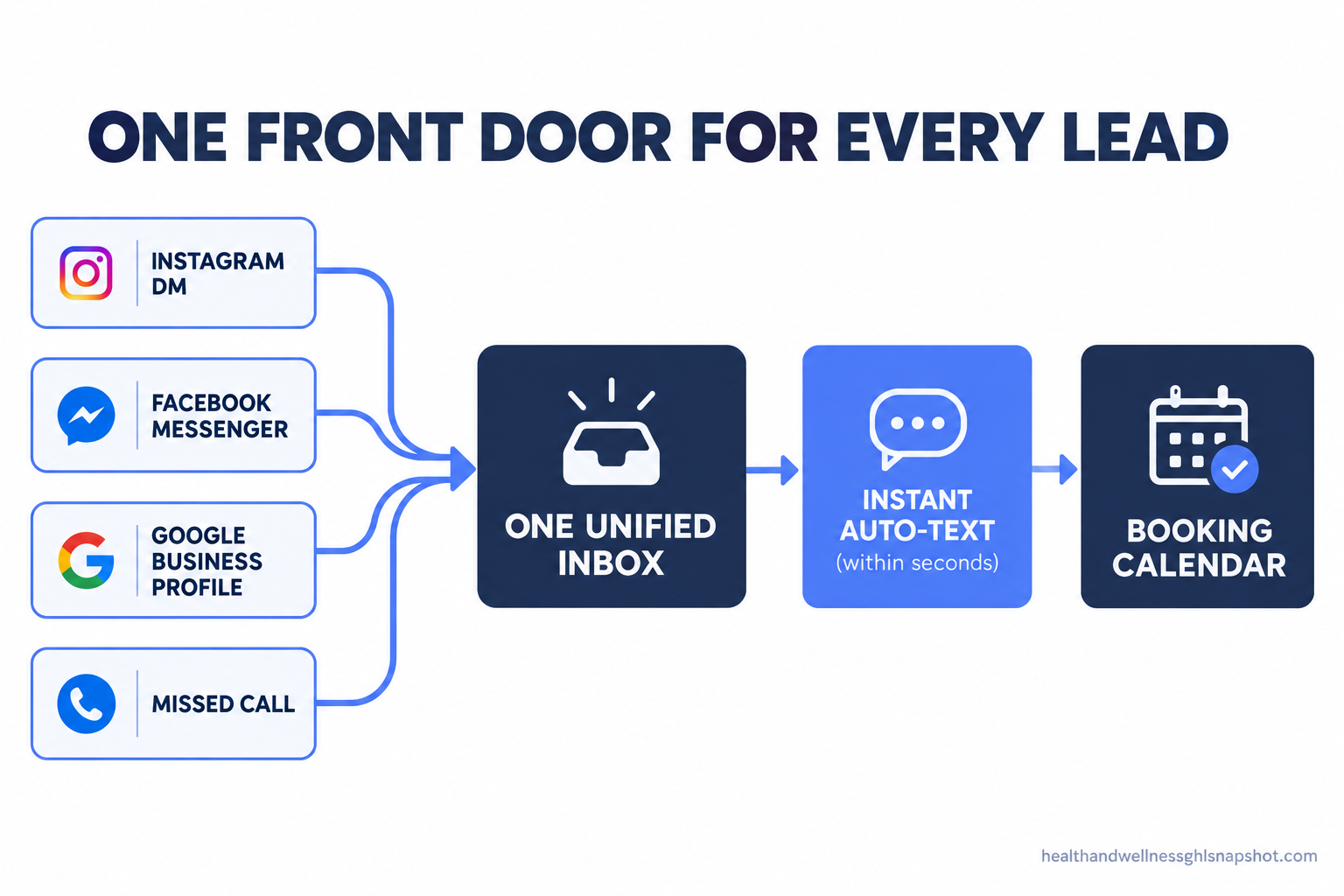
Table of contents
- Why four inboxes is the real problem
- What one slow reply actually costs you
- The seven stages, from DM to booked
- Steal this: the full message set
- Solo bar, three-location clinic, larger group
- Compliance corner: HIPAA, TCPA, and 10DLC
- Objections, answered honestly
- The bottom line
- Frequently asked questions
Why four inboxes is the real problem
You are not losing leads because you aren’t getting enough. You’re losing them because the ones you get land in places a busy clinician can’t watch at the same time.
A new IV, hormone, or weight-loss inquiry in 2026 comes from Instagram (a reel), Facebook (a tagged friend), Google Business Profile (a “near me” search), your website form, and the phone that still rings even though nobody under 40 wants to use it. Each is a separate app, checked by a different person at a different time, if at all.
So the inquiry doesn’t get ignored on purpose. It gets ignored because the Instagram DM is on your personal phone, the Facebook message is on the front-desk laptop, the Google ping goes to an unread email, and the missed call went to a full voicemail box. Studies on unanswered business calls alone put the miss rate anywhere from a quarter to nearly half (JustCall). Stack four channels on that and the question isn’t whether you’re dropping leads, it’s how many. You can’t out-hustle four inboxes. You have to collapse them into one.
What one slow reply actually costs you
The math runs one direction: the faster the first reply, the more leads become paying clients.
The lead-response research is the number to tape to the wall: qualifying odds roughly 21 times higher at five minutes than at 30 (via HBR). Meanwhile the client wants to be texted: more than two-thirds would rather schedule by text than email or phone (Becker’s), and text is now the single most-preferred way to reach a business, ahead of both (EZ Texting).
How consumers prefer to be contacted by a business, share choosing each channel. Source: EZ Texting 2024 Consumer Behavior Texting Report.
The stakes are high in this niche. The average single med-spa location pulled about $1,398,833 in 2023, and repeat patients now drive 73% of visits, up from 65% (AmSpa). A new client isn’t worth one visit. They’re worth a membership, a package, and a year of repeat drips. Lose the first reply and you lose the whole run.
The seven stages, from DM to booked
One lead, one path, seven stages. Each has a job, a piece of copy, and a failure mode. Miss any one and the lead leaks out the side.
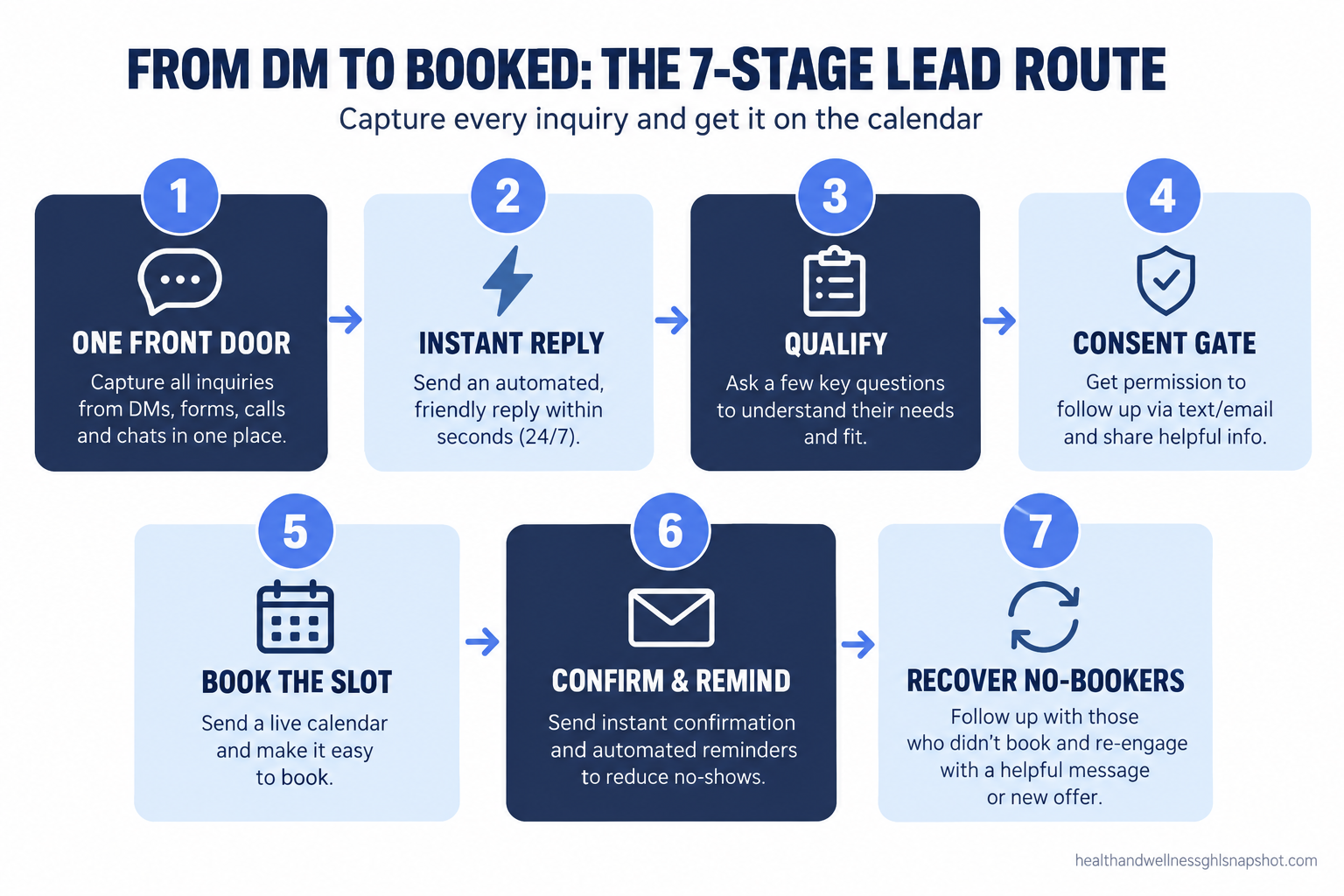
Stage 1, one front door. Pull Instagram DMs, Facebook Messenger, Google Business Profile messages, website forms, and missed calls into one unified inbox, so there’s one place to look and one place automations fire from. Instagram and Facebook route through the Meta integration, Google through its connection, your form posts in, and every missed call triggers a text-back so the call never dies in voicemail. GoHighLevel does this natively, which is why the Wellness Snapshot is built on it. How it breaks: leaving notifications on in the old apps too, so the front desk also answers the DM manually and the client gets two contradicting replies. Make the central inbox the single source of truth, and audit every “contact” button your clinic produces (Google Local Services Ads, TikTok) so no channel is forgotten.
Stage 2, reply in seconds. The moment a lead hits any channel, send one warm, human text within seconds. This is the 21x stage: you can’t reply in five minutes while placing an IV, but an automation replies in five seconds at 2pm or 2am. The first message names the clinic, sounds like a person, and asks one thing. For the research behind the five-minute line, see speed to lead for wellness practices. How it breaks: a wall of text (keep it two sentences and one question), or the same generic reply on every channel. Branch the first reply by channel.
Stage 3, qualify in three questions. New or returning? What are you interested in (drip, weight-loss consult, hormone eval, injectable)? Mornings or afternoons? That’s enough to route them and give the provider context. Branching does the sorting: a returning client skips to the booking link, a new weight-loss lead goes to the longer consult, a drip walk-in to the quick-visit calendar. How it breaks: interrogation. One question per message, conversational, or they bail. And don’t over-qualify, the point is routing, not rejection, so when in doubt, book.
Stage 4, the consent gate. Capture a clean, logged SMS opt-in before anything that counts as marketing, inside the natural flow. Marketing texts require prior express written consent, logged and tied to a disclosure (FCC). A client who messages you first can consent in the conversation, as long as you disclose who you are, that they’re opting into texts, that frequency varies and rates may apply, with STOP to opt out. How it breaks: treating an inbound DM as permission to drop them in a weekly promo blast. An inbound message is permission to reply to that conversation, not to market. See HIPAA-aware SMS for wellness practices.
Stage 5, the right calendar. Put a booking link in front of a qualified, consented lead that lands them on the correct calendar for their service and provider, with real availability, so they self-schedule in one tap. A new weight-loss lead shouldn’t see your 15-minute drip calendar, they should see the 30-minute new-patient consult with the provider who runs that program. The system knows the bucket from Stage 3, so the link arrives pre-filtered. How it breaks: a generic calendar showing every service and provider, so the client has to decode your internal structure (they won’t), or stale availability that double-books. Sync to the real provider calendars, set buffers, and cap daily volume.
Stage 6, confirm then remind. The second a slot is booked, confirm it, then send a short reminder sequence that heads off the no-show without nagging: immediate confirmation with date, time, address, and prep, then a day-before and a morning-of reminder, each with an easy reschedule option. See how to reduce appointment no-shows. How it breaks: reminders with no way to act (if they can’t reschedule in one tap, they no-show), or so many reminders clients tune them out. Two or three, each useful.
Stage 7, recover the no-bookers. Catch the leads who replied, maybe opened the calendar, but didn’t pick a slot: a nudge a few hours later and another the next day, then into longer nurture, not the hard sell. See client reactivation campaigns. How it breaks: recovering too aggressively, three texts in an hour reads as desperate and earns a STOP. Space them, and know when to let the lead rest.
Steal this: the full message set
Here is the actual copy, verbatim. Swap in your clinic and service names and go.
Solo bar, three-location clinic, larger group
Same seven stages, three different shapes. The routing logic scales, but what it routes to changes.
Illustrative: approximate number of distinct booking calendars a clinic maintains (by service and provider) as it grows. Your count depends on service mix and staffing.
Solo cash-pay IV bar, one location. You’re the clinician and the front desk. The system mostly covers you when you can’t answer: one inbox on your phone, an instant auto-reply on every channel, one or two calendars (quick drip, longer new-client), and a missed-call text-back. You don’t need heavy branching yet. The win is simple: the lead that came in while you had a needle in someone’s arm gets answered in seconds and books itself, and that one fix often pays for the whole system in a month.
Three-location hormone and weight-loss clinic, NP-owned. This is where routing earns its keep. Multiple providers, multiple services, three sets of hours. Qualifying sorts by location as well as service, and the booking link lands the client on the right provider’s calendar at the right site. The front desk watches one shared inbox instead of nine apps. Get calendar routing wrong here and you’ll send a Scottsdale client to the Phoenix calendar, so test every branch before you trust it.
Larger group, injectables and memberships at scale. At five or more locations the system is an operations backbone. Leads route by location, service, and sometimes language, often with a live answering service or AI receptionist feeding the same inbox so nothing forks. Reporting matters now: reply times, booking rates, and recovery rates by location so you see which site leaks. The logic is identical to the solo bar, there’s just more of it.
Compliance corner: HIPAA, TCPA, and 10DLC
Three rules sit on top of lead routing in a healthcare-adjacent business. None should scare you off. All should shape how you build it.
HIPAA. Whether you’re covered depends on your setup. A clinic that bills insurance or shares protected health information with covered partners like labs or referring physicians is covered. A pure cash-pay IV bar with no insurance billing may fall outside HIPAA, but still owes state privacy and breach-notification duties, so never assume the exemption (HHS). Practical rule: keep clinical detail out of SMS. A lead text says “let’s get you booked,” never a condition, a medication, or a result.
TCPA. Marketing texts require prior express written consent, logged and tied to a disclosure, with statutory damages of $500 to $1,500 per violating message (FCC). That’s why the Stage 4 consent gate is non-negotiable, and why transactional booking texts stay separate from marketing blasts.
10DLC. This is the carrier registration layer, separate from the TCPA. To send business texts to US mobile numbers reliably, your number must be registered through the campaign registry, or carriers heavily filter or block your messages. Health messaging draws tighter scrutiny than retail, so register before you send a single lead text, or your routed system quietly delivers to nobody.
Objections, answered honestly
“Won’t an instant auto-text feel robotic?” Only if you write it like a robot. A two-sentence text that names your clinic and asks a real question reads as fast service. The alternative isn’t a warm human reply in five minutes, it’s silence until tomorrow. Clients forgive a quick automated text. They don’t forgive being ignored.
“I already pay for Boulevard or Jane. Why add this?” Because your booking software books. It doesn’t capture a lead sitting in an Instagram DM, reply in seconds, qualify, and hand it back ready to book. This layer feeds your scheduler, it doesn’t replace it. For how the core platforms compare on features, see Boulevard vs Mangomint.
“Do I need to be technical?” No. You need it set up correctly once, then it runs. The branching, the consent gate, and the calendar routing are the fiddly parts, exactly what a pre-built system handles so you don’t have to.
“My front desk already texts people back.” When they’re at the desk, awake, and not slammed, sure. The leaks happen at 6:50pm, on Saturdays, and during the lunch rush, which is exactly when leads come in. A system doesn’t take breaks, and your front desk should be closing warm, booked leads, not playing whack-a-mole across four apps.
The bottom line
Your leads aren’t the problem. The four inboxes are. When every inquiry lands in one place, gets a human-sounding reply in seconds, clears a real consent gate, and drops onto the right calendar, the 6:50pm scramble disappears and the client who messaged while you had a needle in someone’s arm books themselves before they shop a competitor.
Build it stage by stage, test every branch, and get the consent and 10DLC pieces right before you send. Back to that Tuesday evening: same four messages, but this time each got a text back before you’d finished the second chair, two have picked a slot for next week, and the Google price-asker is mid-conversation with a booking link in hand. You didn’t touch your phone once.
Frequently asked questions
How do I get Instagram and Facebook leads into my booking system?
Connect your Instagram and Facebook accounts to a platform with a unified conversations inbox (GoHighLevel does this through the Meta integration). Every DM then lands in the same place as your other channels, can trigger an instant auto-reply, and can route the lead to a booking calendar. The key is one central inbox so a DM never sits unseen on a personal phone.
How fast should a wellness clinic reply to a new lead?
As close to immediately as possible. Lead-response research found the odds of qualifying a lead were roughly 21 times higher at five minutes than at 30. A human can't reliably hit five minutes while seeing patients, which is why an automated first text that fires in seconds is the only practical way to win the speed game.
Is it legal to auto-text a lead who messaged my clinic?
Replying to a conversation the client started is generally fine as a transactional response. But marketing texts require prior express written consent under the TCPA, with damages of $500 to $1,500 per violating message. Build a clear opt-in with disclosure into your capture flow, keep transactional and marketing streams separate, and register your number for 10DLC so carriers deliver your texts.
Do I need HIPAA-compliant texting to route leads?
At the lead stage, the safest rule is to keep all clinical detail out of SMS, so booking logistics only. Whether your clinic is HIPAA-covered depends on your setup: billing insurance or sharing PHI with covered partners makes you covered, while a pure cash-pay IV bar may fall outside HIPAA but still owes state privacy duties. Never discuss conditions, medications, or results over text regardless.
Will this replace my booking software like Boulevard or Jane?
No. This is a lead capture and routing layer that feeds your scheduler, not a replacement. It handles the part your booking software doesn't: grabbing a lead out of a DM or a missed call, replying instantly, qualifying, and handing a ready-to-book client to your calendar. Your existing scheduler still owns the actual appointment.
What does a system like this cost to set up?
You can build it yourself on a platform like GoHighLevel, which takes time and technical setup for the branching, consent, and calendar routing. Or you can install a pre-built version: the Wellness Snapshot ships all seven stages ready to go for a one-time $997, with no per-location fees and no cut of your bookings.