
A Phoenix nutrition coach adds a front-desk hire to answer the phone, book consults, and chase no-shows. The offer letter says $38,000. The real number the practice pays — once benefits, payroll tax, hiring, and the risk of that person leaving in a year are added — is closer to $58,000, and it still leaves the phone unanswered every night and weekend. Meanwhile a trained GoHighLevel virtual assistant, paired with automation that never sleeps, starts at $700 a month.
For most Phoenix wellness practices, a GoHighLevel virtual assistant plus automation costs roughly 70–85% less than a full-time in-house front-desk employee and covers the hours a single person physically can’t — because the true cost of an employee is far higher than their salary, while a VA carries no benefits load, no hiring fee, and no turnover risk. This comparison lays out the sourced cost math, shows exactly where the in-house number balloons, and gives an honest account of the one thing an in-house person still does better. Every figure below is cited.
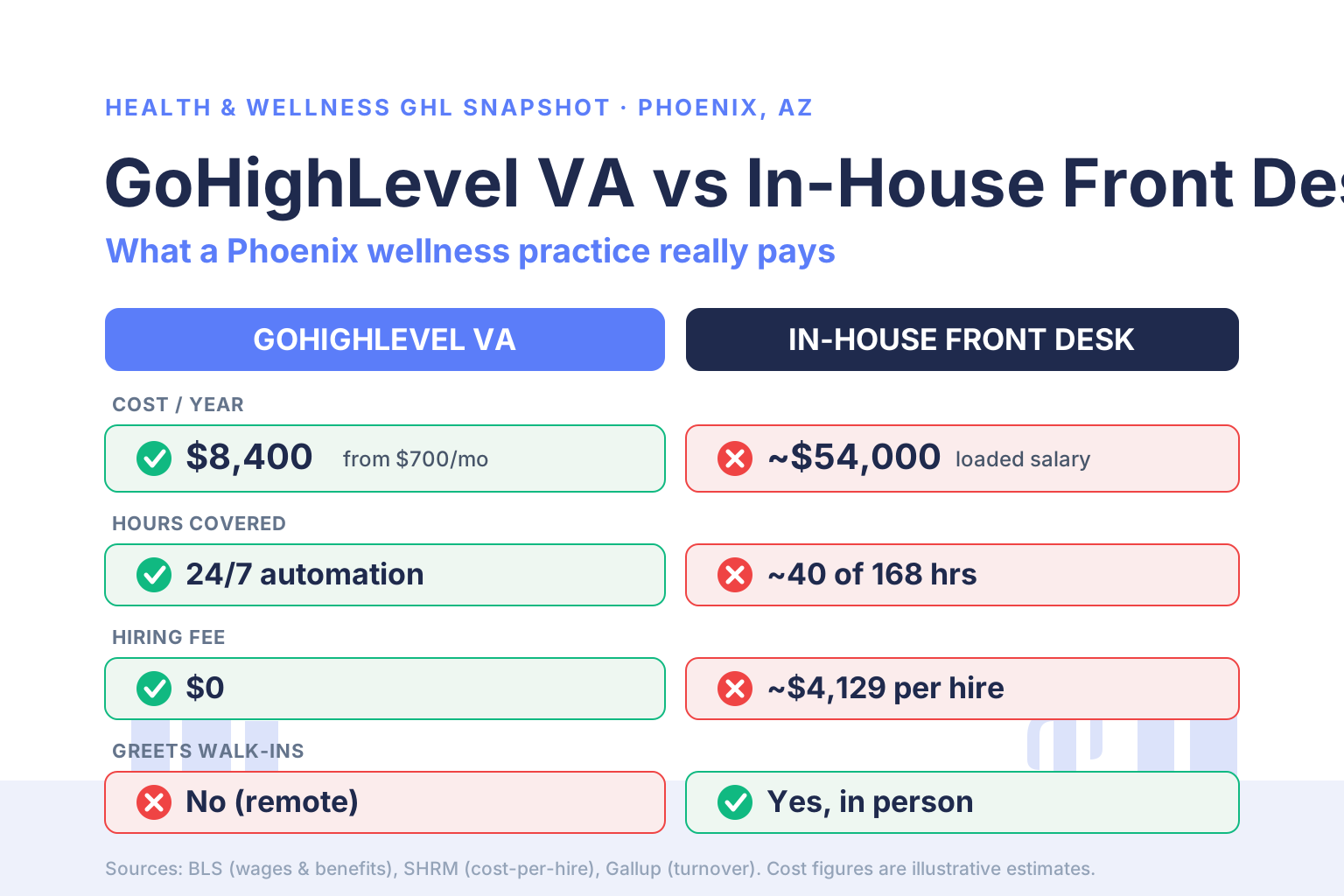
Table of contents
- The two options at a glance
- What a Phoenix front-desk hire actually costs
- What a GoHighLevel virtual assistant costs
- The hidden gap: hours covered and speed-to-lead
- The honest case for keeping an in-house person
- What most Phoenix wellness practices should do
- Frequently asked questions
The two options at a glance
Both roles answer the phone, book consults, and follow up — but they cost, cover, and scale completely differently. Here is the head-to-head for a typical Phoenix wellness practice: a solo or small-team nutrition, functional-medicine, hormone, or weight-loss practice that lives and dies on booked consultations and kept renewals.
| What you’re comparing | In-house front desk (Phoenix) | GoHighLevel VA (Wellness Snapshot) |
|---|---|---|
| Recurring cost | ❌ |
✅ From $8,400/yr ($700/mo) |
| One-time hiring cost | ❌ ~$4,129 average cost-per-hire | ✅ $0 |
| Turnover exposure | ❌ 0.5–2× salary to replace | ✅ None — we cover and replace staff |
| Payroll tax, PTO, sick days, insurance | ❌ You pay all of it | ✅ None — flat monthly, cancel anytime |
| Hours the role covers | ⚠️ ~40 of 168 hrs/week (~24%) | ✅ Mon–Fri delivery plus 24/7 GHL automation |
| Time to productive | ❌ Weeks of GHL training | ✅ Wellness-niche GHL experts, ~5-day start |
| Greets walk-ins / in-person hospitality | ✅ Yes | ❌ No (remote) |
| Builds & runs GHL automations | ⚠️ Only if you train them | ✅ Core skill — funnels, check-ins, no-show recovery |
| HIPAA-aware SMS / TCPA / A2P setup | ⚠️ Needs training | ✅ Done routinely |
The pattern is consistent: the in-house hire wins on physical presence, and the VA wins on cost, coverage, and GoHighLevel skill. The rest of this article is the sourced math behind those rows.
What a Phoenix front-desk hire actually costs
The salary you offer is the smallest part of what a front-desk employee costs — the true number is roughly 40–55% higher before you’ve paid a single recruiting fee. Start with the wage. Nationally, receptionists earned a median of about $17.90 an hour, or roughly $37,240 a year, in May 2024 (BLS Occupational Outlook Handbook). Phoenix tracks close to that: market data puts a Phoenix “Receptionist I” at about $39,781 a year (Salary.com), with medical-office receptionists running higher. Call it a $38,000 base for a wellness front-desk role — a fair Phoenix midpoint.
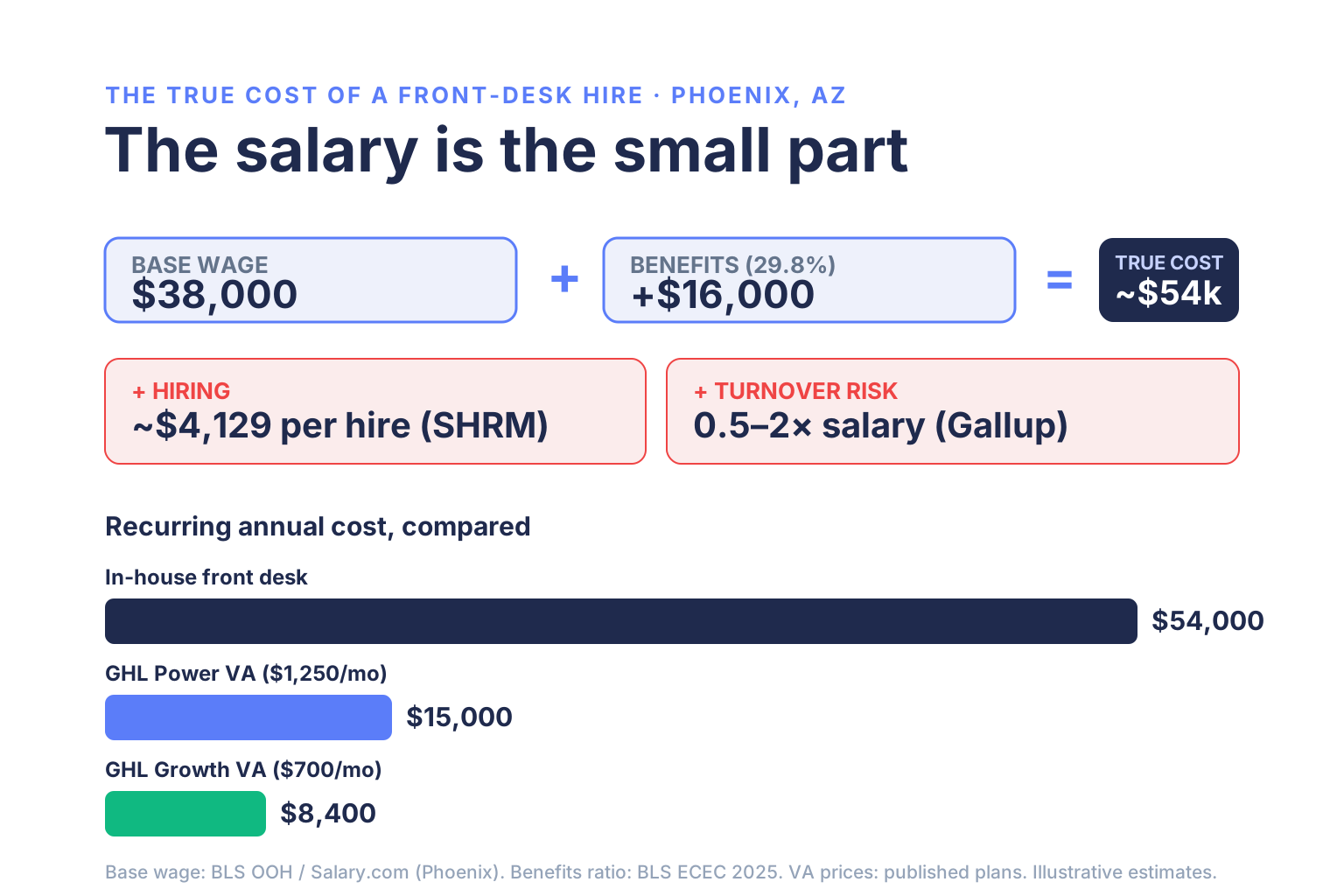
Now the part most owners forget. According to the Bureau of Labor Statistics’ Employer Costs for Employee Compensation, wages and salaries make up only about 70.2% of what a private-industry employer actually spends on an employee; benefits — payroll taxes, insurance, paid leave, retirement — account for the other 29.8% (BLS ECEC, June 2025). Apply that ratio and a $38,000 wage becomes about $54,000 in true annual cost before anyone answers a single call.
Then layer the costs that don’t show up on a pay stub:
- Hiring. SHRM’s benchmarking puts the average cost to fill a role at $4,129 (SHRM) — job ads, screening, interviewing, and your own hours. SHRM’s more recent updates place it higher still.
- Turnover. Front-desk roles turn over often. Gallup estimates the cost of replacing an employee at one-half to two times their annual salary — and calls that “a conservative estimate” (Gallup, 2019). At half a salary, one departure is another ~$19,000.
- Ramp-up. A new hire doesn’t know your GoHighLevel account, your intake flow, or your HIPAA-aware SMS rules on day one. Weeks of your time go into training before they’re independent.
Stack it up and a “$38,000 hire” is a $58,000+ first-year commitment — and that assumes they stay.
Estimated recurring annual cost (USD). In-house = $38k Phoenix base wage loaded with the BLS 29.8% benefits ratio; VA figures are our published plan prices. Excludes the in-house-only one-time hiring cost ($4,129, SHRM) and turnover risk (0.5–2× salary, Gallup). Sources: BLS OOH, BLS ECEC 2025.
What a GoHighLevel virtual assistant costs
A wellness-trained GoHighLevel VA is a flat monthly line item with none of the loading that inflates an employee — no benefits, no payroll tax, no PTO, no hiring fee, no turnover exposure. With the Hire a Wellness VA service, the plans are simple and published:
- GHL Growth Expert — $700/mo: 4 hours/day, Monday–Friday (~80 hours/month). Part-time power for a solo or growing practice.
- GHL Power Expert — $1,250/mo: 8 hours/day (~160 hours/month). A full-time expert for a scaling clinic — the most popular plan.
- GHL Elite Expert + Dev — $1,500/mo: a full-time expert plus a developer for practices that want custom builds.
- Pay-as-you-go hourly for one-off fixes, no contract or minimum.
At $700/month, that’s $8,400 a year — roughly one-seventh the true cost of the in-house hire. Even the full-time Power plan at $1,250/month ($15,000/year) lands well under half of a loaded front-desk salary, and it comes with no recruiting, no benefits administration, and no risk of being back at square one when someone quits. If a VA leaves, that’s our problem to solve, not yours — coverage and replacement are built into the service.
Just as important is what the VA does. A front-desk employee who’s never touched GoHighLevel needs training to build a discovery-call funnel, wire up missed-call text-back, or set up HIPAA-aware SMS consent. A wellness GHL VA has done those dozens of times across a network of practices — so the automation that actually drives bookings gets built in days, not learned over months.
The hidden gap: hours covered and speed-to-lead
The cost gap is only half the story — the coverage gap is the other half, and it’s where practices quietly lose the most revenue. A full-time employee covers about 40 of the 168 hours in a week — roughly 24%. The remaining 76% — evenings, early mornings, weekends — is exactly when a prospective client, finally off work, searches “functional medicine near me Phoenix” and fills out a form or calls. If your front desk is dark, that lead waits.
And waiting is expensive. In a Harvard Business Review audit of 2,241 U.S. companies, firms that contacted a web lead within an hour were nearly 7× more likely to qualify it than those who waited even an hour longer — and more than 60× more likely than firms that waited 24 hours (HBR, 2011). An earlier MIT/InsideSales study found responding within 5 minutes rather than 30 made a lead 21× more likely to be qualified (MIT/InsideSales Lead Response Management Study). Speed isn’t a nicety in wellness — it’s the difference between a booked consult and a client who went to the clinic that answered first.
Relative likelihood of qualifying an online lead by first-response time (baseline = a 24-hour-plus response). Firms contacting within 1 hour were ~7× the “an hour later” group and ~60× the 24-hour group. Source: Harvard Business Review, “The Short Life of Online Sales Leads,” 2011 (audit of 2,241 U.S. companies).
This is the real argument for pairing a VA with automation instead of relying on a single person. A GoHighLevel VA doesn’t just work business hours — they build and run the automations that respond instantly, 24/7: an AI chat widget and AI caller that answer after hours, missed-call text-back that fires in seconds, and no-show recovery that runs on nights and weekends without anyone clocking in. One employee gives you 40 hours of human coverage; a VA plus automation gives you 40 hours of expert human work and 168 hours of instant response. That’s a level of coverage no single Phoenix hire can match — the same speed-to-lead advantage we cover in our AI receptionist playbook.
The stakes are only rising. The U.S. wellness economy reached roughly $2.1 trillion in 2024, growing about 7.9% a year (Global Wellness Institute, 2024). In a fast-growing, competitive Phoenix market, the practice that answers first and follows up relentlessly wins the client — and that’s a coverage problem, not a hospitality one.
The honest case for keeping an in-house person
A GoHighLevel VA is the right call for most Phoenix wellness practices — but not all, and pretending otherwise would be the kind of hype this brand avoids. There are real situations where an in-person front desk earns its cost:
- Your front desk is about in-person hospitality. If clients arrive for physical appointments — a hands-on functional-medicine clinic, an IV lounge, a med-spa — someone has to greet them, warm up the room, and hand them the intake iPad. A remote VA can’t do that. Keep the person for presence, and let the VA run the phones, CRM, and automation behind them.
- High walk-in or retail volume. Practices with a steady stream of unscheduled visitors or on-site product sales need a body at the desk. The economics shift when the role is genuinely physical.
- You have compliance reasons for on-site handling of certain records. Some clinical workflows are easier to keep entirely in-house. A good VA works within your HIPAA-aware boundaries, but if your comfort level requires everything on-premises, that’s a legitimate choice.
Notice the shape of the honest answer: it’s rarely “one or the other.” The highest-leverage setup for many growing practices is a lean in-person presence plus a GoHighLevel VA — the human handles the room, the VA handles the system, and automation handles the 128 hours a week nobody is at the desk.
A Phoenix wellness practice, before and after
One full-time front-desk hire at ~$54,000 loaded, plus benefits admin and the constant risk of turnover. Phones ring out every evening and weekend, no-shows slip through, and after-hours leads book with the clinic that answered first. Every GHL change waits on someone learning the platform.
A lean setup: a wellness GHL VA from $700/mo runs the funnels, check-ins, reviews, and pipeline, while automation answers instantly 24/7. Consults book after hours, no-shows get recovered on autopilot, and the practice pays a flat monthly line item with no benefits load and no turnover exposure.
What most Phoenix wellness practices should do
For the large majority of Phoenix wellness practices — solo coaches and small clinics whose front desk is really a phone, a calendar, and a follow-up system — a GoHighLevel VA plus automation is the better economic and operational choice. It costs a fraction of a loaded salary, covers hours a single person can’t, and brings GoHighLevel skill an untrained hire would spend months acquiring.
The practical playbook is simple: if your front desk work is mostly digital — answering, booking, reminding, following up, and running the CRM — start with a wellness VA and let automation handle after-hours speed-to-lead. If your practice depends on in-person hospitality, keep a lean human presence and put a VA behind it to run the system. Either way, the goal is the same one every growing practice needs: no lead unanswered, no consult unbooked, and no renewal lost to a desk that was empty when it mattered. If retention is your bigger leak, pair this with our retention benchmarks; if it’s local visibility, start with local SEO for wellness practitioners.
Frequently asked questions
GoHighLevel VA vs in-house front desk — FAQ
How much does a front-desk employee really cost a Phoenix wellness practice?
More than the salary. Nationally, receptionists earned a median of about $17.90/hour (~$37,240/year) in May 2024 (BLS), and Phoenix tracks close to that (~$39,781 for a Receptionist I per Salary.com). But wages are only about 70.2% of what an employer actually pays — benefits add the other 29.8% (BLS Employer Costs for Employee Compensation, 2025). That turns a ~$38,000 wage into roughly $54,000 in true annual cost, before a ~$4,129 average hiring cost (SHRM) and turnover risk of 0.5–2× salary (Gallup).
How much does a GoHighLevel virtual assistant cost?
The Hire a Wellness VA plans start at $700/month for a part-time GHL Growth Expert (4 hours/day), $1,250/month for a full-time GHL Power Expert (8 hours/day), and $1,500/month for an expert-plus-developer plan, with pay-as-you-go hourly available. At $700/month ($8,400/year), a VA is roughly one-seventh the true cost of a loaded full-time front-desk hire — with no benefits, payroll tax, hiring fee, or turnover exposure.
Can a virtual assistant replace my front desk entirely?
It depends on what your front desk really does. If the role is mostly phones, booking, reminders, follow-up, and running your CRM, a GoHighLevel VA plus automation can cover it — and cover it 24/7. If your front desk is fundamentally about greeting in-person clients, a remote VA can't do that; the best setup is usually a lean in-person presence with a VA running the system behind it.
Why does 24/7 coverage matter so much for booking clients?
Because a single employee only covers about 40 of the 168 hours in a week (~24%), and most 'near me' wellness searches happen in the evenings and weekends when the desk is closed. Speed decides the booking: firms that contact a web lead within an hour are nearly 7× more likely to qualify it, and more than 60× more likely than those who wait 24 hours (HBR, 2011). A VA builds automation that answers instantly, around the clock — coverage no single hire can match.
Is a GoHighLevel VA HIPAA-aware for wellness communications?
Our wellness VAs are trained on the compliance quirks of health & wellness GHL — HIPAA-aware SMS, TCPA/A2P consent gates, and health-category ad restrictions — and work within your practice's boundaries. That said, each licensed practitioner remains responsible for their own HIPAA obligations, clinical claims, and state compliance; the VA sets up compliant workflows, but the accountability for your client communications stays with you.
Written by Anjali Mehta, Wellness Growth Editor. Anjali covers the business of wellness — pricing, staffing, and the operational decisions that decide whether a great practitioner stays small or scales. She has a low tolerance for hype and a preference for honest math. Anjali writes about wellness-practice growth and marketing technology; she is not a licensed healthcare provider, and nothing here is medical, legal, or tax advice. Cost figures are illustrative estimates built from the cited public sources.
Keep reading: Speed to Lead: Why the First 5 Minutes Decide the Client · Missed-Call Text-Back for Wellness Practices · The AI Receptionist Playbook for Wellness Practices · Reduce Appointment No-Shows · Wellness Client Retention Benchmarks