A prospective client in Atlanta watches your Reel about cortisol and belly fat at 9:15 p.m., taps your profile, and sends a DM: “Do you work with hormone stuff? How much is your program?” Two other people comment “price?” under the same post. You’re asleep, or with family, or seeing clients the next morning — so the DM sits unread until lunchtime, and the comments never get a reply at all. By the time you answer, that first person has already messaged two other Buckhead practices and booked with whoever replied first. You never knew you were in a race.
Atlanta wellness practices don’t lose these leads because their offer is weak — they lose them because Instagram DMs and Facebook comments arrive after hours and in volume, and a human can’t answer fast enough to beat the competitor who automated it. This is a plain-language look at where those leads leak, the sourced cost of a slow (or missing) reply, and how instant DM and comment automation books the consult while the intent is still hot — without you living in your inbox. Every statistic below is sourced, and the honest caveats run throughout.
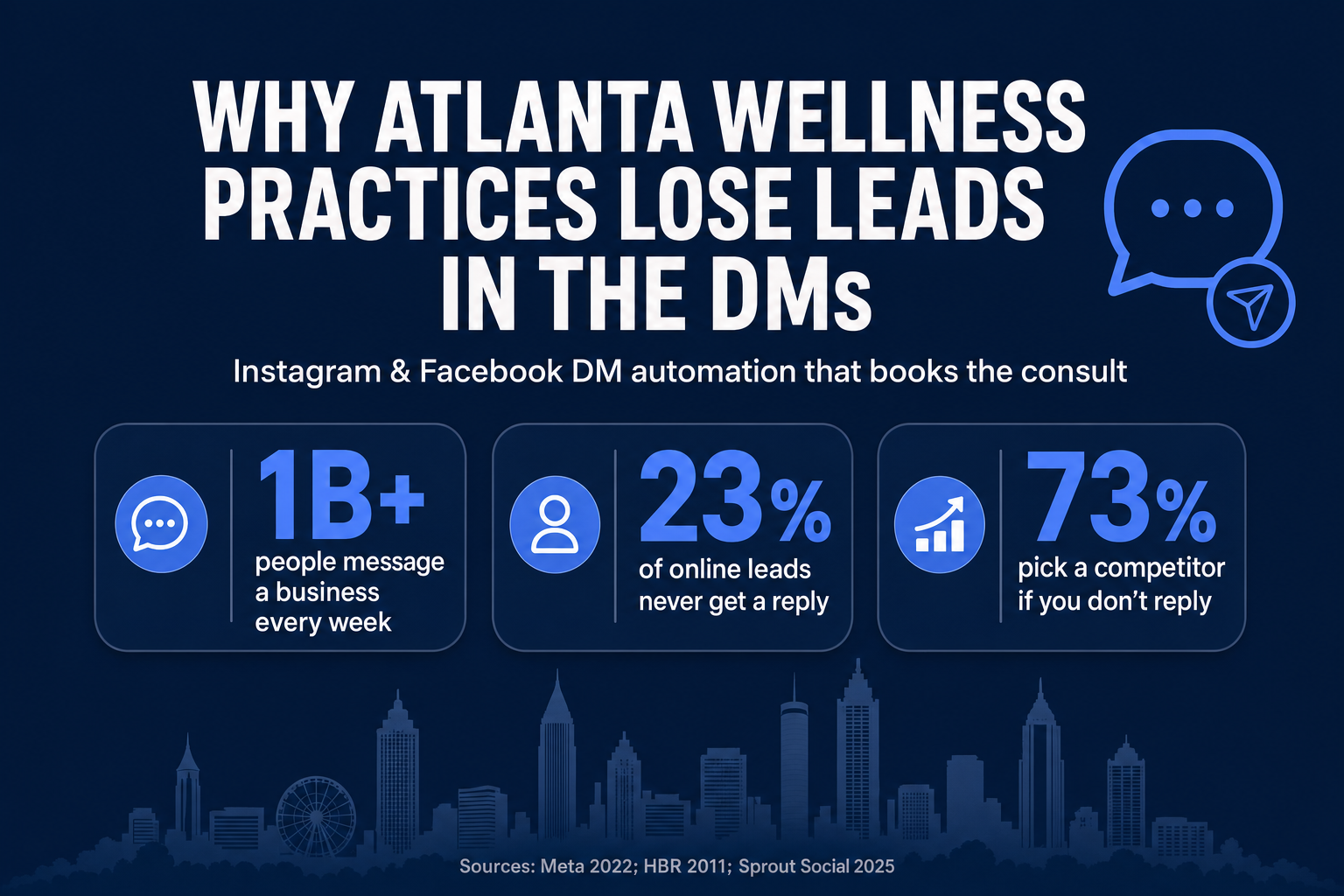
Table of contents
- Why Atlanta wellness leads now arrive in the DMs, not the phone
- The real cost of a slow (or missing) reply
- The four places Atlanta practices leak DM and comment leads
- How DM and comment automation plugs the leaks
- What consumers now expect — and how fast
- Is DM automation compliant? HIPAA, TCPA, and Meta’s rules
- Who should — and shouldn’t — automate their DMs
- Frequently asked questions
Why Atlanta wellness leads now arrive in the DMs, not the phone
In 2026, a wellness client’s first contact is almost never a phone call — it’s a DM or a comment. They found you on Instagram or Facebook, watched a video, and messaged you the way they message everyone else in their life: by typing, not dialing. The scale of that shift is hard to overstate. More than 1 billion people message a business every week across Meta’s apps, and 150 million people have a conversation with a business on Instagram every single month (Meta, 2022). By late 2023, people and businesses were exchanging over 600 million chats a day on Meta’s platforms (Meta via TechCrunch, 2023). This isn’t a fad — consumers have wanted it for years: 9 out of 10 said they’d rather message with a business than call it back when the trend was just starting (Twilio, 2016).
Atlanta sharpens the pressure. The metro’s most active wellness submarkets — Buckhead, Sandy Springs, Midtown, Alpharetta — are dense with nutrition coaches, hormone and functional-medicine clinics, and med spas competing for the same scroll. And demand keeps climbing: the US wellness economy reached roughly $2.1 trillion in 2024, the largest in the world at about $6,293 per person (Global Wellness Institute, 2024), and the medical-spa segment alone grew from 8,899 US locations in 2022 to 10,488 in 2023 (American Med Spa Association, 2024). More practices, more content, more DMs — and the same 24 hours in your day. When a motivated Atlanta client sends “how much?” to three practices, the one that answers first usually wins, and lately that’s whoever automated the reply.
The real cost of a slow (or missing) reply
The problem isn’t that you ignore your DMs on purpose — it’s that inbound leads go cold faster than any solo practitioner can keep up with. The most-cited study on this audited 2,241 US companies and found the average response time to an online lead was 42 hours. Only 37% responded within an hour, another 16% took between one and 24 hours, 24% took longer than a day, and a full 23% never responded at all (Harvard Business Review, 2011). A wellness DM that says “do you take my situation?” has an even shorter shelf life than a B2B web form — that person is anxious, motivated, and shopping right now.
How fast businesses actually respond to an inbound online lead (% of 2,241 companies audited). Nearly a quarter never reply at all. Source: Harvard Business Review, 2011.
Speed isn’t a nice-to-have; it’s the whole ballgame. The classic Lead Response Management study — nearly 15,000 leads and 100,000+ call attempts analyzed with MIT — found that contacting a new lead within 5 minutes rather than 30 minutes made you about 100× more likely to connect and 21× more likely to qualify that lead (Lead Response Management / MIT, 2007). The odds fall off a cliff in the first half hour.
Relative odds of qualifying a new lead by how fast you respond (30-minute reply = baseline of 1). Source: Lead Response Management / MIT, 2007.
Now layer on the social-specific expectation: 73% of consumers expect a brand to respond on social within 24 hours, and 73% say that if a brand doesn’t respond to them on social, they’ll simply buy from a competitor (Sprout Social Index, 2025). A DM you answer at noon the next day isn’t “a little late” — for most people, it’s already lost.
The four places Atlanta practices leak DM and comment leads
Almost every lost DM lead traces back to one of four specific leaks. Naming them is the fastest way to see where automation earns its keep:
- Comments that never become conversations. Someone comments “price?” or “does this work for PCOS?” under your Reel. That’s a raw, public buying signal — and it usually dies in the comments because you didn’t see it, or answering everyone publicly felt like too much. Every unanswered comment is a warm lead you let walk.
- After-hours DMs. Wellness content performs at night and on weekends, which is exactly when you’re off the clock. The DM lands at 9 p.m.; you see it at 11 a.m.; the moment is gone. Meta’s platforms host 600 million+ business chats a day (Meta via TechCrunch, 2023) precisely because people message on their schedule, not yours.
- No qualification, so good leads and tire-kickers look identical. When you finally reply, you’re starting from zero — asking their goal, their situation, whether they’re local to metro Atlanta. That back-and-forth takes hours across a slow DM thread, and motivated people lose patience.
- No clear next step. Even a great DM conversation stalls if it ends with “let me know if you want to chat” instead of a live booking link. The gap between interested and booked is where most consults quietly evaporate.
How DM and comment automation plugs the leaks
DM and comment automation is a set of rules that watch your Instagram and Facebook for buying signals and respond in seconds — reply, qualify, and book — then hand a genuinely interested person to you. It is not a spam bot blasting strangers. It’s a front desk for your social inbox that never sleeps. Here’s the flow that turns a 9 p.m. comment into a booked consult.
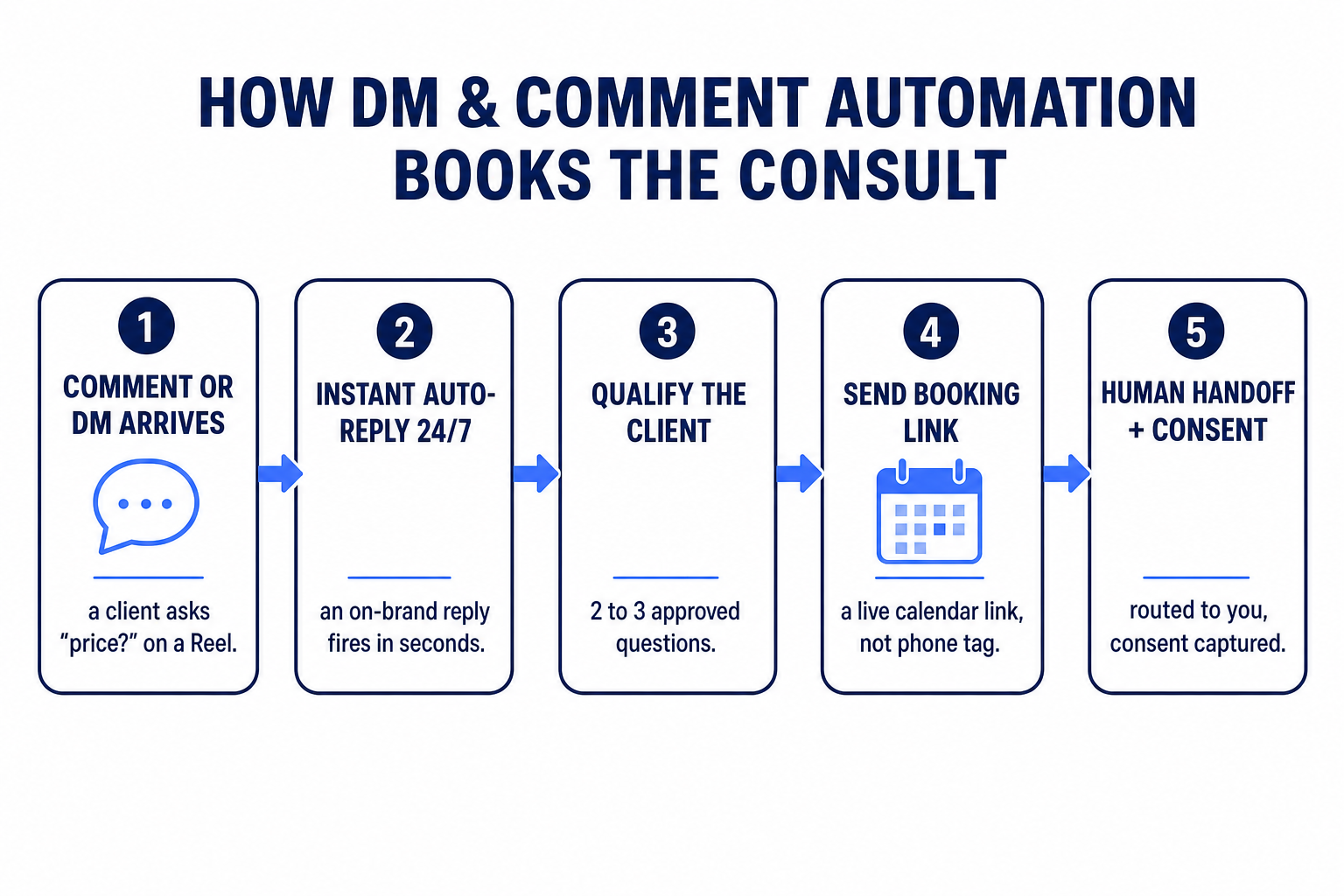
- Comment-to-DM. When someone comments a trigger word (“price,” “info,” “PCOS”) on a post or Reel, the system replies publicly and slides into their DMs with the answer and a next step — catching the leak in Step 1 above automatically.
- Instant DM auto-reply, 24/7. A new DM gets a helpful, on-brand response in seconds, at any hour, so the after-hours message that used to sit until lunch now gets acknowledged before the person closes the app. This is the same Instagram DM automation and Facebook Messenger automation that ship inside the Wellness Snapshot.
- Qualify while intent is hot. The automation asks two or three approved questions — goal, situation, are you in the Atlanta area — so by the time a human is involved, you already know if it’s a fit.
- Send the booking link. Instead of “DM me for details,” a qualified person gets a live calendar link and books the consult themselves. No phone tag, no waiting.
- Human handoff + consent. Anything nuanced, sensitive, or high-value is routed to you with the full context, and the system captures messaging consent so your follow-up stays compliant.
Answering DMs by hand vs. running a system
A Reel pops at 9 p.m., three people comment 'price?', two send DMs. You see them at 11 a.m. You reply, ask their goal, wait hours for each answer, then say 'let me know if you'd like to book.' One already started with someone else; the others go quiet.
The second a comment or DM lands, an on-brand reply fires, asks two qualifying questions, and drops a booking link — 24/7. You wake up to three consults on the calendar and a short list of qualified people to personally message.
The point isn’t to sound like a robot; it’s to make sure no warm lead waits on a human who’s asleep or with a client. A viral post about gut health at midnight is a party — automation makes sure someone’s at the door.
What consumers now expect — and how fast
Consumer patience for a slow reply has effectively hit zero, and the data is blunt about it. People want to message businesses, they expect a fast answer, and they’ll move on without one. Pair the messaging preference (9 in 10 want to message with businesses, Twilio, 2016) with the 2025 expectation data, and the mandate is obvious: be there when they message, or lose them to whoever is.
This is also why DM automation compounds with the rest of your funnel. Fast social replies pair naturally with fast phone follow-up — the same principle behind our speed-to-lead playbook and missed-call text-back — and with a content engine feeding the top of the funnel, covered in our Instagram lead-gen guide and the Reels-first social system. The DMs are where all that attention either converts or dies.
Is DM automation compliant? HIPAA, TCPA, and Meta’s rules
Automation done right is more compliant than manual messaging, not less — because the rules are enforced by the system every time instead of relying on you remembering them. Three guardrails matter for a wellness practice:
- Meta’s 24-hour messaging window. Instagram and Messenger let businesses reply freely within 24 hours of a user’s message; outside that window, only approved message types are allowed. Good automation respects this automatically, so you stay in Meta’s good standing.
- TCPA / SMS consent. The moment a DM conversation moves to text or email, you need consent. The automation captures and logs it at the point of hand-off, exactly as covered in our HIPAA-aware SMS guide, so your follow-up is documented and opt-out-ready.
- HIPAA-aware content. DMs are not a place for protected health information. Well-built flows keep the automated replies to scheduling and general education — “let’s book a consult to talk through your goals” — and route anything clinical to a private, appropriate channel. You teach the mechanism, not a diagnosis.
Who should — and shouldn’t — automate their DMs
DM and comment automation is the right move for most Atlanta wellness practices — but not every one, and pretending otherwise would be the hype this brand avoids. A few honest cases:
- You’re getting DMs and comments you can’t keep up with. If posts generate questions faster than you can answer them, or leads regularly go cold overnight, this is the highest-leverage fix you can make. Turn it on.
- You barely post yet. Automation converts attention you already have; it can’t manufacture it. If your feed is quiet, start with a content system first, then automate the inbox once the DMs are flowing.
- You love the personal touch and have the time. If answering every DM yourself genuinely energizes you and you can do it fast, keep doing it — just add automation for after-hours and comment-to-DM so nothing leaks while you sleep. The failure mode isn’t caring too much; it’s caring at 11 a.m. about a message that arrived at 9 p.m.
- Your bigger leak is elsewhere. If clients book but don’t show, or don’t renew, fix that first — a dedicated wellness VA can run the DMs, the calendar, and the follow-up as one operation while you focus on care.
For the large majority — an Atlanta practice that’s building an audience and losing warm leads in an inbox they can’t watch 24/7 — automating DMs and comments is the difference between a busy feed and a full calendar.
Frequently asked questions
Instagram & Facebook DM automation for Atlanta wellness practices — FAQ
What is Instagram and Facebook DM automation for a wellness practice?
It's a set of rules that watch your Instagram and Facebook for buying signals — a new DM, or a comment with a trigger word like 'price' — and respond in seconds: reply on-brand, ask two or three qualifying questions, and send a booking link, 24/7. Anything sensitive or high-value is handed to a human with the conversation's context and messaging consent captured. It's a front desk for your social inbox, not a bot that messages strangers.
Why do Atlanta wellness practices lose so many leads in the DMs?
Because wellness content performs at night and on weekends — exactly when a solo practitioner is off the clock — and inbound leads go cold fast. Across 2,241 companies, the average response to an online lead was 42 hours and 23% never replied at all (HBR, 2011), while 73% of consumers now expect a social reply within 24 hours and 73% will buy from a competitor if ignored (Sprout Social, 2025). A human can't beat those clocks alone.
Isn't automated messaging spammy or against Instagram's rules?
Not when it's built correctly. It only responds to people who message you or comment on your posts — never cold outreach — and it respects Meta's 24-hour messaging window, replying freely within 24 hours of a user's message and using only approved message types after. Done right, it's more compliant than manual messaging because the rules are enforced automatically every time.
Is DM automation HIPAA compliant?
The automation itself keeps replies to scheduling and general education and routes anything clinical to a private, appropriate channel, so protected health information stays out of DMs. It captures and logs consent before any conversation moves to SMS or email (TCPA). That said, the Wellness Snapshot is a marketing and operations tool, not a healthcare provider — each licensed practitioner remains responsible for HIPAA and FTC health-claim compliance in their own communications.
How fast does automation actually reply compared to doing it by hand?
In seconds, at any hour. That speed is the whole point: replying to a lead within 5 minutes instead of 30 makes you about 21× more likely to qualify it (Lead Response Management / MIT, 2007). An automated reply catches the 9 p.m. DM before the person closes the app, where a manual reply the next morning usually arrives after they've already booked elsewhere.
How much does it cost to automate DMs and comments for my practice?
The Instagram DM and Facebook Messenger automations ship inside the Wellness Snapshot, or you can have it run for you: the done-for-you social media service is $397/month for one brand (up to four brands for $997/month) and includes three AI agents for Instagram/Facebook DMs and comments, website chat, all nine channels, and monthly reporting, white-label, with 15 days notice to cancel.
Written by Kwame Adeyemi, GHL Snapshot Engineer. Kwame builds and stress-tests the workflows that ship inside the Wellness Snapshot — DM triggers, comment automation, SMS consent gates, and the quiet failure modes that lose a practice a booking. He translates technical GoHighLevel mechanics into language a busy practitioner can act on. Kwame writes about automation and marketing technology; he is not a licensed healthcare provider, and nothing here is medical advice.
Keep reading: How to Get Wellness Clients From Instagram · Social Media for Wellness Practices: A Reels-First System · Speed to Lead: Why the First 5 Minutes Decide the Client · Missed-Call Text-Back for Wellness Practices