
A prospective client in The Heights opens her phone at 9pm and, instead of typing “functional medicine near me” into Google, she asks ChatGPT: “Who are the best functional-medicine practitioners in Houston for gut health, and what do they charge?” In three seconds she has a short, confident list of three names, a sentence on each, and a rough price range. Your practice is either one of those three names — or it isn’t. She never saw a search-results page, never scrolled past ten blue links, and never clicked an ad. The comparison happened inside an AI answer, and you weren’t in the room.
This is the fastest-moving shift in how Houston wellness clients find a provider, and the numbers are no longer small: roughly 68% of U.S. Google searches now end without a click, 45% of consumers used an AI tool like ChatGPT or Gemini to find a local business in the past year, and 34% of U.S. adults have already used an AI chatbot for a health-related task (SparkToro; BrightLocal; Pew Research Center). Being on page one of Google is no longer the whole game. Being the practice an AI quotes is. Every number below is cited.
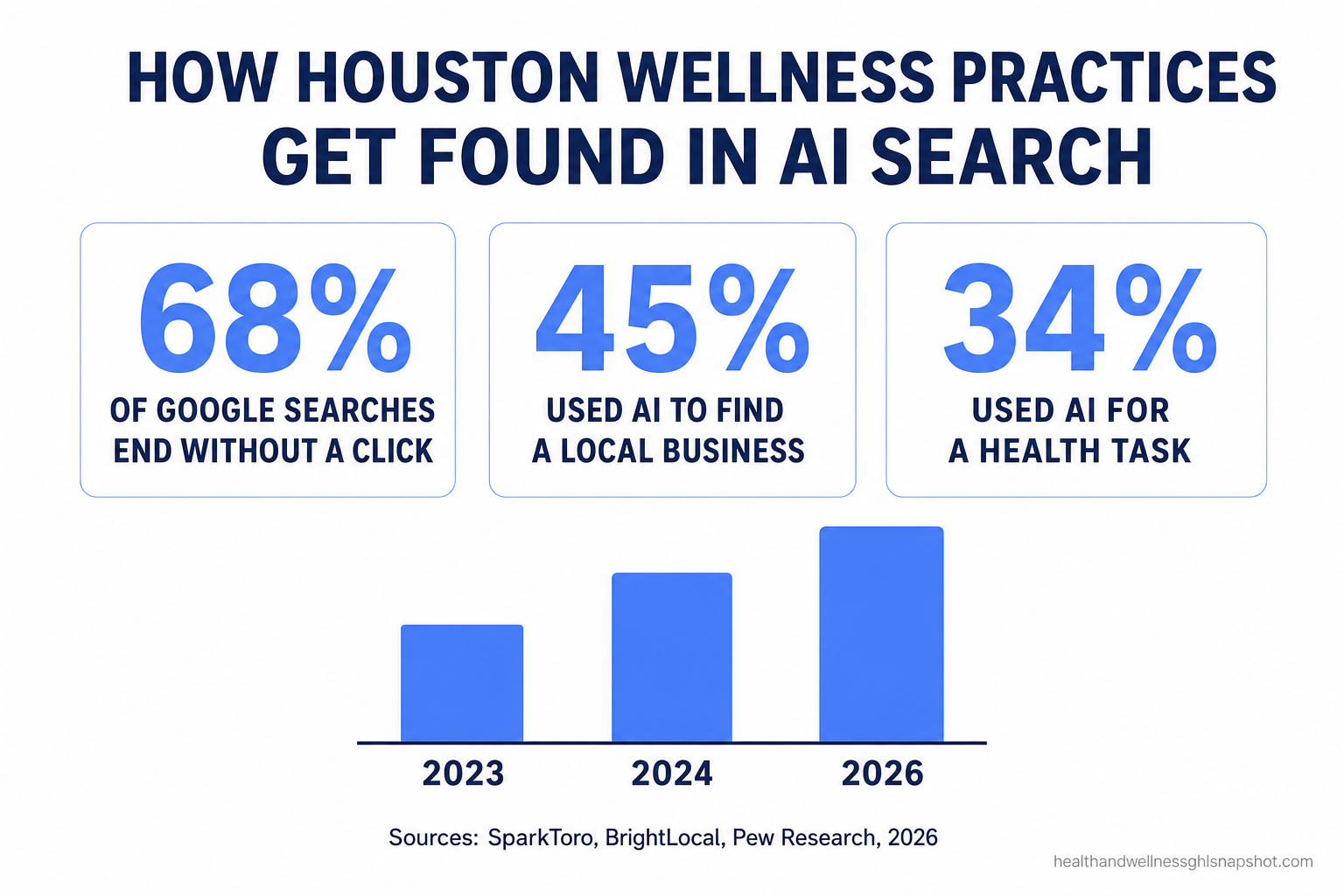
Table of contents
- What is AEO, and why can’t Houston wellness practices ignore it?
- How Houston clients actually search now
- What AI search quietly costs your practice
- How AI answer engines decide who to cite
- The AEO checklist for a Houston wellness practice
- What to do next
- Frequently asked questions
What is AEO, and why can’t Houston wellness practices ignore it?
Answer Engine Optimization (AEO) is the practice of structuring your website so AI answer engines — ChatGPT, Perplexity, Google’s AI Overviews, and Gemini — can find, understand, and quote your content when someone asks a question. Traditional SEO optimizes to rank a page in a list of links. AEO optimizes to be the sentence the AI reads back to a person who never sees that list. For a Houston nutrition coach or functional-medicine clinic, the difference is concrete: SEO gets you into the “functional medicine Houston” results page; AEO gets your name into the answer when a prospect asks an assistant to just tell them who to call.
This matters now because the front door to your practice has moved. Google’s AI Overviews — the AI-generated summary at the top of many results — reshaped search behavior through 2025, appearing on a rising share of queries (peaking near 24.6% of searches in mid-2025 before settling around 15–16% later in the year) (Semrush data, via Search Engine Land). Meanwhile ChatGPT crossed 800 million weekly active users by October 2025 (OpenAI, via reporting), and 49% of U.S. adults now say they use AI chatbots — up from 33% a year earlier (Pew Research Center). Your future clients aren’t a fringe of early adopters. They’re half the adults in Harris County.
How Houston clients actually search now
Houston clients increasingly ask an AI a full question — “which gut-health clinic in Houston takes my situation seriously and what does a program cost?” — and act on the answer, often without ever visiting a search results page. Houston is the fifth-largest U.S. metro, with about 7.8 million people and the city itself near 2.4 million (U.S. Census Bureau). It’s a young, mobile, tech-comfortable market, and health is one of the fastest-adopting AI use cases: 34% of U.S. adults have used a chatbot for a health task, most commonly to get quick information (28%) or understand symptoms (25%), and 47% call the answers very or extremely helpful (Pew Research Center).
The broader adoption curve is steep. The share of Americans using AI chatbots roughly doubled in two years.
Share of U.S. adults who use AI chatbots, by year. Source: Pew Research Center, “Americans and AI 2026.”
Crucially, AI has become a genuine local-discovery channel, not just a homework tool. In BrightLocal’s 2026 survey, 45% of consumers said they’d used an AI tool such as ChatGPT, Gemini, or Perplexity to find a local business in the past year, making AI the third most-used discovery channel behind Google and Facebook — ahead of Yelp and TripAdvisor (BrightLocal). When a prospect asks “who’s a good hormone-balance practitioner in Houston,” the assistant answers with real business names. Those names came from somewhere — and AEO decides whether one of them is yours.
That said, providers still matter most for trust: when Americans look for health information, 85% turn to healthcare providers and 66% to people with similar health experiences, while 36% use social media and 22% use AI chatbots (Pew Research Center). The takeaway isn’t “AI replaces you.” It’s that AI is now the introduction — the step that decides whether a Houston prospect ever reaches your booking page at all.
Where U.S. adults get health information (share using each source at least sometimes). Source: Pew Research Center, April 2026.
What AI search quietly costs your practice
The cost of ignoring AI search is invisible in your analytics: it’s the prospect who got a confident answer that didn’t include you, and who never generated a click, a session, or a lead for you to see. This is the zero-click problem, and it’s now the majority case. SparkToro’s 2026 clickstream analysis found roughly 68% of U.S. Google searches ended without a click on any result — up from about 60% in 2024 — meaning only around 276 of every 1,000 searches now reach the open web (SparkToro). When Google shows an AI Overview specifically, Ahrefs’ study of 300,000 keywords found the top-ranking organic result received about 34.5% fewer clicks (Ahrefs).
So a Houston wellness practice can do everything right on classic SEO — rank #1 for “nutrition coach Houston” — and still watch a third of that hard-won visibility get absorbed into an answer box the prospect reads and moves on from. If your practice isn’t structured to be part of that answer, the ranking is worth less every quarter.
There’s an upside for the practices that adapt early: AI-referred visitors are unusually high-intent. Adobe Analytics found generative-AI referral traffic to U.S. retail sites jumped roughly 1,200% year over year, and that visitors arriving from AI sources converted at rates about 31% higher than other channels — because they arrive pre-qualified, having already gotten a recommendation (Adobe). A prospect an AI sent to your booking page has, in effect, already been told you’re a good fit. Those are the easiest consults you’ll ever get — if you’re the one being recommended.
How AI answer engines decide who to cite
AI answer engines cite sources that are easy to read, explicitly structured, and quotable — content with clear claims, cited statistics, and machine-readable markup — not the pages with the most keywords. This isn’t guesswork. A Princeton-led study, “Generative Engine Optimization” (KDD 2024), tested optimization tactics across roughly 10,000 queries and found that GEO methods could increase a source’s visibility in AI-generated answers by up to 40% (arXiv). The tactics that moved the needle most were consistent and, helpfully, honest ones:
- Cite your sources. Content that references authoritative data was more likely to be pulled into answers. (This very article is built that way on purpose.)
- Add quotable statistics. Specific, sourced numbers give an AI a clean, self-contained sentence to lift.
- Write with clear, authoritative, fluent language. Vague or hedged copy is skipped in favor of confident, well-structured claims.
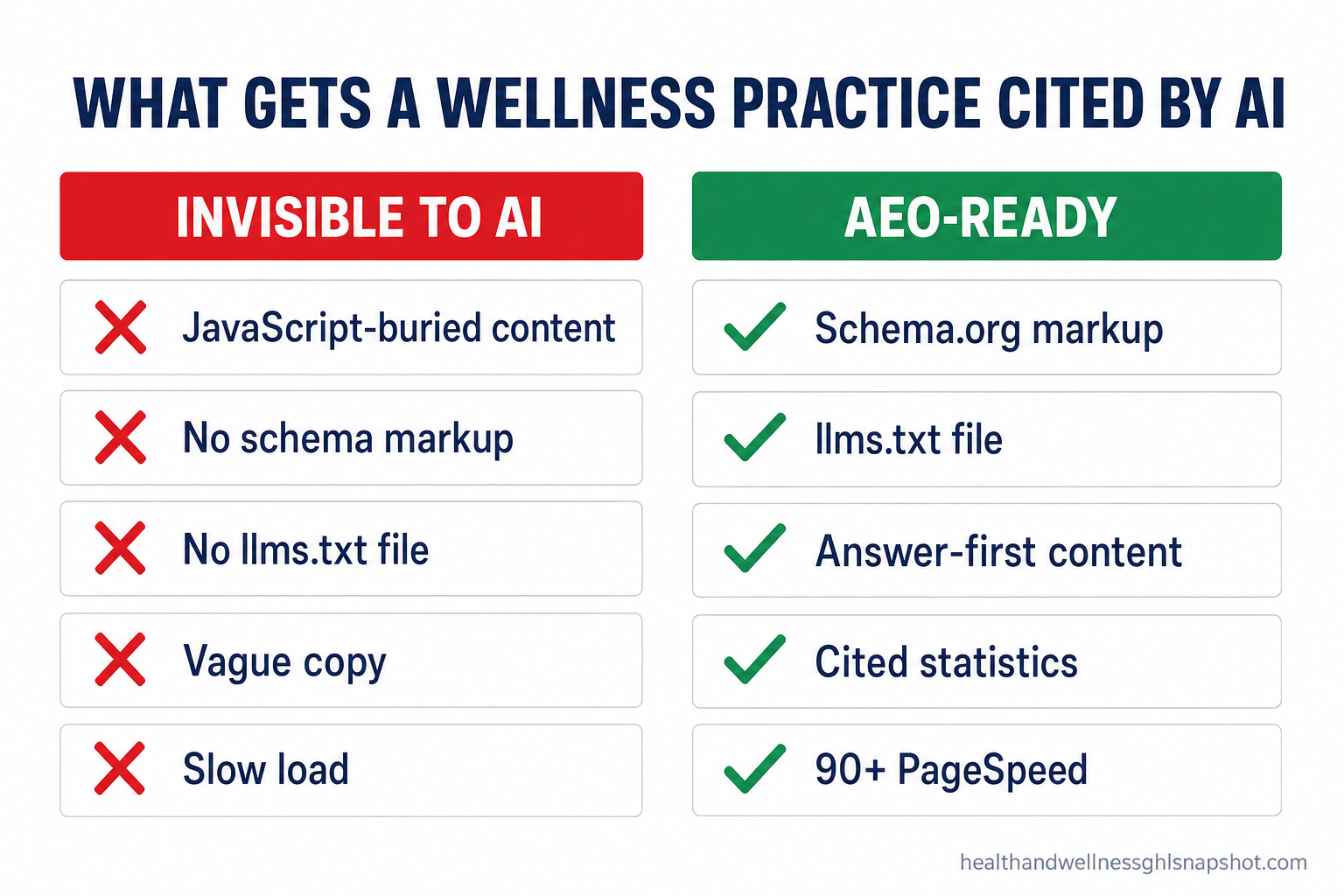
Layer onto that the mechanics AI crawlers rely on to parse a wellness site in the first place: structured data (Schema.org markup like LocalBusiness, Service, FAQPage, and Person), an llms.txt file that tells AI crawlers what your site is and where the important content lives, answer-first passages under question-shaped headings, and a fast, server-rendered page whose content isn’t hidden behind JavaScript. Get those right and you’re not hoping to be cited — you’re making it easy.
The AEO checklist for a Houston wellness practice
To get cited by AI search, a Houston wellness practice needs seven things in place — and most template-built sites are missing five of them. Here’s the working checklist we implement on every site we build:
- Structured data (Schema.org). Mark up your practice as a
LocalBusiness/MedicalBusinesswithareaServedset to Houston and your neighborhoods, plusService,FAQPage, andPersonschema for your practitioners. This is the machine-readable layer AI uses to understand who you are, what you offer, and where. - An
llms.txtfile. A simple, standardized file at your domain root that points AI crawlers to your key pages and describes your practice in plain language. It’s to AI whatsitemap.xmlwas to Google. - Answer-first content under question-shaped headings. Lead each section with a direct, self-contained answer (like every H2 in this post) so an AI can lift a clean, correct passage without stitching fragments together.
- Cited, quotable statistics and specifics. Real numbers, sourced. Vague marketing copy doesn’t get quoted; a clear claim with a citation does.
- Location signals. City and neighborhood names in your titles, headings, and content, plus dedicated location and service pages, so “in Houston” queries resolve to you. (See our local SEO playbook for the Google-side of this.)
- Third-party mentions and reviews. AI cross-checks. A consistent name, address, and phone across the web and a healthy stream of Google reviews raise the odds you’re the recommended name. Our reviews playbook covers the automation.
- A fast, server-rendered site. If your content only appears after heavy JavaScript loads, some AI crawlers won’t see it — and slow pages lose the humans too (see what page speed costs). A static-first build serves clean, complete HTML instantly.
The honest problem: WordPress, Wix, and GoHighLevel page-builder sites make items 1, 2, and 7 genuinely hard. Schema is bolted on via plugins (or absent), llms.txt usually doesn’t exist, and the front end ships a pile of JavaScript. That’s exactly the gap our website build closes.
What to do next
Start by asking the AI yourself. Open ChatGPT and Google, and ask them, as a prospect would: “Who are the best [your modality] practitioners in Houston, and what should I expect to pay?” If you’re not named — or the details are wrong — that’s your baseline, and it’s fixable. From there, the priority order is: get structured data and an llms.txt on your site, rewrite your key pages answer-first with real Houston signals, and keep your reviews and business listings consistent. None of it requires medical claims or hype — just a site built to be read by machines as cleanly as by people.
If auditing schema and hand-writing an llms.txt isn’t how you want to spend your evenings, that’s the whole point of a done-for-you build. Compare the Get-a-Website plans and pricing, or talk to a real human about where your practice stands in AI search today. The clients asking ChatGPT about Houston wellness providers this week aren’t waiting for you to catch up.
Frequently asked questions
What is AEO, and how is it different from SEO?
AEO (Answer Engine Optimization) structures your site so AI answer engines — ChatGPT, Perplexity, Google AI Overviews, Gemini — can find and quote your content when someone asks a question. SEO optimizes to rank a page in a list of links; AEO optimizes to be the answer the AI reads back to a person who may never see that list. They overlap — fast, well-structured, authoritative content helps both — but AEO adds machine-readable structure (schema, llms.txt) and answer-first writing on top of classic SEO.
Do Houston wellness clients really use AI to find a provider?
Increasingly, yes. BrightLocal's 2026 survey found 45% of consumers used an AI tool like ChatGPT or Gemini to find a local business in the past year, making AI the third most-used local-discovery channel. Separately, Pew found 34% of U.S. adults have used an AI chatbot for a health task. Houston is a large, mobile, tech-comfortable metro of about 7.8 million people, so local adoption tracks — or exceeds — the national numbers.
Will AI search hurt my Google rankings?
Not directly — but it changes what a ranking is worth. Roughly 68% of U.S. Google searches now end without a click, and when a Google AI Overview appears the top organic result loses about 34.5% of its clicks (Ahrefs, 2025). You can rank #1 and still lose visibility to the answer box. The fix isn't to abandon SEO; it's to add AEO so your practice is part of the answer, not just the list beneath it.
What is an llms.txt file, and does my wellness site need one?
An llms.txt file is a simple, plain-language file at your domain root that tells AI crawlers what your site is about and where your important content lives — roughly what sitemap.xml did for search engines. It's an emerging standard for AEO. Most template and page-builder sites don't have one. It won't guarantee citations on its own, but it removes friction for the AI crawlers that increasingly decide who gets recommended. Our Get-a-Website build includes one by default.
How much does it cost to make my wellness website AEO-ready?
It depends whether you retrofit or rebuild. Bolting schema plugins and hand-written llms.txt onto a slow WordPress or Wix site is possible but fiddly and often still leaves the JavaScript-and-speed problem. Our done-for-you Get-a-Website build ships schema, llms.txt, answer-first structure, local SEO, and a 90+ PageSpeed score from day one — plans from $97/month plus a one-time build fee you only pay after the site is live and you're happy. See the Get-a-Website page or pricing for details. We don't promise specific citation results — AI answers vary — but the structural foundation is what makes them possible.
About the author
Kwame Adeyemi is a GHL Snapshot Engineer at Health and Wellness GHL Snapshot, based in Austin, Texas. He builds and stress-tests the automation and website infrastructure behind wellness practices — schema, structured data, integrations, and the quiet technical details that decide whether a practice gets found. He translates technical mechanics into language a busy practitioner can actually act on, and has a low tolerance for hype and unsourced claims.