
A prospect in Ballard is scrolling on her phone at 9pm, comparing three Seattle nutrition coaches. She taps your site first. It hangs — a blank white screen, then a slow-stacking hero image — and by the third second she’s already tapped “back” and opened the next result, which loaded instantly. You never got a visit, a form fill, or a chance. Your site didn’t lose her because your programs are worse. It lost her because it was slow.
A slow website costs a Seattle wellness practice real bookings: 53% of mobile visitors abandon a page that takes longer than three seconds to load, bounce probability jumps 32% as load time slips from one to three seconds, and even a 0.1-second speed improvement can lift mobile conversions by 8.4% (Google; Deloitte). For a practice that lives on “near me” search and Instagram taps, page speed isn’t a technical nicety — it’s the difference between a booked discovery call and a client who books with the clinic down the street. Every number below is cited.
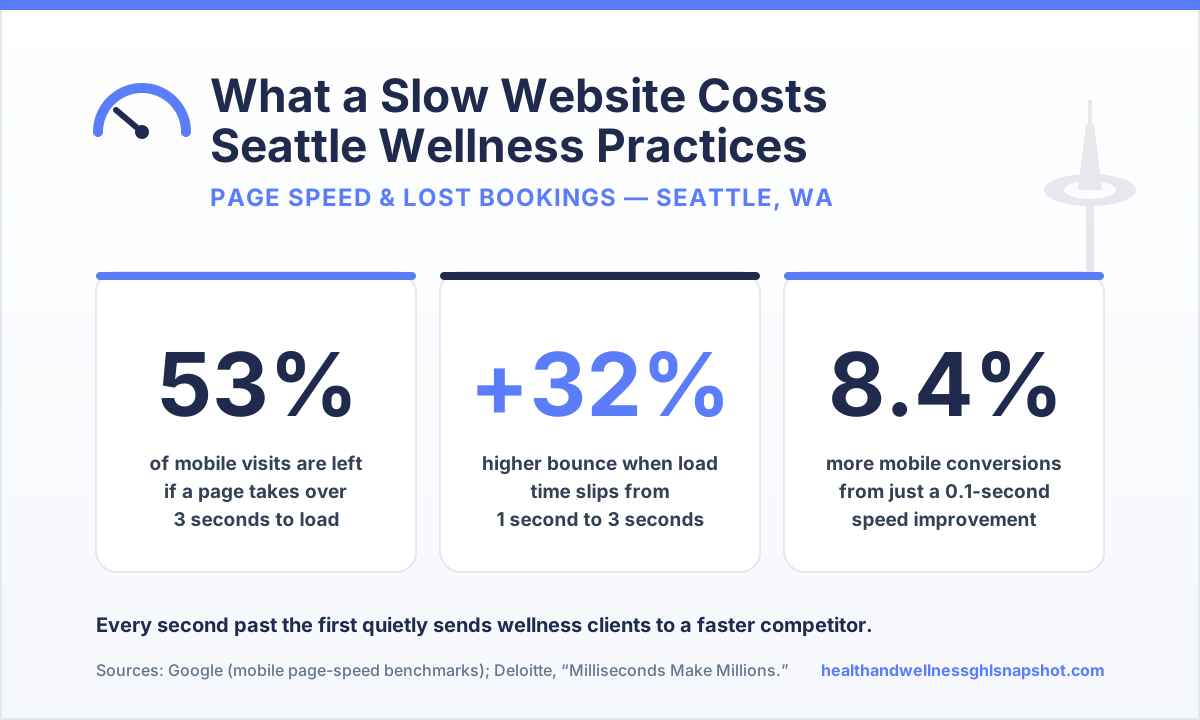
Table of contents
- Why Seattle wellness prospects bounce before they book
- Pain #1 — Every second past the first costs you conversions
- Pain #2 — Google quietly buries a slow site
- Pain #3 — The hidden monthly tax of a bloated site
- Do the math: what a slow site costs your practice
- The fix: a fast, Astro-built wellness site
- Frequently asked questions
Why Seattle wellness prospects bounce before they book
Seattle wellness prospects decide in seconds, on a phone, usually while comparing you against two or three other practices — and a slow first tap ends the comparison before you’re in it. Seattle is a mobile-first, tech-literate market: people expect apps and sites to feel instant, and they have no patience for a spinner. Roughly 60% of web traffic now comes from mobile devices (StatCounter), and mobile is exactly where a typical WordPress, Wix, or GoHighLevel-built wellness site struggles most — plugin bloat, unoptimized hero images, and page-builder JavaScript stack up into a five-to-eight-second load on a real phone on a real cellular connection.
The behavioral data is blunt. Google’s mobile benchmark research found that 53% of mobile site visits are abandoned if a page takes longer than three seconds to load, and that as load time moves from one second to three seconds, the probability of a bounce increases by 32% (Google). Stretch that to five seconds and bounce probability climbs 90%; to six seconds, 106%. This isn’t about a prospect judging your care — most never see your content at all. They see a blank screen, and they leave.
Increase in mobile bounce probability as page load time slows. Source: Google / Think with Google, mobile page-speed benchmarks.
Washington is home to 695,695 small businesses — 99.5% of all businesses in the state (SBA, 2025), and a large share of Seattle’s wellness market — nutrition coaches, functional-medicine clinics, hormone and gut-health practitioners — competes for the same local searches. When several practices show up in a “functional medicine near me” result, the one whose site loads first and cleanest wins the tap. Speed is the tiebreaker you can’t afford to lose.
Pain #1 — Every second past the first costs you conversions
The moment someone does land on your site, each additional second of load time shaves measurable percentage points off your booking rate — and the steepest drop happens in the first five seconds. Portent’s analysis of 94 million pageviews across ten sites found that conversion rates are highest when pages load in zero to two seconds, and that the rate drops by an average of about 0.3% for every additional second of load time, with the falloff getting sharper after the five-second mark (Portent). A site that loads in one second converts dramatically better than the same site at four or five seconds.
The upside of fixing it is just as measurable. In the landmark “Milliseconds Make Millions” study, Google and Deloitte analyzed more than 30 million user sessions across dozens of brands and found that a mere 0.1-second improvement in mobile load time lifted retail conversions by 8.4% and average order value by 9.2%, while lead-generation form submissions jumped 21.6% (Deloitte / web.dev). For a wellness practice, “lead-generation form submission” is a booked discovery call — the exact action your website exists to produce. A tenth of a second is invisible to a human but decisive to your calendar.
This is why speed compounds with everything else you do. If you’re paying for Facebook ads or working hard to get clients from Instagram, a slow landing page taxes every click. And it undercuts your speed-to-lead advantage before the lead is even captured — you can’t be fast to follow up with someone who never made it onto your form.
Pain #2 — Google quietly buries a slow site
Page speed isn’t only a conversion problem — it’s a ranking problem, because Google uses Core Web Vitals as part of how it decides which pages to show for local wellness searches. Google’s page-experience signals incorporate the Core Web Vitals: Largest Contentful Paint (how fast the main content appears), Interaction to Next Paint (how responsive the page feels), and Cumulative Layout Shift (how much the layout jumps around while loading). A “good” LCP is 2.5 seconds or less; a good CLS is under 0.1 (Google / web.dev). A bloated wellness site routinely fails all three on mobile.
The practical consequence for a Seattle practice: when a prospect searches “hormone specialist Seattle” or “gut health coach near me,” Google is weighing your page experience alongside your content and links. A fast, well-structured competitor with the same expertise can outrank you purely because their pages load cleanly and yours don’t. Speed and structure are also increasingly what AI answer engines — Google’s AI Overviews, ChatGPT, Perplexity — can crawl and cite. If your site is slow and thin on schema, you’re invisible in exactly the two places new clients now look. (We break the local-search side of this down in detail in our guide to local SEO for wellness practitioners.)
None of this is fixable with a single plugin. Core Web Vitals reflect how the whole site is built — the framework, the amount of JavaScript shipped, how images are handled, where the pages are served from. A page-builder site that bolts on a “speed optimization” plugin is treating a symptom. The comparison below is what actually separates a slow site from a fast one for a wellness practice:
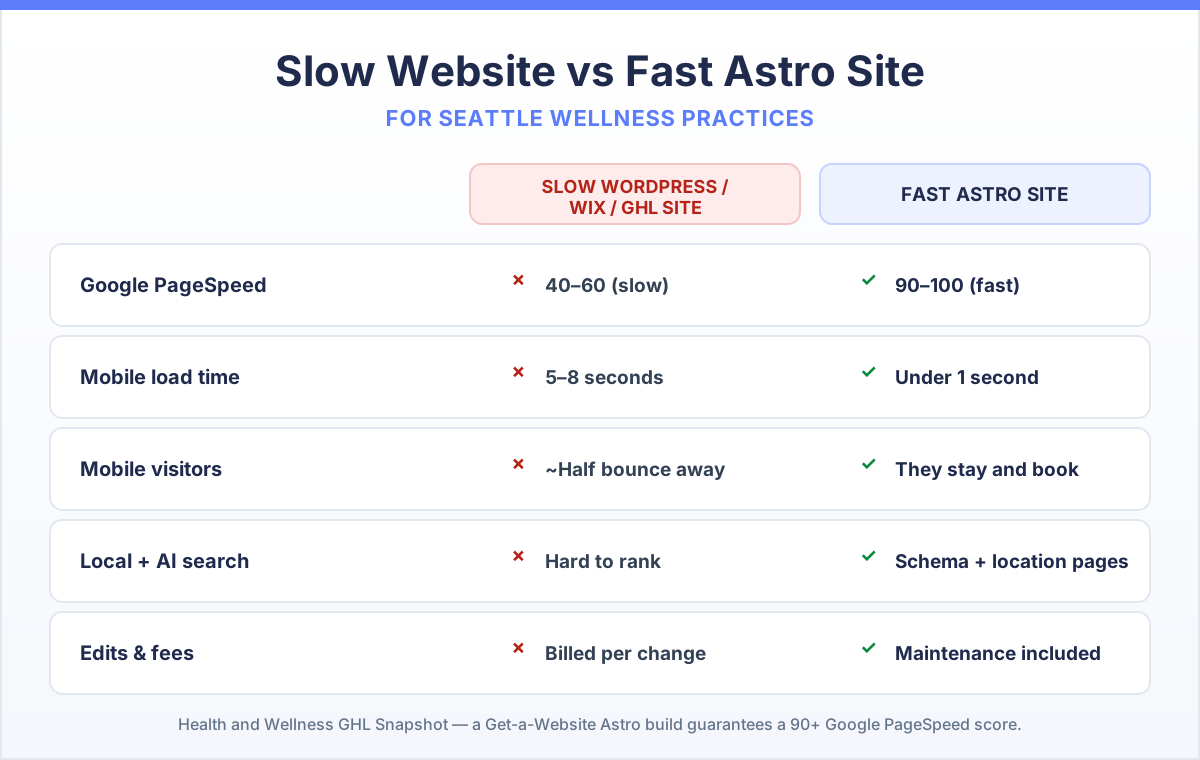
We compared these two builds head-to-head — architecture, editability, and speed — in our deep dive on Astro vs WordPress for wellness websites, if you want the technical side.
Pain #3 — The hidden monthly tax of a bloated site
Beyond lost bookings, a slow, plugin-heavy site charges you a quiet monthly tax in fees, fragility, and time — and it never stops. The typical WordPress or page-builder wellness site accumulates costs that have nothing to do with getting clients: premium plugin licenses, a caching plugin to fight the bloat, an image-optimization plugin, a security plugin because plugins are the attack surface, hosting that gets upgraded every time traffic spikes, and an agency retainer or a “$150/hour, let me get you a quote” bill every time you want to change your program pricing or add a service page.
Then there’s the fragility tax. Plugins update, conflict, and break — often silently, often on mobile, often right after you’ve paid to promote the page. A practitioner discovers the contact form has been down for two weeks only when a prospect emails to say it wouldn’t submit. Every one of those quiet failures is a lost client and an afternoon you spend on tech support instead of clients.
Do the math: what a slow site costs your practice
Put conservative numbers to it and the cost of a slow site stops being abstract. Say your practice gets 1,000 website visitors a month from search, ads, and social — a modest number for an active Seattle practice running any marketing at all. Here’s how speed quietly reshapes the funnel:
| Scenario | Slow site (~6s load) | Fast site (under 1s load) |
|---|---|---|
| Monthly visitors | 1,000 | 1,000 |
| Mobile bounce before render (~half on slow) | ~500 lost | ~120 lost |
| Visitors who actually see your offer | ~500 | ~880 |
| Discovery calls booked (at a 4% booking rate) | ~20 | ~35 |
| New clients (at a 40% consult-to-client rate) | ~8 | ~14 |
The exact figures depend on your traffic and offer, but the shape is real and it’s backed by the data above: roughly half of mobile visitors abandoning a slow page (Google), and conversion rates climbing sharply as load time falls (Portent). If your average wellness program is worth even $1,500 in lifetime value, six extra clients a month is roughly $9,000 in monthly revenue that a slow site is silently handing to faster competitors. That gap dwarfs what you’d ever spend to fix the site.
Illustrative monthly new-client outcome at 1,000 visitors, using published bounce and conversion rates. Sources: Google; Portent. Illustrative, not a guarantee.
Speed also protects the bookings you do earn. A fast, well-structured site pairs naturally with the automations that keep those calls from slipping — instant missed-call and no-show recovery and a 24/7 AI chat widget that answers questions and books consults the moment a fast page earns the visitor’s attention.
The fix: a fast, Astro-built wellness site
The durable fix is to rebuild on an architecture that’s fast by default — a static-first framework like Astro that ships almost no JavaScript and serves pre-rendered pages from a global edge network. Instead of a browser downloading a page builder, a dozen plugins, and megabytes of scripts before anything appears, an Astro page arrives essentially finished. That’s why these builds routinely score 90–100 on Google PageSpeed on both mobile and desktop, with load times under a second — the range where bounce is lowest and conversion is highest.
For a Seattle wellness practice, that translates into concrete wins: a first impression that loads before the prospect can reconsider, Core Web Vitals that clear Google’s “good” thresholds so you rank for local “near me” searches, proper location pages and schema so AI answer engines can find and cite you, and no plugin-bloat tax — hosting, SSL, and maintenance handled, with edits done for you instead of billed by the hour. It’s the same trust signal your calm, credible care deserves: a site that feels as considered as your practice.
Speed isn’t a vanity metric. For a wellness practice that depends on a stranger choosing you over the next result, it’s the first thing your website says — before your credentials, your reviews, or your programs. Make it say fast.
Frequently asked questions
How fast should a wellness website load?
Aim for a page that shows its main content in under 2.5 seconds on mobile — Google's threshold for a ‘good’ Largest Contentful Paint — and ideally under one second for the full load. Google's data shows 53% of mobile visitors abandon a page that takes longer than three seconds, so every fraction of a second under that mark protects bookings. A modern Astro-built site typically lands well inside these targets.
Why is my WordPress, Wix, or GHL wellness site slow on mobile?
Most page-builder and plugin-based sites ship a large amount of JavaScript, unoptimized images, and page-builder overhead that a phone on a cellular connection has to download and run before anything appears. Each plugin adds weight. Speed-optimization plugins treat the symptom but not the cause. A static-first framework is fast because it ships almost nothing to the browser to begin with.
Does page speed really affect Google rankings?
Yes. Google's page-experience signals include the Core Web Vitals — Largest Contentful Paint, Interaction to Next Paint, and Cumulative Layout Shift. They're not the only ranking factor, but for competitive local searches like ‘functional medicine Seattle,’ a fast, well-structured page can outrank a slower competitor with similar content and authority.
What does a fast Astro wellness website cost?
Our Get-a-Website build is $497 one-time plus $97/month, and you only pay the one-time fee after the site is live and you're happy. The monthly covers managed Cloudflare hosting, your domain, SSL, and ongoing maintenance and edits — so there's no plugin-license or per-change agency tax. See the Get-a-Website page or pricing for details.
Will a faster site actually get me more wellness clients in Seattle?
Faster pages reduce bounce and lift conversion — Google and Deloitte found even a 0.1-second improvement raised conversions 8.4% and lead-form submissions 21.6%. Combined with proper local SEO, location pages, and booking automations, a fast site converts more of the traffic you already have. Results vary by market and offer; we don't promise specific numbers, but the direction is well-documented.
About the author
Anjali Mehta is a Wellness Growth Editor at Health and Wellness GHL Snapshot, based in Portland, Oregon. She covers the business of wellness — pricing, program economics, and the marketing decisions that decide whether a great practitioner stays small or scales. She has a low tolerance for hype and a preference for honest math over motivational fluff.