Most wellness practitioners write YouTube off as “too much work.” You picture a studio, an editor, a weekly upload treadmill, and you go back to posting the occasional Reel instead. That instinct is understandable — and it’s costing you the single largest audience in the country. More US adults use YouTube than any other platform, and they use it specifically to learn how to fix things about their health.
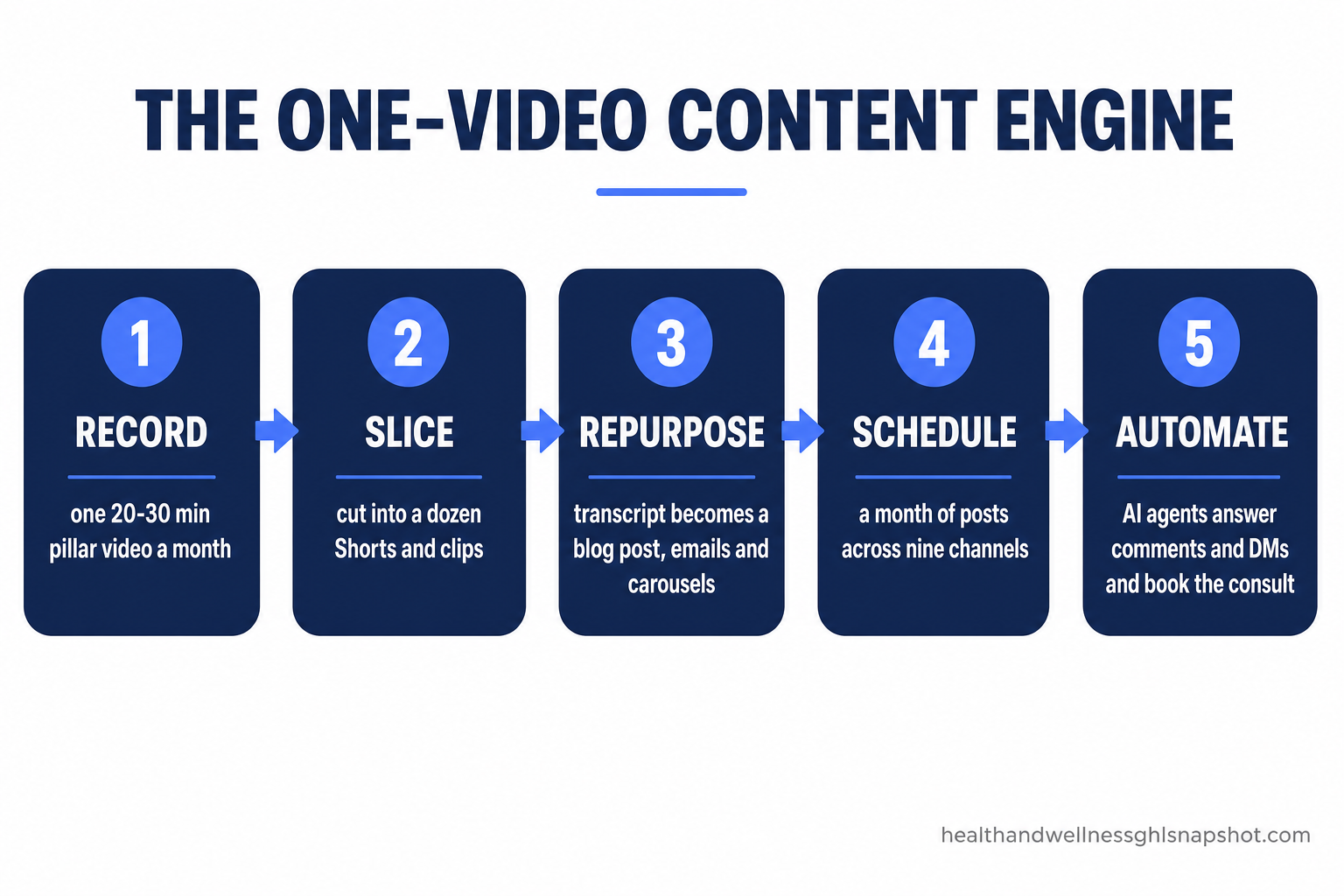
The way a busy wellness practice actually wins on YouTube is not by filming constantly — it’s by recording one longer “pillar” video a month, slicing it into a dozen Shorts and clips, repurposing the transcript into a blog post, emails, and carousels, and automating the comments and DMs so views turn into booked consults. One recording session becomes thirty days of content across every channel. This is that system, step by step, with every statistic sourced — plus an honest look at why most solo practitioners still can’t sustain it alone.
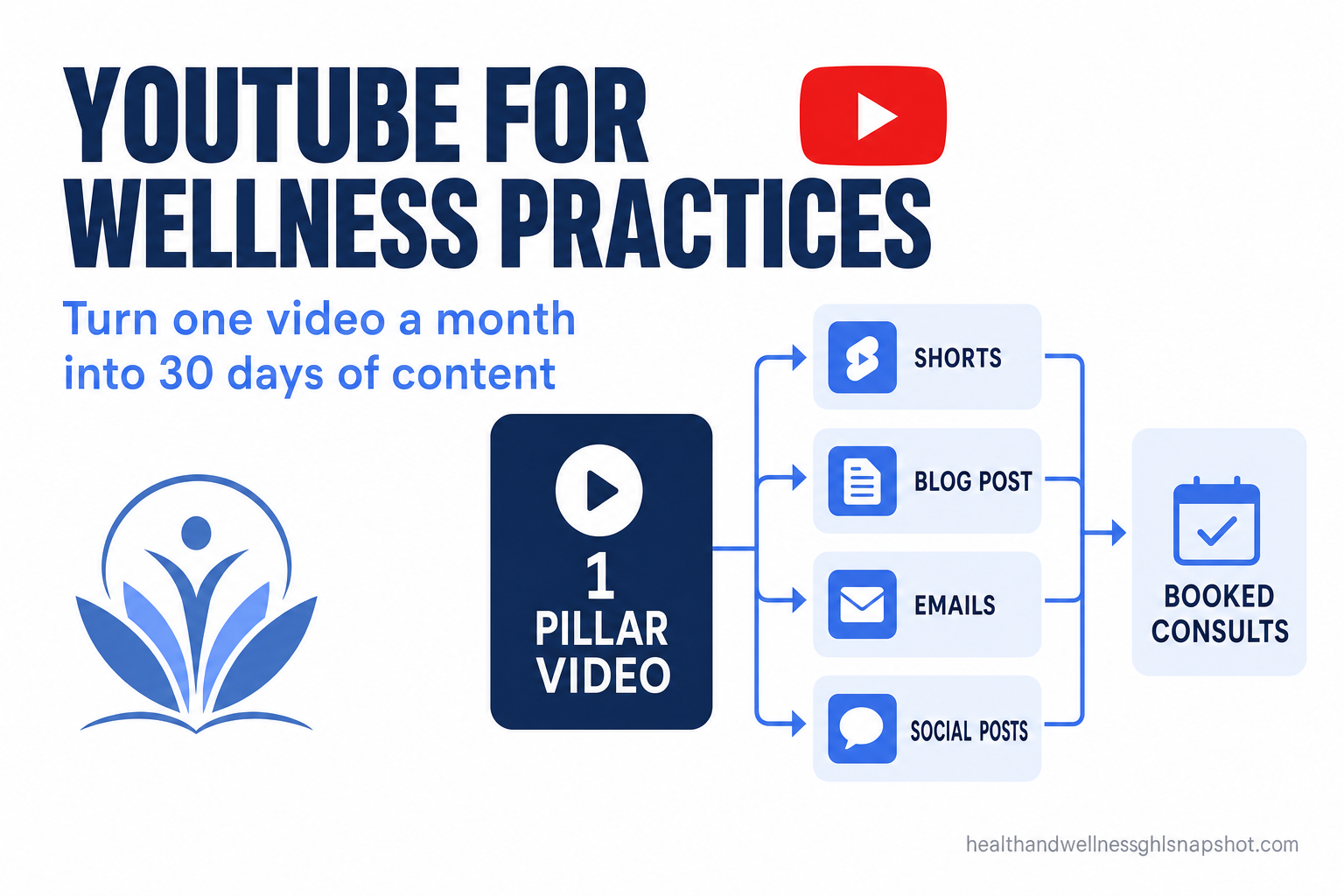
Table of contents
- Why YouTube is the highest-leverage channel for wellness practices
- The one-video content engine, step by step
- Step 1 — Batch-record one pillar video a month
- Step 2 — Slice the pillar into a dozen Shorts and clips
- Step 3 — Repurpose the transcript into a blog post, email, and carousels
- Step 4 — Schedule a month of content across nine channels
- Step 5 — Automate the comments and DMs so views become booked consults
- How to measure whether YouTube is actually booking clients
- Honest caveats: who should not run this solo
- Frequently asked questions
Why YouTube is the highest-leverage channel for wellness practices
YouTube reaches more Americans than any other platform: 84% of US adults use it — ahead of Facebook, Instagram, and TikTok (Pew Research Center, 2025). For a wellness practice, that reach matters more than raw follower counts, because YouTube is where people go to learn — and deciding to hire a coach or clinic is a learning decision first.
Think about how someone lands in your program. They don’t wake up and buy a hormone protocol. They spend weeks half-worried about their gut, their sleep, their weight, watching videos to understand what’s happening to them. YouTube is the second most-visited website in the world (Similarweb, 2026), and it behaves like a search engine — a video you post today keeps getting found by someone typing “why am I always bloated” a year from now. That’s the opposite of a Reel that peaks in a day and vanishes.
The short-form surface is where discovery has exploded. YouTube Shorts now average more than 200 billion daily views, up from a widely reported 70 billion milestone the year before (Google, 2025). A wellness practice that posts vertical clips is fishing in the single largest short-video pool on the internet — one that, unlike a competing app, sits right next to a searchable library of your longer videos.
And video is how trust gets built before a call ever happens. In Wyzowl’s marketing survey, 85% of people said a video has convinced them to buy a product or service, and 89% said the quality of a video affects how much they trust a brand (Wyzowl, 2024). Marketers agree on where the payoff is: short-form video is the #1 content format for return on investment (HubSpot, 2024). In a US wellness economy that reached roughly $2.1 trillion, the largest in the world (Global Wellness Institute, 2026), the practices that win aren’t the loudest — they’re the ones prospective clients found while quietly trying to learn.
Percent of respondents. Source: Wyzowl, Video Marketing Statistics 2024.
The one-video content engine, step by step
The mistake isn’t a lack of video ideas — it’s treating every post as a separate job. You film a Short on Monday, run out of steam by Wednesday, and the channel goes quiet for three weeks. The fix is to invert the workflow: create once in a batch, then let one recording feed every channel for a month. That’s why small businesses call social posting their single most time-consuming marketing task (Constant Contact, 2024) — they’re doing it the slow way.
Here’s what one monthly recording session should actually produce before we break down each step.
Our content-engine model: the assets a single ~30-minute recording session yields once it’s repurposed. Illustrative production plan, not an external statistic.
Our finding: across the wellness practices we build content engines for, the bottleneck is never ideas or camera quality — it’s the twenty small publishing tasks that come after filming. Automate those, and one honest half-hour on camera each month is genuinely enough.
Step 1 — Batch-record one pillar video a month
Record one 20–30 minute “pillar” video per month on a single client question you answer all the time — “Is intermittent fasting safe with a thyroid condition?”, “What actually causes bloating after meals?”, “How do I read my own hormone panel?” One honest, unscripted take on a real question outperforms ten polished clips about nothing, because YouTube rewards watch time and people reward candor.
You do not need a studio. A phone on a tripod, a $30 clip mic, and a window for light is enough — remember, 89% of viewers say video quality affects trust (Wyzowl, 2024), and “quality” here means clear audio and a steady frame, not cinema. Block ninety minutes, record two pillar videos back to back while you’re warmed up, and you’ve got two months of raw material in one sitting.
Pick topics from the questions clients actually ask on discovery calls and in your inbox. Those are, by definition, the searches your future clients are typing. If you keep a simple intake process, you already have a list; if you don’t, our wellness client intake automation captures every question so your content always answers a real one.
Step 2 — Slice the pillar into a dozen Shorts and clips
One 30-minute pillar video contains roughly a dozen standalone moments — a myth busted, a step explained, a number that surprises people — and each becomes its own vertical Short. This is where YouTube’s scale pays off: Shorts average over 200 billion daily views (Google, 2025), and a viewer who likes a 40-second clip is one tap from your full video and your booking link.
Cut each clip to a single idea, add captions (most people watch muted), and open with the payoff instead of an intro. The same vertical file you export for YouTube Shorts works, unchanged, as an Instagram Reel, a TikTok, a Facebook Reel, a Pinterest Idea Pin, and a LinkedIn video — which is the whole point. You filmed once; you now have a dozen assets that fit every short-video surface your clients use.
Don’t overthink editing. A clean cut, burned-in captions, and your logo in the corner is enough. The practices that stall are the ones that treat every Short like a film project. If editing a dozen clips a month sounds like exactly the kind of task that never happens, you’re right — which is what Step 5 and the done-for-you option are about.
Step 3 — Repurpose the transcript into a blog post, email, and carousels
Your pillar video already contains a full blog post — it’s the transcript. Run the recording through any transcription tool, tidy the spoken language into clean prose, add your sourced stats and internal links, and you have a search-optimized article that earns Google traffic and feeds AI answer engines. This is how one recording works two search surfaces at once: video on YouTube, text on Google.
That same transcript becomes an email to your list (the highest-ROI channel most wellness coaches under-use — see our email marketing playbook for wellness coaches), two or three swipeable carousels for Instagram and LinkedIn, and a handful of text posts. Nothing here is net-new writing; it’s all reshaping the words you already said on camera. That’s the difference between a content habit and a content engine.
If the idea of turning every video into a blog post, an email, and five posts sounds like a second job, that’s the honest truth — it is, if you do it by hand. The leverage comes from systematizing it once, then either running the checklist religiously or handing it off.
Step 4 — Schedule a month of content across nine channels
Batch-scheduling turns a pile of assets into a consistent presence — publish the pillar video, then drip the Shorts and repurposed posts across the month so your practice looks alive every single day. Consistency, not volume, is what compounds: a steady cadence signals an active, trustworthy practice, while a feed that goes dark for three weeks quietly tells a prospective client you might be gone.
Load everything into a scheduler and map it across the nine channels that matter for wellness — YouTube, Facebook, Instagram, Google Business Profile, LinkedIn, TikTok, Pinterest, Threads, and Bluesky. Google Business Profile deserves special attention because it feeds local discovery; pair this with our local SEO playbook for wellness practitioners so the same clips also help you show up in the map pack. Reels and short video are the reach engine — our Reels-first social system breaks down the cadence in depth.
The scheduling itself is unglamorous and endless, which is why it’s the first thing that slips. One recording session is sustainable. Twenty manual uploads a month, cropped and captioned per platform, is not — for anyone still seeing clients full-time.
Step 5 — Automate the comments and DMs so views become booked consults
Attention only becomes revenue if someone answers the “do you help with my issue?” comment before the viewer moves on — and speed is exactly where solo practices lose. A clip can reach thousands of people, but the ones who comment or DM are the warm leads, and every hour they wait is a chance for the practice that replied first to win them.
This is the job of automation. An AI comment agent replies under your TikTok, Instagram, and Facebook clips so no question goes cold. An AI DM agent answers Instagram and Facebook messages in your voice, qualifies the person, and books a discovery call straight onto your calendar. A web-chat agent does the same for the traffic your YouTube links send to your site. For the mechanics of turning message threads into booked calls, see our Instagram and Facebook DM automation guide and why speed-to-lead wins wellness clients.
This is also the honest hinge of the whole system. You can film once a month and repurpose like a machine, but if the replies that content generates sit unread for two days, the engine leaks at the last step. Automating the follow-up is what makes the reach worth generating in the first place.
How to measure whether YouTube is actually booking clients
Ignore vanity metrics and track one chain: views → clicks to your booking page → discovery calls booked → clients enrolled. Likes and subscriber counts feel good, but they don’t pay for the program. The only numbers that matter are how many people your content sent to a booking page and how many of those became consults.
Set it up so every YouTube link, Short description, and repurposed post points to a booking page you can attribute, and let your CRM tag where each lead came from. Then read the funnel monthly. If Shorts are getting views but nobody clicks, your calls-to-action are weak. If people click but don’t book, the booking page or offer needs work — our wellness website conversion breakdown covers exactly that. Give it 60–90 days before judging: video, like SEO, compounds, and the pillar you post today keeps earning search views long after a feed post is forgotten.
The YouTube channel, before and after a system
One Short filmed on impulse, then three weeks of silence. Comments unanswered. No idea if any of it books clients. Channel feels like a chore you keep abandoning.
One pillar video a month, sliced into a dozen clips and a month of posts across nine channels. AI agents answer every comment and DM and book the call. Views tracked all the way to enrolled clients.
Honest caveats: who should not run this solo
This system works — and it’s still 5–8 hours a week of slicing, captioning, writing, scheduling, and replying, every week, before it compounds. That’s the part the “just post more” advice leaves out. Recording one pillar video a month is easy. The twenty downstream tasks are what quietly don’t happen when you’re back-to-back with clients — which is why small businesses rank social posting their most time-consuming marketing job (Constant Contact, 2024).
If you genuinely enjoy editing and posting, run the checklist above and you’ll pull ahead of nearly every wellness practice in the country, because almost none of them sustain it. If you don’t — and most practitioners don’t — the channel sits empty no matter how good your intentions are. That’s the gap our done-for-you social media system is built to close: you record once, and we handle the slicing, repurposing, scheduling across nine channels, and the AI agents that answer comments and DMs and book the consults. One brand runs $447/mo; up to four brands (ideal for group practices or agencies reselling to wellness clients) is $1,097/mo.
A quick compliance note, because wellness is regulated: keep video claims conservative, avoid promising specific health outcomes, and honor SMS consent on any automated follow-up. Our HIPAA-aware SMS guide covers the follow-up side so your automation stays on the right side of TCPA and FTC health-claim rules.
Related reading
- Social Media for Wellness Practices: A Reels-First System That Books Clients
- Pinterest Marketing for Wellness Practices: The Evergreen Traffic Engine
- How to Get Wellness Clients From Instagram
- Instagram & Facebook DM Automation for Wellness Practices
- How Wellness Practices Get Found in AI Search (AEO Playbook)
- Local SEO for Wellness Practitioners: The 2026 Google Business Profile Playbook
Frequently asked questions
Is YouTube really worth it for a small wellness practice in 2026?
Yes — it reaches more Americans than any other platform. 84% of US adults use YouTube, more than Facebook, Instagram, or TikTok (Pew Research Center, 2025), and it behaves like a search engine, so a video you post today keeps getting found for months. Because it pairs long-form authority with Shorts that average over 200 billion daily views, it's the highest-leverage single channel for a wellness brand.
How often do I actually need to film?
Once a month is enough if you repurpose. Record one 20–30 minute pillar video on a real client question, then slice it into about a dozen Shorts and clips and reshape the transcript into a blog post, emails, and carousels. One honest recording session, repurposed properly, produces roughly a month of content across every channel — the filming is the small part.
Do I need expensive gear or an editor?
No. A phone on a tripod, a clip-on mic, and good light are enough. Wyzowl's data shows 89% of viewers say video quality affects trust, but 'quality' there means clear audio and a steady, well-lit frame — not cinema production. The bottleneck for wellness practices is almost never camera quality; it's sustaining the publishing and follow-up tasks that come after filming.
How long until YouTube starts booking me clients?
Treat it like SEO, not ads: expect momentum over roughly 60–90 days of consistent publishing, after which the same videos keep earning search-driven views and bookings for a long time. Track the real chain — views to booking-page clicks to discovery calls booked to clients enrolled — rather than likes or subscribers, which don't pay for the program.
Can you run YouTube and the rest of my social for me?
Yes. Our done-for-you social media system turns one monthly recording into a month of Shorts, posts, a blog article, and emails across nine channels including YouTube, plus AI agents that answer the comments and DMs and book consults onto your calendar. One brand is $447/mo; up to four brands is $1,097/mo. You show up on camera once; the engine runs without you.
Maya Ellison is a Wellness Automation Strategist at the Health & Wellness GHL Snapshot. She spent six years running operations for a multi-coach nutrition studio before going all-in on GoHighLevel automation, and she writes the content-and-retention playbooks she wishes she’d had when her old studio was drowning in manual follow-up. Maya writes about GoHighLevel automation and wellness-practice marketing; she is not a licensed medical or clinical provider, and nothing here is medical advice.