
You booked two demos in one week because a Facebook group told you to. The Cerbo rep walked you through a clinical chart that ordered labs, e-prescribed a compounded formula, and logged a hormone pellet, all in one note. The Healthie rep showed you a gorgeous client app, a group program, and a payment link, and quoted you a price so low you did a double take. You hung up more confused than when you started, because both looked right.
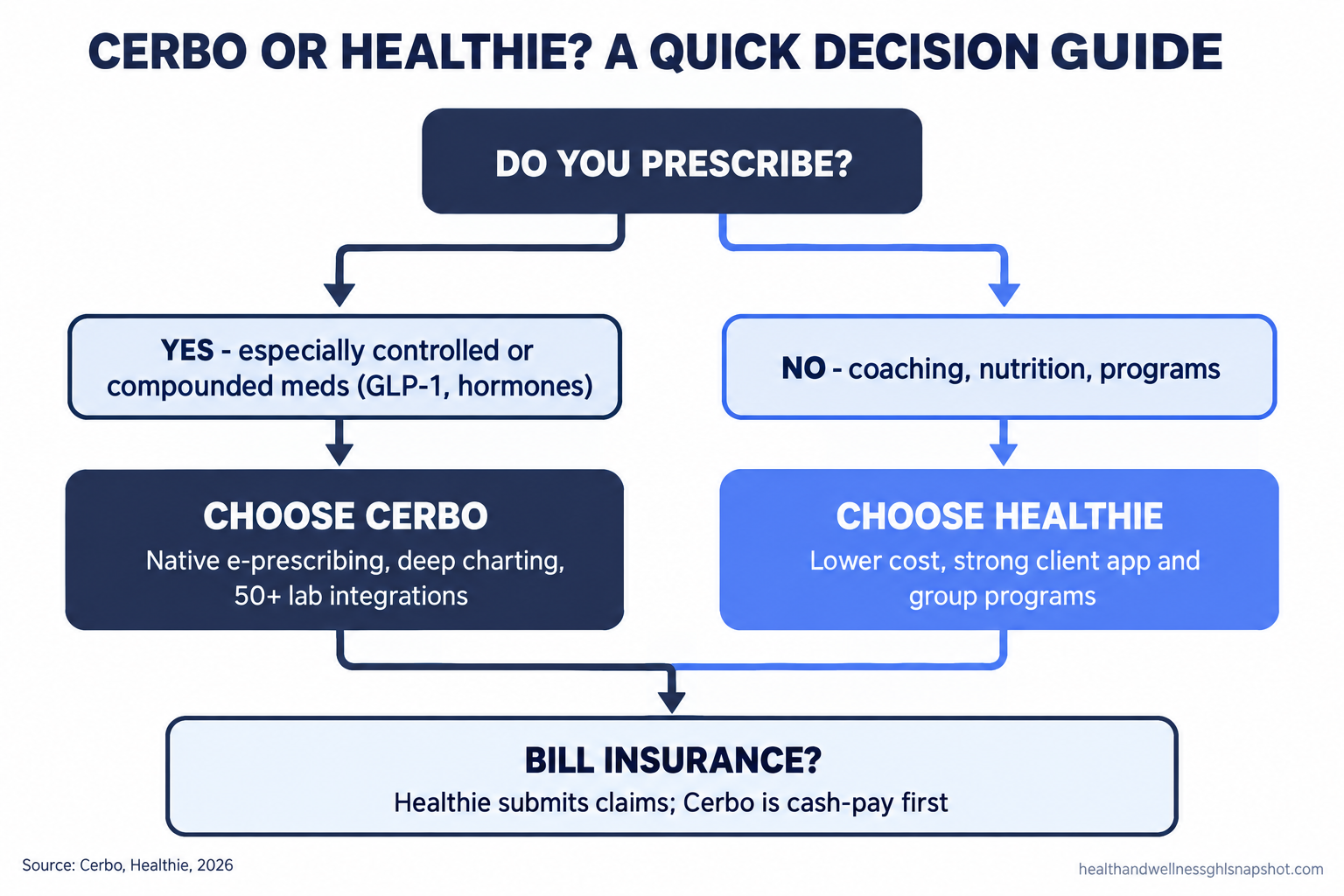
Here is the honest answer up front: Cerbo is a clinical EHR built for practitioners who prescribe, with native e-prescribing baked into the price and a one-time setup fee. Healthie is an engagement-first platform built for coaches, dietitians, and virtual-first practices, cheap to start but with e-prescribing sold as a per-provider add-on. If you write prescriptions, especially controlled substances or compounded GLP-1, Cerbo usually wins on total cost and workflow. If your care is coaching, nutrition, and programs with little or no prescribing, Healthie is lighter and far cheaper. This piece breaks down both across eight things that actually decide the bill, then runs the math for three real practice shapes.
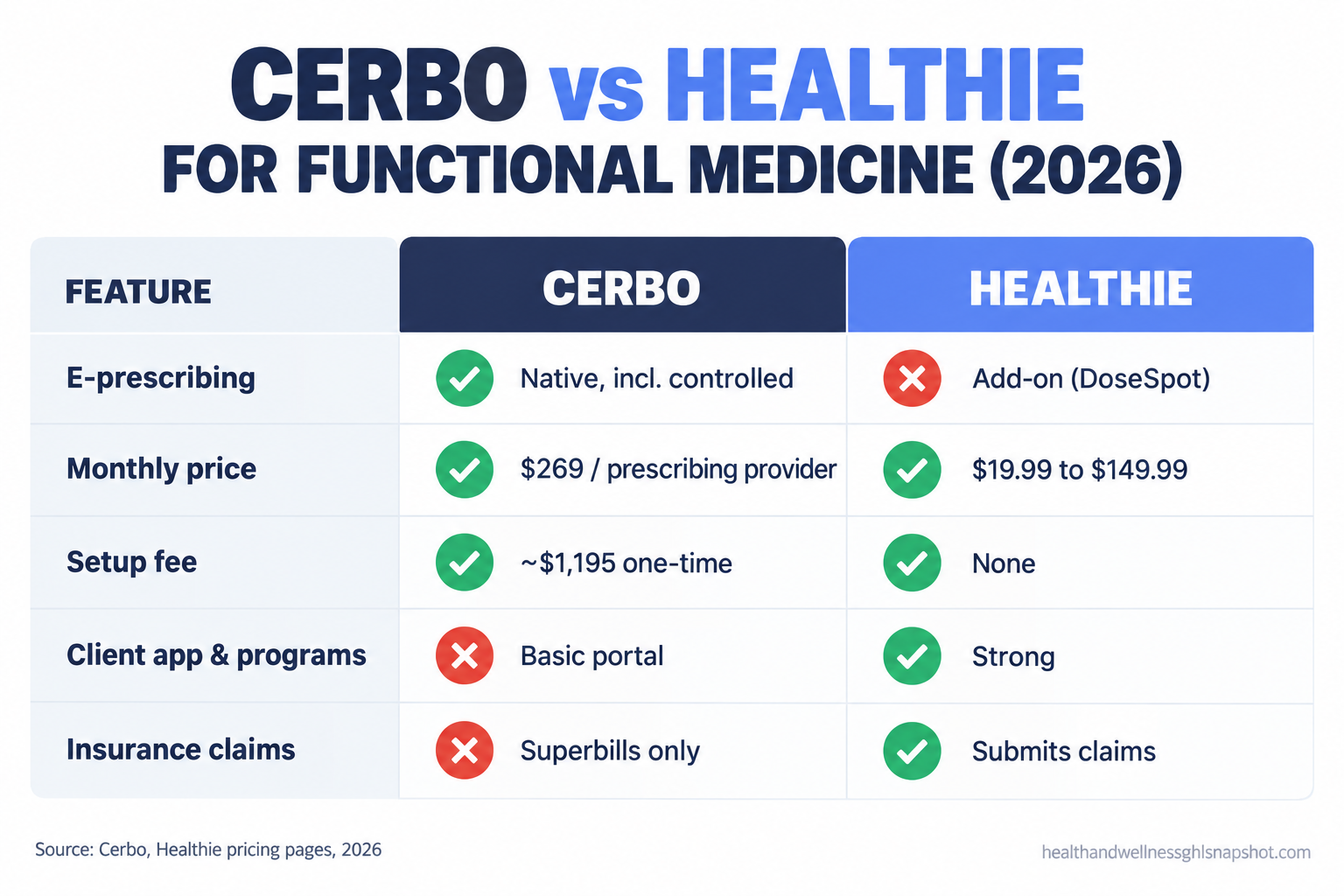
Table of contents
- Why this is really a choice between two different products
- The eight things that decide the bill, side by side
- Pricing and the real first-year cost
- E-prescribing and controlled substances
- Labs, charting, and the supplement dispensary
- Client engagement, programs, and telehealth
- What a coach, a solo prescriber, and a small clinic each pay
- Where each platform quietly breaks
- Common objections, answered honestly
- Frequently asked questions
Why this is really a choice between two different products
Most “Cerbo vs Healthie” advice fails because it treats them as two versions of the same tool. They are not. Cerbo, built by MD HQ, is a clinical EHR aimed at direct primary care, concierge medicine, and functional and integrative practices that chart, order labs, and write prescriptions (Cerbo). Healthie started life serving dietitians, nutritionists, and health coaches, and it is still best at client engagement: a polished app, programs and courses, and payments.
So the real question is not “which is better.” It is “which shape is my practice.” Get that wrong and you either pay for clinical depth you never touch, or you buy a coaching app and then bolt medical features onto it one add-on at a time.
The category is growing fast: the functional medicine lab testing market alone was valued at about $12.5 billion in 2024 and is projected to reach $23.13 billion by 2032, an 8.5% CAGR (Verified Market Research). Decide what you clinically must do before you fall for the interface.
The eight things that decide the bill, side by side
Every row below is unpacked later with sources.
| What you are comparing | Cerbo | Healthie |
|---|---|---|
| Product type | Clinical EHR for prescribers | Engagement platform for coaching and care |
| Base pricing model | Per user, per role | Per plan, with per-provider add-ons |
| Entry price | ~$244–$269/mo per provider | $19.99–$149.99/mo |
| Setup fee | ~$1,195 one-time | ~$50–$100 for optional integrations |
| E-prescribing | Native, incl. controlled and compounded | DoseSpot add-on, ~$40/mo (+$20 EPCS) |
| Lab integrations | 50+ labs, incl. Genova, Vibrant, Rupa | Rupa and Fullscript labs |
| Supplement dispensary | Integrated, with dosing profiles | Fullscript embedded |
| Best fit | Prescribing FM, DPC, concierge, hormone/weight-loss | Dietitians, coaches, virtual-first, group programs |
Sources: PricingNow (Cerbo), Healthie pricing, Cerbo functional medicine, Healthie e-prescribing. Prices as reported at the time of writing; confirm current figures on each vendor’s page.
Pricing and the real first-year cost
The sticker prices look miles apart. The real first-year totals are closer than you think, because the cheap option gets expensive the moment you prescribe.
Cerbo prices by role. Reported 2026 figures are about $269/mo per prescribing provider, $244/mo per non-prescribing provider, $121/mo per supporting or alternate provider, and $60/mo per additional staff seat, on top of a one-time setup fee of about $1,195 that can be spread over installments in the first year (PricingNow; G2). Cerbo has recently advertised waiving that setup fee as a promotion, so confirm what you will actually pay at signup (Cerbo). A solo prescriber is looking at roughly $3,228 in provider fees plus up to $1,195 setup, about $4,423 in year one, then about $3,228 a year after that.
Healthie prices by plan. Core is $19.99/mo for up to 10 active clients, Essentials $49.99/mo for up to 250 clients, Plus $129.99/mo for unlimited clients, and the Group plan is $149.99/mo for one provider plus one support seat, with $50/mo per additional provider (Healthie). There is also a 2.9% transaction fee on payments processed through the platform. A non-prescribing coach can genuinely run on $600 to $1,560 a year. But a prescriber has to add e-prescribing, and that changes the math, as the next section shows.
Illustrative year-one cost by practice type, built from published 2026 prices (before payment processing). Healthie prescriber assumes Plus plan plus DoseSpot eRx and EPCS add-ons. Sources: Healthie, PricingNow, Healthie e-prescribing.
For a coach who never prescribes, Healthie is dramatically cheaper and it is not close. For a prescriber, the gap narrows fast once you add e-prescribing, which is the next section.
E-prescribing and controlled substances
This is the single factor that should decide the whole thing for a prescribing practice.
Cerbo treats e-prescribing as core. It supports e-prescribing for standard medications, controlled substances, and compounded formulations in the same workflow, with drug interaction checks and smart search (Cerbo). For a hormone clinic writing testosterone or a weight-loss practice prescribing compounded or brand GLP-1, that is the daily job, and it is included.
Healthie takes the opposite approach. E-prescribing is an integration with DoseSpot, sold as an add-on. Reported pricing is about $40/mo per prescribing provider for standard e-prescribing, plus another $20/mo per provider to prescribe controlled substances (EPCS), and EPCS is offered at the Enterprise plan level (Healthie; Healthie EPCS). Turning on EPCS also requires an identity-verification process that can take up to two weeks. None of that is a dealbreaker, but it is cost and friction the low sticker price hides.
Labs, charting, and the supplement dispensary
For functional medicine, the lab and supplement workflow is where you live, so test the actual click path, not the feature list.
Cerbo integrates bidirectionally with LabCorp and Quest and with more than 50 labs in total, and pulls results directly into the chart, plus supplement dispensary connections through Fullscript (Cerbo lab integrations; Cerbo). Its charting is built for this work: in-depth functional intake forms, flexible templates, the ability to pull intake answers straight into the encounter note, and treatment plans for IVs, injections, and hormone pellets.
Healthie leans on Fullscript and Rupa too. Fullscript is embedded for supplements and labs, and Rupa accounts are migrating to labs on Fullscript throughout 2026 (Healthie; Fullscript). The charting is capable for coaching and care plans, but it is not a deep clinical EHR in the way Cerbo is. If your notes have to stand up to a medical board inquiry and carry prescriptions, that difference is not cosmetic.
Client engagement, programs, and telehealth
Here the tables turn, and Healthie is the stronger tool.
Healthie was built around the client relationship. It ships a polished patient app, secure messaging, telehealth video, programs and courses, and group-program delivery, all designed so a coach can keep dozens of clients engaged between visits. If your model is memberships, group cohorts, or nutrition coaching where the daily touchpoints are the product, Healthie feels purpose-built, because it is.
Cerbo has a patient portal, embedded card processing for point-of-care payments, and subscription billing that automates recurring charges for concierge and direct-pay models (Cerbo). That covers a clinical practice well. It is not trying to be a course platform or a coaching app, and you should not expect Healthie-grade program delivery from it.
Healthie is also the stronger choice if you bill insurance. It generates CMS-1500 claims and submits electronically through clearinghouses like ClaimMD and Office Ally, while Cerbo is cash-pay-first and only exports superbills for outside submission (Healthie). So if a chunk of your revenue runs through insurance, that alone can point you to Healthie even if you prescribe.
This is the honest tension in the whole decision. Neither platform is great at outbound marketing and retention, which is why so many practices end up paying for a third system. Before you add that third tool, read our pricing teardown of med spa and wellness clinic software to see how the stack adds up.
What a coach, a solo prescriber, and a small clinic each pay
One framework, three real shapes. The right answer genuinely changes with each.
Scenario 1: solo cash-pay nutrition or health coach, no prescribing
You run programs, take payments, and never write a prescription. Healthie is the clear pick. The Plus plan at $129.99/mo, about $1,560 a year, gives you unlimited clients, the app, programs, and Fullscript, and you skip the e-prescribing add-on entirely (Healthie). Cerbo here would mean paying a non-prescribing provider fee plus setup for clinical depth you will not use. For a coach, that is money set on fire.
Scenario 2: solo prescriber, functional or integrative, writes controlled or compounded meds
You prescribe daily, including compounded GLP-1 or hormones. Cerbo’s native e-prescribing and lab depth make it the better home. Year one runs about $4,423 (one provider plus setup), then roughly $3,228 a year, with prescribing included, not metered. On Healthie you would need the Plus or Enterprise plan plus the DoseSpot eRx and EPCS add-ons, and still get a lighter clinical chart. When you prescribe, Cerbo usually wins on both workflow and honest total cost.
Scenario 3: small clinic, two prescribers plus a front-desk staffer
Now per-user pricing bites both ways. On Cerbo, two prescribing providers at $269 plus one staff seat at $60 is about $598/mo, roughly $7,176 a year, plus any setup. On Healthie, the Group plan at $149.99/mo covers one provider and one support seat, a second provider adds $50/mo, and both prescribers need the eRx and EPCS add-ons, landing near $3,600 a year on a lighter clinical base. A clinic that prescribes heavily tends to be happier on Cerbo despite the higher number, because the alternative is a coaching platform doing a clinician’s job.
Where each platform quietly breaks
Every tool has a failure mode the demo will not show you. Here are the ones that actually cost practices money.
Cerbo breaks on cost creep and the learning curve. The per-user model means every new provider and staff seat is another line, and the clinical depth means a real onboarding effort. A tiny practice that does not prescribe will feel like it is paying for a hospital-grade system to send a few care plans. Be honest about whether you are a clinical practice before you buy.
Healthie breaks the moment prescribing gets serious. The low entry price does not include e-prescribing, EPCS is an Enterprise-tier add-on with a two-week verification process, and the clinical chart is lighter than a dedicated EHR (Healthie EPCS). Practices buy it for the price, grow into prescribing, and discover the real cost after they have migrated. Price the add-ons you will need in year two, not just year one.
Both break at the marketing edge. Neither one chases a no-show back onto the calendar, asks for a review at the right moment, or re-warms a lapsing member, which is the quiet reason practices carry a third subscription. That membership and reminder layer can live on a platform you own once, which is the slice the Wellness Snapshot installs.
Common objections, answered honestly
“Healthie is a fraction of the price. Why would I ever choose Cerbo?” Because price per month is not cost per practice. If you prescribe, Healthie needs the eRx and EPCS add-ons and still gives you a lighter chart, so the gap shrinks and Cerbo’s clinical depth starts to pay for itself. If you do not prescribe, Healthie wins and you should not pay for Cerbo. The question is not which is cheaper on paper. It is which fits what you clinically do.
“I want one system for everything. Can either be my whole stack?” Not really, and that is fine. Both are strong at the clinical or coaching core and weak at outbound marketing, reviews, and retention. Keep the EHR for charting and prescribing, and put reminders, no-show recovery, and nurture on something built for it. See our guide to functional medicine automation for where those lines fall.
“I already prescribe compounded GLP-1. Does the software change my compliance risk?” The software does not lower your risk, and it can raise it if your automated messaging overpromises. The FDA declared the semaglutide and tirzepatide shortages resolved in late 2024 and early 2025, so “shortage” is no longer a valid compounding justification in 2026 (FDA). And the FTC has warned almost 700 marketers of health products that unsupported claims could bring civil penalties (FTC). On the HIPAA side, if you bill insurance or share protected health information with a lab, you are almost certainly a covered entity and need a signed Business Associate Agreement with any platform touching patient data (HHS). Whatever you pick, keep marketing copy conservative and read our HIPAA-aware SMS guide before turning on a single automated text.
The bottom line
Back to those two demos. The confusion was never about which product is better built. It was that you were comparing a clinical EHR to a coaching platform as if they were the same thing. If you prescribe, especially controlled or compounded medications, Cerbo’s native e-prescribing, lab depth, and clinical charting usually make it the better and, once you count the add-ons, the more honest value. If your work is coaching, nutrition, and programs with light or no prescribing, Healthie is lighter, cheaper, and better at keeping clients engaged. Decide what you clinically must do first, then let that pick the platform, and keep your marketing and retention layer separate from either. To see how much of that follow-up stack can live on a system you buy once, book a quick demo and compare it against the per-seat tools you carry now.
Frequently asked questions
Is Cerbo or Healthie better for functional medicine?
It depends on whether you prescribe. Cerbo is a clinical EHR with native e-prescribing, deep charting, and 50-plus lab integrations, so it fits prescribing functional and integrative practices, direct primary care, and concierge medicine. Healthie is an engagement-first platform that is lighter and cheaper, and it fits nutrition coaches, dietitians, and virtual-first practices that prescribe little or not at all.
How much does Cerbo cost in 2026?
Reported 2026 pricing is about $269/mo per prescribing provider, $244/mo per non-prescribing provider, $121/mo per supporting provider, and $60/mo per staff seat, plus a one-time setup fee of about $1,195 (which Cerbo has advertised waiving as a promo). A solo prescriber lands near $4,423 in year one and about $3,228 a year after.
How much does Healthie cost, and is e-prescribing included?
Healthie runs $19.99/mo (Core), $49.99/mo (Essentials), $129.99/mo (Plus, unlimited clients), and $149.99/mo (Group), with $50/mo per extra provider and a 2.9% payment transaction fee. E-prescribing is not included; it is a DoseSpot add-on at about $40/mo per provider, plus roughly $20/mo more for controlled substances (EPCS).
Does Healthie support controlled substance prescribing (EPCS)?
Yes, through the DoseSpot integration at the Enterprise plan level, for an extra per-provider fee, and enabling it requires an identity-verification process that can take up to two weeks. Cerbo, by contrast, includes e-prescribing for standard, controlled, and compounded medications in its core workflow.
Can I run my whole wellness practice on just Cerbo or just Healthie?
For charting, prescribing, scheduling, and payments, yes. For marketing, no-show recovery, review requests, and membership nurture, no. Both platforms are weak at outbound retention and lead work, which is why many practices add a separate marketing and automation layer built for that job.
Do I need a HIPAA Business Associate Agreement with Cerbo or Healthie?
If you bill insurance or share protected health information with a lab or referring physician, you likely need a signed BAA with any software that touches patient data. A pure cash-pay practice may fall outside federal HIPAA but still owes state privacy and breach-notification duties. Request the BAA in writing and confirm it covers messaging.
This article is for general informational purposes and is not legal, medical, or compliance advice. Prices are as published or reported at the time of writing and change frequently; confirm the current figure on each vendor’s own page before purchasing. Each practice is responsible for its own HIPAA, TCPA, FTC, DEA, and state-licensing obligations.