A Center City nutrition clinic runs its front end on GoHighLevel — booking, reminders, nurture — but every new client still gets re-keyed by hand into Practice Better, lab results live in a shared Google Drive, and the owner rebuilds the same monthly report in a spreadsheet every Friday night. GoHighLevel is doing 80% of the job beautifully. It’s the last 20% — the parts that don’t connect — that quietly eats the practice’s evenings and loses the occasional renewal.
GoHighLevel custom development is the work of extending GHL past what the platform does out of the box: syncing it to your EHR or booking tool, building a branded client portal or care dashboard on top of it, wiring in a custom AI agent, or automating a workflow GHL was never designed for. For most Philadelphia wellness practices, an off-the-shelf snapshot is the right starting point — and a small share eventually hit a wall where a custom build pays for itself. This guide explains exactly where that line is, what the common builds are, what they cost, and how to tell whether your practice has actually outgrown off-the-shelf. Every statistic below is sourced, and the honest caveats run throughout.
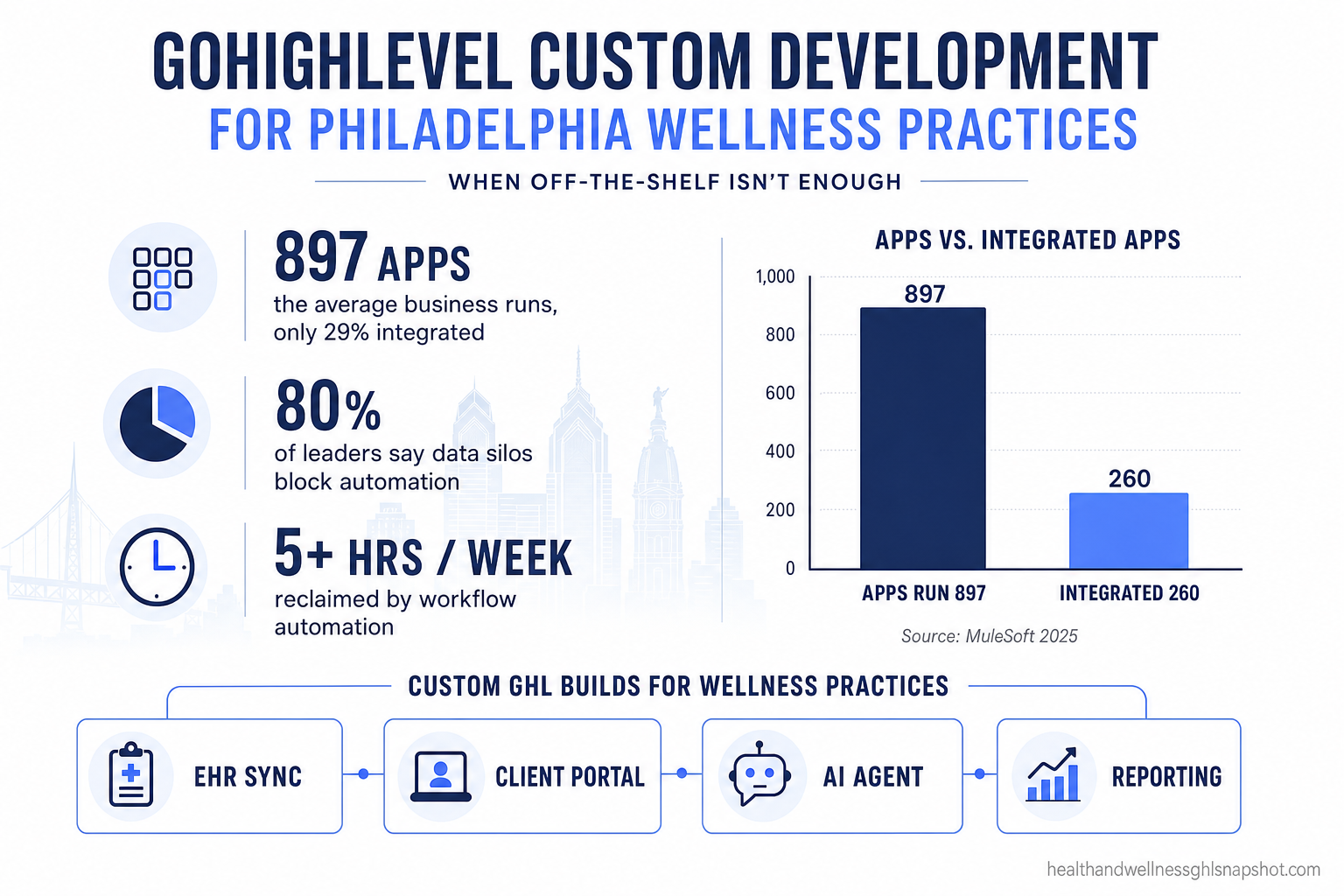
Table of contents
- What “GoHighLevel custom development” actually means
- Signs your Philadelphia practice has outgrown off-the-shelf GHL
- The real cost of running on disconnected tools
- Six custom GHL builds Philadelphia wellness practices actually ask for
- What custom GHL development costs — and the honest ROI math
- Build vs. buy vs. DIY: how to decide
- Compliance: HIPAA and TCPA for custom wellness builds
- How to choose a GoHighLevel developer
- Frequently asked questions
What “GoHighLevel custom development” actually means
GoHighLevel custom development is any work that connects to, extends, or replaces part of GoHighLevel to fit how your practice actually runs — as opposed to configuring the features GHL ships with. Installing a snapshot, building a funnel, setting up a nurture sequence, mapping a pipeline: that’s configuration, and it’s most of what any practice needs. Custom development starts where configuration stops.
Concretely, that means things like:
- Integrations — a two-way sync between GoHighLevel and a tool it doesn’t natively connect to (Jane, SimplePractice, Practice Better, IntakeQ, a payment processor, a lab portal), built against the GHL API so data flows without re-keying.
- Custom software on top of GHL — a branded client portal, a program dashboard, or a care-management view that reads and writes GHL data but presents it the way your practice needs.
- Custom automations — branching logic, timezone and consent handling, or triggers that go beyond what the workflow builder exposes.
- Custom AI agents — a chatbot or voice agent trained on your programs and wired directly into your GHL sub-account, not a generic bolt-on.
- Migrations — moving a practice fully into GoHighLevel from another CRM or a pile of disconnected tools without losing history (we cover the mechanics in our Charlotte GHL migration playbook).
The distinction matters because it sets expectations on cost and timeline. Configuration is days. Custom development is weeks and a real budget — which is exactly why you only reach for it once off-the-shelf genuinely can’t do the job.
Signs your Philadelphia practice has outgrown off-the-shelf GHL
You’ve outgrown off-the-shelf the moment a human is doing work a system should be doing — repeatedly, every week, because two tools won’t talk to each other. Here are the signals we see most often from Philadelphia practices — Rittenhouse med spas, University City functional-medicine clinics, Fishtown coaching studios, Main Line hormone and longevity practices:
- You re-key the same client into two systems. A lead books in GHL, then someone types their details into Practice Better, SimplePractice, or Jane by hand. That’s the single clearest sign.
- You export data to build a report. Every month you pull CSVs and rebuild the same dashboard — clients by practitioner, conversion by source, MRR by program — because no single tool shows it.
- Client-facing information lives in Google Drive. Protocols, lab results, and program materials sit in shared folders instead of a real portal (we compare the two in client portal vs. Google Drive).
- You’ve hit a wall in the workflow builder. The automation you need has a branch, a timezone rule, or a consent gate the native builder won’t express cleanly.
- Your AI is generic. You bolted on a chatbot, but it doesn’t know your programs or write anything back into GHL, so your team still triages every conversation.
If none of these describe you, you almost certainly don’t need custom development yet — configure the snapshot and move on. If two or more do, the manual work is now a recurring tax, and it’s worth pricing a build.
The real cost of running on disconnected tools
The cost of disconnected tools isn’t the software bill — it’s the compounding hours your team spends being human glue between systems that won’t talk. The scale of that problem is well documented. The average business now runs 897 applications, yet only 29% of them are integrated, and 90% of leaders say data silos create business obstacles (MuleSoft/Salesforce, 2025). Even small businesses deploy around 36 apps on average (Okta, 2024) — a coach doesn’t have an IT department, but they still have a stack.
The average organization runs 897 applications but has integrated only 29% of them — the gap is filled by people re-keying data by hand. Source: MuleSoft / Salesforce 2025 Connectivity Benchmark.
That gap gets filled by people. Knowledge workers spend roughly 60% of their time on “work about work” — searching for information, switching apps, duplicating effort — rather than the skilled work they were hired for (Asana, Anatomy of Work 2021). In a wellness practice, “work about work” is the practitioner re-typing intake answers, the VA copying a payment status, the owner rebuilding a spreadsheet on a Friday night.
Healthcare makes the number concrete. Administrative transactions consume a large share of every health dollar, and the CAQH Index estimates the US medical and dental industries could save $18.3 billion a year by fully automating those transactions (CAQH, 2023). You won’t capture billions — but the same principle scales down: every admin task a custom integration removes is an hour your practice gets back, and by McKinsey’s analysis roughly 57% of US work hours are spent on activities that are technically automatable with today’s tools (McKinsey, 2025). Not all of it should be — but the copy-paste absolutely should.
Six custom GHL builds Philadelphia wellness practices actually ask for
Most custom GoHighLevel work for wellness practices falls into six repeatable patterns — you rarely need something truly bespoke, you need one of these fitted to your tools. These map directly to what our team builds on GHL:
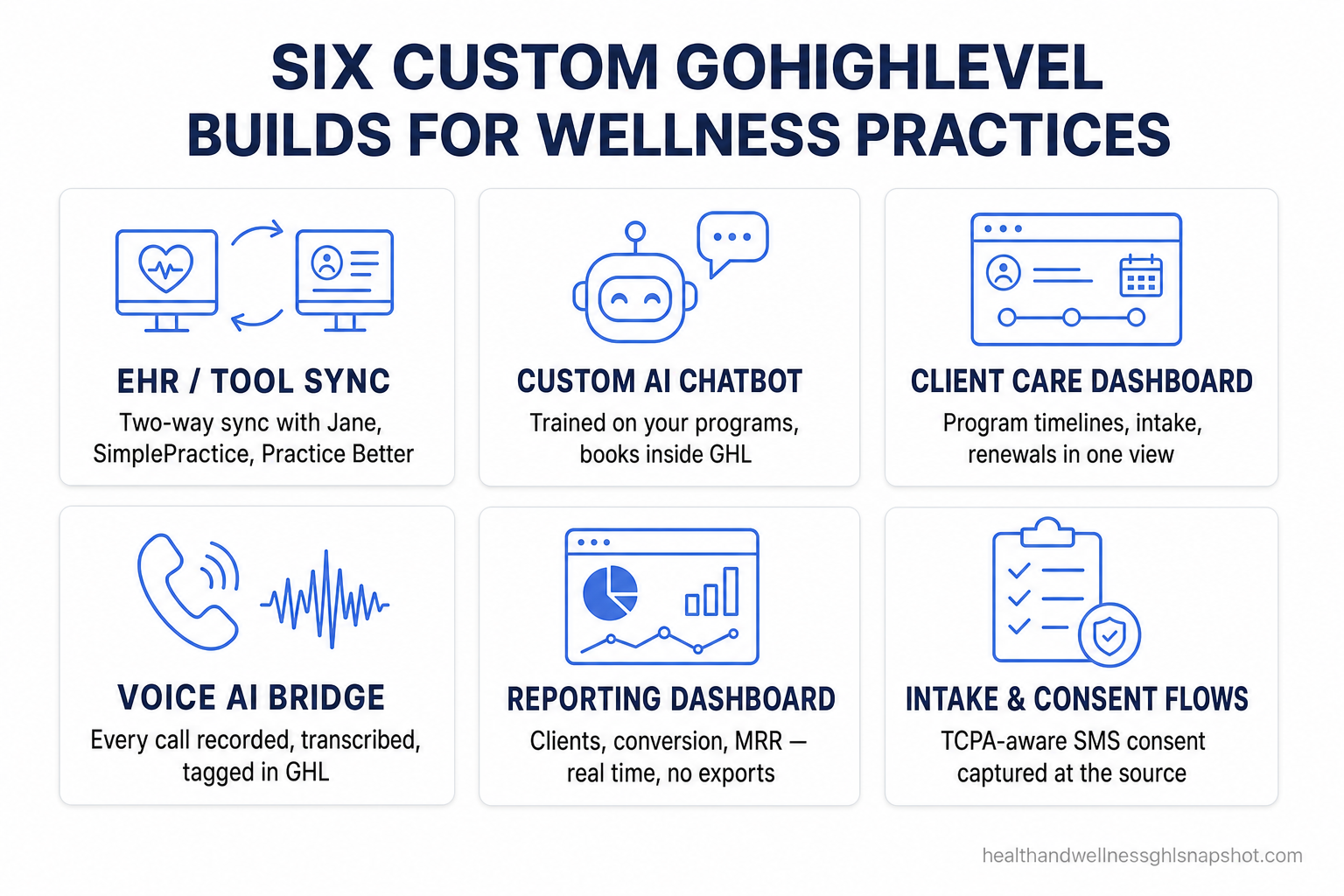
- EHR / practice-tool ↔ GHL sync. A custom connector that keeps clients, appointments, custom fields, and pipeline stages in step between Jane, SimplePractice, Practice Better, or IntakeQ and your GoHighLevel sub-account — two-way, no re-keying. This is the single most-requested build, because it’s the copy-paste problem most practices feel daily.
- Custom AI chatbot in GHL. A branded conversational agent on your site, connected to GHL pipelines, that answers program questions, qualifies, books, and tags leads automatically — trained on your protocols, not a generic FAQ bot. (If you’re earlier in that journey, start with our AI chat widget playbook.)
- Client care-management software. A care dashboard on top of GHL — program timelines, intake checklists, lab-status fields, renewal reminders — branded to your practice, so practitioners see a client’s whole journey in one view.
- Voice AI ↔ GHL bridge. A pipeline (VAPI or Retell) that records, transcribes, and tags every inbound call inside GHL, with urgency triggers and new-client qualification, so no phone conversation goes uncaptured.
- Custom reporting dashboard. A real-time view pulling from GHL and your other tools — clients by practitioner, conversion by source, MRR by program type — so nobody rebuilds a spreadsheet again.
- Custom intake & consent flows. Structured intake that writes cleanly into GHL with TCPA-aware SMS consent captured at the source (see our intake-forms automation guide).
Notice the through-line: every one of these removes a manual handoff. That’s what makes them worth building — and what makes them measurable after the fact.
What custom GHL development costs — and the honest ROI math
Custom GoHighLevel development is priced by scope, and for wellness practices it typically runs from a few thousand dollars for a connector to the low tens of thousands for a full care dashboard or migration. As a working reference, our own fixed-price GHL builds start around $3K for a small connector, $5–15K for a custom AI intake chatbot, and $15–40K for a full client care-management dashboard or a complete migration, with an hourly retainer for evolving scopes. Those are real ranges, not teaser pricing — a custom build is a capital decision, and it should clear a bar before you make it.
Here’s the honest way to judge that bar: a build pays for itself when the recurring hours it removes are worth more than its one-time cost. Workflow automation saves a small-business owner about 5 hours a week and employees roughly 11.5 hours a week, and 88% of SMBs say automation lets them compete with larger companies (Zapier, State of Business Automation).
Hours per week reclaimed by workflow automation, by role. A custom integration converts these recurring hours into a one-time build cost. Source: Zapier, State of Business Automation.
Put a number on it: if a practitioner’s time is worth $100/hour and an EHR sync removes five hours of re-keying a week, that’s roughly $26,000 of reclaimed capacity a year — capacity you can spend on billable client work instead. Against a one-time connector build, the payback is usually months, not years. And the broader tooling data agrees the direction is right: CRM investment currently returns about $3.10 for every $1 spent (Nucleus Research, 2021), and 76% of small businesses that increased their tech spend are growing (Salesforce, 2024). Custom development isn’t the first dollar you spend on GHL — it’s the dollar you spend once the platform is already working and the only thing left slowing you down is the seams between tools.
Build vs. buy vs. DIY: how to decide
Before you commission anything, be honest about which of three paths actually fits the gap — because for a lot of practices, the answer is still “buy the snapshot,” not “build custom.” Here’s how the options compare for a Philadelphia wellness practice:
| Consideration | DIY in native GHL | Off-the-shelf snapshot | Custom development |
|---|---|---|---|
| Upfront cost | Lowest (your time) | Low, fixed | Higher, scoped |
| Time to live | Days–weeks of your effort | ~24 hours to install | Weeks per build |
| Fits your exact tools | Only what GHL natively supports | Common wellness workflows | Exactly — built to your stack |
| Connects to your EHR | No | No | Yes, two-way |
| Custom portal / dashboard | No | No | Yes |
| Ongoing maintenance | You own it | Handled | Handled / retainer |
| Best when | You’re small and tools already fit | You want a proven system fast | You’ve outgrown templates |
Read it top to bottom and the sequence is usually obvious: start with the snapshot because it’s fast and proven, DIY the small tweaks native GHL supports, and reserve custom development for the specific seams — the EHR sync, the portal, the report — that neither of the first two can close. If you’d rather not manage any of it, a dedicated wellness VA can run the day-to-day system for you, and truly standalone software that doesn’t touch GHL lives on our custom software page.
Compliance: HIPAA and TCPA for custom wellness builds
Custom development in a wellness practice is exactly where compliance has to be designed in from the first line of code — not bolted on after. Pennsylvania practices that handle protected health information carry real obligations, and a custom build touches data in ways a template rarely does. A few guardrails to hold any developer (including us) to:
- PHI stays on BAA-eligible infrastructure. Builds that touch protected health information should run on providers that will sign a Business Associate Agreement, with logging and access controls configured to align with HIPAA technical-safeguard requirements. You maintain the administrative safeguards; the build supplies the technical architecture.
- SMS is TCPA-aware by construction. Consent is captured at intake, quiet hours are respected, and STOP opt-outs are honored automatically. Our HIPAA-aware SMS guide walks through the specifics for wellness practices.
- Keep clinical detail out of plain channels. A custom automation should move scheduling and lead data freely and treat sensitive health details conservatively — never sending diagnoses or lab specifics over unencrypted SMS.
- You own the clinical claims. We build the plumbing. Your license, your HIPAA obligations, and your FTC health-claim compliance remain yours — the automation is your operations layer, not a healthcare provider.
Done right, a custom build usually reduces compliance risk versus the status quo, because it replaces staff improvising with personal phones and shared drives with one consistent, logged, consent-aware system.
How to choose a GoHighLevel developer
The right GHL developer is one who tells you when you don’t need a custom build — and, when you do, scopes it to the specific gap instead of selling you a platform rebuild. If you’re evaluating one for a Philadelphia practice, insist on:
- GHL API and Marketplace fluency, not just workflow-builder configuration — real integrations live in the API.
- Fixed-price scoping on defined builds, so you know the number before you commit, with an hourly retainer only for genuinely evolving work.
- A stack chosen per project — Python for data pipelines and AI, Next.js for portals and dashboards, VAPI/Retell for voice — never a one-size-fits-all rebuild.
- BAA-eligible infrastructure and NDA as a default for anything touching PHI.
- A bias toward the smallest build that closes the gap, because the goal is to remove a manual handoff, not to maximize scope.
A Philadelphia practice, before and after a custom GHL build
A new client books in GHL, then gets re-typed into the EHR by hand. Lab results sit in a shared Drive. Every month the owner exports CSVs to rebuild the same MRR report. Two tools, one human copying between them, evenings lost to admin.
The EHR sync writes each new client across both systems automatically. A branded portal holds protocols and results. The reporting dashboard updates in real time. The owner's Friday nights are back, and nothing falls through the seams.
The custom builds above are the exception, not the rule — most Philadelphia practices are best served by installing a proven Wellness Snapshot first and reaching for custom development only when a real, recurring manual task proves the template can’t stretch far enough. When that day comes, scope it tight, price it against the hours it saves, and build the seam — not the whole platform.
Frequently asked questions
GoHighLevel custom development for wellness practices — FAQ
What is GoHighLevel custom development?
It's any work that extends GoHighLevel past its built-in features to fit how your practice runs — custom integrations to tools GHL doesn't natively connect to (like an EHR or booking system), a branded client portal or care dashboard built on top of GHL, custom AI agents wired into your sub-account, advanced automations, and full migrations. It's distinct from configuration (installing a snapshot, building a funnel), which is most of what any practice needs first.
Does my Philadelphia wellness practice actually need custom development?
Usually not at first. A pre-built snapshot covers the vast majority of a practice's needs. You need custom development when a human is repeatedly doing work a system should do — re-keying clients between GHL and your EHR, exporting data to build reports, or storing client materials in Google Drive because there's no portal. If two or more of those describe you, a custom build likely pays for itself.
How much does a custom GoHighLevel build cost?
It's priced by scope. As a reference, our fixed-price GHL builds start around $3K for a small connector, $5–15K for a custom AI intake chatbot, and $15–40K for a full client care-management dashboard or a complete migration, with an hourly retainer for evolving scopes. The fastest way to a real number is to book a call and get a quote on your specific gap.
Can you connect GoHighLevel to Practice Better, Jane, or SimplePractice?
Yes — an EHR/practice-tool sync is the most-requested build. We build a custom two-way connector against the GHL API so clients, appointments, custom fields, and pipeline stages stay in step between GoHighLevel and Jane, SimplePractice, Practice Better, or IntakeQ, with no re-keying. Scope depends on which fields and directions you need synced.
Is a custom GHL build HIPAA-compliant?
A well-built one is designed to be. Builds that touch protected health information run on BAA-eligible infrastructure with logging and access controls aligned to HIPAA technical safeguards, and any SMS is TCPA-aware with consent capture and STOP handling. We build the technical architecture; your practice maintains the administrative safeguards, clinical claims, and licensing obligations. We are not a healthcare provider.
How is this different from custom software that doesn't use GoHighLevel?
This is software that connects to, extends, or replaces parts of GoHighLevel — the GHL API, Marketplace apps, EHR/booking syncs, and migrations. Standalone AI agents and SaaS builds that don't touch GHL are covered on our custom software page. If you already run on GHL, GHL custom development is almost always the right entry point.
About the author
Kwame Adeyemi is a GHL Snapshot Engineer who builds and stress-tests the workflows that ship inside the Wellness Snapshot. A former agency developer, he cares about the parts of automation nobody sees until they break — branching logic, timezone handling, SMS consent gates, EHR syncs, and the quiet failure modes that lose a practice a renewal. He translates technical GoHighLevel mechanics into language a busy practitioner can actually act on. Kwame’s guidance is operational, not clinical; he is not a licensed healthcare provider.