
An Austin nutrition coach signs a new client on Monday. That single client now lives in six places: the booking tool, the payment processor, a spreadsheet of program milestones, the email platform, a folder of intake PDFs, and the coach’s own head. Every one of those tools was a reasonable choice on its own. Together they’ve become a tax — a few minutes here re-keying a name, an hour there reconciling who paid and who didn’t, a renewal that slipped because the reminder lived in a system nobody checked.
Custom software becomes worth it for an Austin wellness practice at the point where stitching off-the-shelf tools together costs more — in hours, errors, and lost renewals — than building one system around how you actually work. This is a pain-points guide, not a sales pitch: below is the sourced math on what tool sprawl really costs, the honest signs you’ve outgrown generic apps, and the cases where you should not build custom. Every statistic is cited, and the caveat runs throughout — the right answer depends on your size, your workflow, and how much manual glue you’re paying for today.
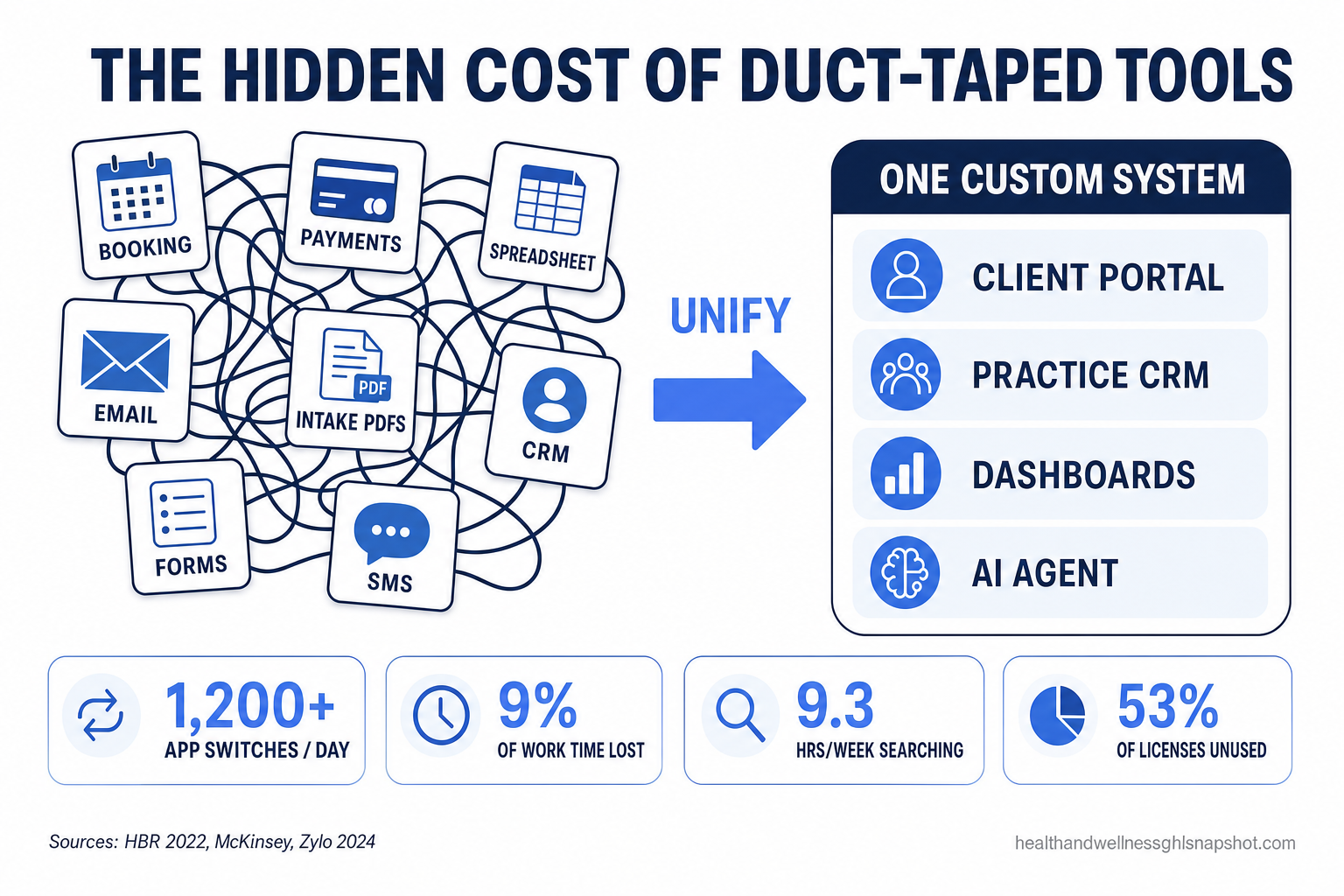
Table of contents
- What duct-taped tools actually cost a wellness practice
- Why Austin wellness practices outgrow off-the-shelf software
- The five hidden costs of tool sprawl
- Off-the-shelf vs custom software: an honest comparison
- What custom software for a wellness practice looks like
- When it pays to build — and when it doesn’t
- Frequently asked questions
What duct-taped tools actually cost a wellness practice
The cost of tool sprawl isn’t the monthly subscriptions — it’s the human glue holding the tools together. Every disconnected app in your stack creates a seam, and every seam needs a person to copy data across it, check that nothing fell through, and remember which system is the source of truth this week.
That glue is expensive because it’s invisible. You don’t see a line item for “45 minutes re-keying Monday’s new client into four tools.” You see it as a founder who never gets out of admin, a renewal that lapsed because the trigger lived in a spreadsheet, and a program experience that feels held-together because it is. The research puts numbers on the invisible part: workers toggle between applications and websites roughly 1,200 times a day and lose close to 9% of their working time just re-orienting after each switch (Harvard Business Review, 2022). On top of that, knowledge workers spend about 9.3 hours a week — nearly a full day — searching for and gathering information scattered across systems (McKinsey Global Institute).
Hours lost per worker, per week. Sources: Harvard Business Review (2022); McKinsey Global Institute.
For a solo practitioner or a small Austin clinic, those hours don’t come out of a large team — they come out of the one or two people who are also the product. That’s the real cost: the highest-value person in the practice spends their week being a data courier.
Why Austin wellness practices outgrow off-the-shelf software
Off-the-shelf tools are built for the average of everyone; a growing practice needs software built for the specific way it runs. Generic apps are excellent at the start — they’re cheap, fast to set up, and cover the basics. The problem shows up on the way up, when your program model gets more specific than the tool’s assumptions.
Austin is a textbook case. The city’s functional-medicine, longevity, hormone, and metabolic-health scene has grown into a genuine market, and it’s part of a national wave: the US wellness economy reached $2.1 trillion and is growing 7.9% a year (Global Wellness Institute, 2026). Digital health coaching specifically is projected to roughly double — from about $11.0 billion in 2024 to $22.1 billion by 2030 (Grand View Research).
US digital health coaching market size, USD billions. Source: Grand View Research.
Growth is the pressure that exposes a duct-taped stack. At 15 clients, a spreadsheet and a booking link feel fine. At 60, 120, or across two practitioners and a group program, the seams start tearing: the intake process doesn’t branch the way your protocols do, the “portal” is really a shared Drive folder, and no single screen tells you which clients are at risk of not renewing. You’ve outgrown the average.
The five hidden costs of tool sprawl
Before you decide anything, it helps to name what the sprawl is actually costing — because most of it never appears on an invoice. Here are the five that quietly add up in a wellness practice.
- The toggle tax. Every extra tool multiplies the switching. At ~1,200 app switches a day and ~9% of time lost to re-orientation (HBR, 2022), a stack of 8–12 apps is a real, recurring drain on the exact people you can least spare.
- Paying for seats you don’t use. Sprawl means overlap — three tools that each do 60% of the job. With about 53% of SaaS licenses unused within 30 days and six-figure average waste on unused software (Zylo, 2024), you’re often renting capability twice.
- Re-keyed, drifting data. The same client’s details get typed into four systems, and within a month they disagree — an old phone number here, a wrong package there. That’s the 9.3 hours a week of searching and reconciling (McKinsey) — and every re-key is a chance to introduce an error into a client’s record.
- The workflow that doesn’t exist off the shelf. Your best idea — a specific onboarding branch, a group-program flow, a renewal pre-warm keyed to milestones — is the one thing no generic app supports. So it lives in someone’s memory and runs inconsistently.
- The client experience gap. Clients feel the seams: they get a payment link from one brand, a form from another, and reminders from a third. A coherent, on-brand experience is hard to fake when it’s assembled from five logos.
Off-the-shelf vs custom software: an honest comparison
Neither option is universally right — the honest answer is that off-the-shelf wins early, and custom wins once your workflow and volume justify it. Here’s the trade-off laid out plainly for a wellness practice:
| Factor | Off-the-shelf SaaS | A configured GHL snapshot | Custom software |
|---|---|---|---|
| Upfront cost | Low (monthly) | Low–moderate (one-time + hosting) | Higher (project fee) |
| Fits your exact workflow | Rarely — you adapt to it | Mostly, within GHL’s model | Yes — built around you |
| Time to first value | Minutes | ~Days | Weeks |
| Data in one place | No — silos by design | Largely unified in GHL | Yes — one source of truth |
| Scales with volume | Costs stack per tool | Flat, predictable | Yes — you own it |
| You own the asset | No | You own the setup | Yes — fully owned |
| Best for | Getting started, testing | Most growing practices | Specific workflows tools can’t fit |
The middle column matters. Many Austin practices don’t need bespoke software at all — a done-for-you GoHighLevel snapshot unifies booking, intake, check-ins, and renewals inside one system for a fraction of a custom build. Custom software is the right call when even a well-configured platform can’t model how you work — a novel program structure, a client portal with your exact journey, or an integration between tools that were never meant to talk. If you’re weighing the platforms themselves, our breakdown of a client portal vs a Google Drive folder is a useful next read.
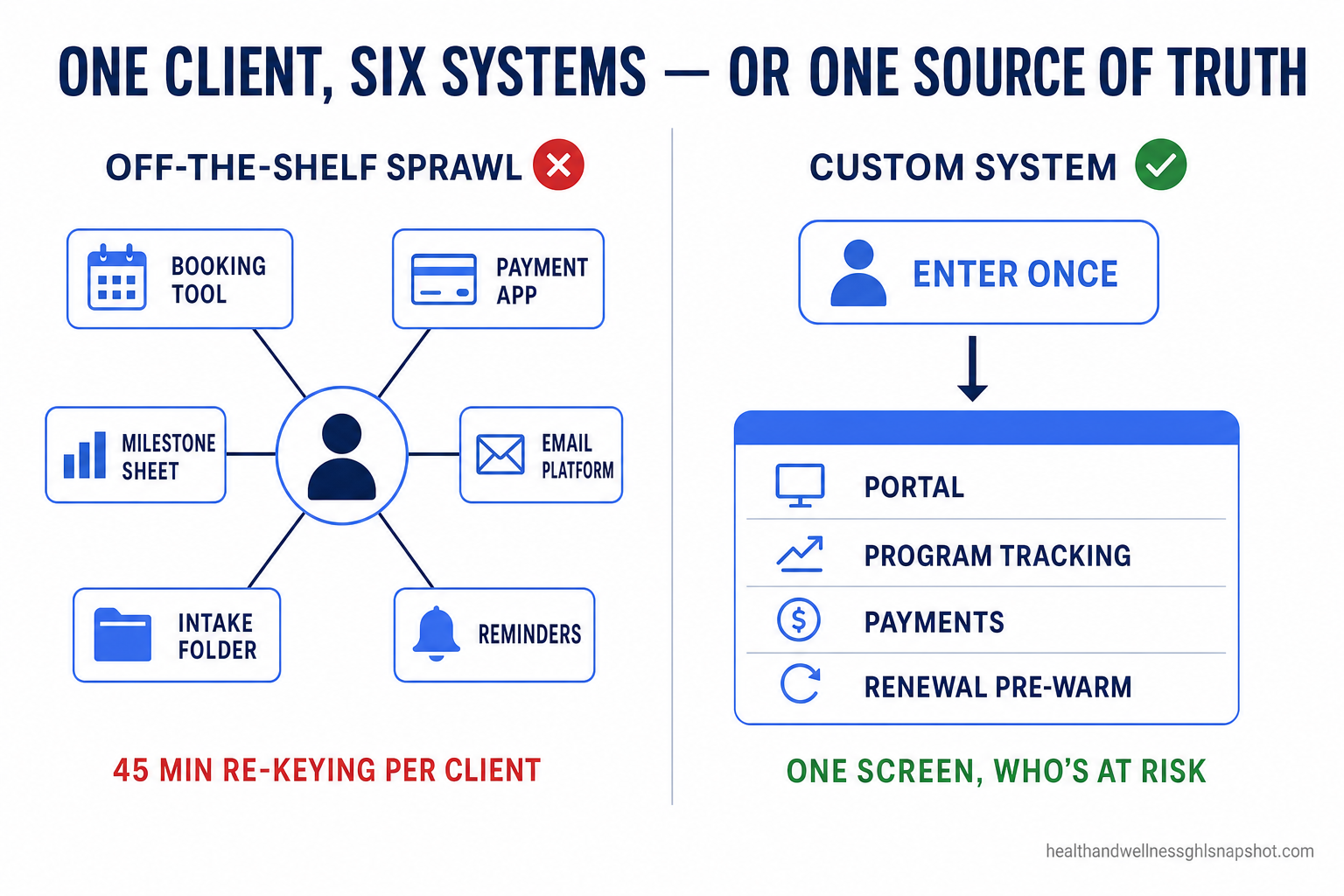
The Monday new-client, before and after
A new client is typed into the booking tool, the payment processor, a milestones spreadsheet, the email platform, and an intake folder. Forty-five minutes of re-keying, and the renewal reminder lives in a sheet nobody opens. The founder does admin instead of coaching.
The client is entered once. A custom portal (or unified system) collects intake, tracks their program, handles payments, and fires the renewal pre-warm on its own. One screen shows who's at risk. The founder coaches; the software does the couriering.
What custom software for a wellness practice looks like
Custom software doesn’t mean a giant, risky, ground-up rebuild — most wellness projects are focused tools that remove one specific bottleneck. In practice, the builds that pay off for practices tend to fall into a few buckets:
- A client portal where people log in to upload intake, track their program, see next steps, and book sessions — instead of a scattered Drive folder. It replaces the “clients have nowhere to log in” problem directly.
- A practice-management CRM shaped to your programs and packages, unifying the EHR-here, spreadsheet-there, GHL-somewhere-else sprawl into one source of truth.
- Program & package dashboards that show renewals, at-risk clients, and recurring revenue on one screen — the view no off-the-shelf tool assembles for you.
- A custom AI agent trained on your protocols and tone — intake qualification, document processing, or re-engagement — working inside the tools you already run.
Because we build with Claude Code — Anthropic’s AI-assisted development CLI — a focused build ships in weeks, not the quarters a traditional dev shop quotes, and the output is yours to own and deploy. Typical projects run $3K–$50K+ depending on scope, with a written fixed quote before anything starts. If you’d rather migrate onto one unified platform first, our Charlotte GHL migration guide and the Philadelphia custom development playbook walk through what that path looks like.
When it pays to build — and when it doesn’t
Build when the manual glue costs more, year over year, than the software would cost once. That’s the whole test, and it cuts both ways. Some honest guardrails:
Lean toward custom when:
- You have a workflow no tool supports, and it’s core to how you deliver results.
- Your team spends real hours every week re-keying and reconciling data across systems.
- You’re scaling — more clients, a group program, a second practitioner — and the seams are tearing.
- You want to own the asset instead of renting capability that resets to zero if you leave.
Stay off-the-shelf (or on a snapshot) when:
- You’re early, still testing your offer, and your workflow is changing monthly.
- A well-configured platform already covers 90% of what you need. Don’t build to save the last 10%.
- You can’t yet name the specific bottleneck a build would remove. “Everything’s messy” isn’t a spec; “clients have nowhere to log in” is.
The wrong reason to build is novelty. The right reason is math: when the invisible tax — the toggling, the searching, the re-keying, the lapsed renewals — adds up to more than a one-time build, custom software stops being a luxury and starts being the cheaper option. If you want help running that math for your practice, that’s exactly what a scoping call is for. And if the bottleneck is staffing rather than software, a dedicated wellness VA can run your existing systems instead.
We are not a healthcare provider, and custom software does not diagnose, treat, or advise. Your clinical claims, HIPAA obligations, and FTC compliance remain yours — the software is your operational layer, built to be HIPAA-aware, nothing more.
Frequently asked questions
Custom software for Austin wellness practices — FAQ
When should an Austin wellness practice invest in custom software?
When the hidden cost of stitching off-the-shelf tools together — the hours re-keying data, reconciling silos, and chasing renewals that slipped between systems — exceeds the one-time cost of building software around your workflow. Research puts real numbers on that hidden cost: workers lose about 9% of their time toggling between apps and roughly 9.3 hours a week searching for information across systems. If your highest-value person is spending their week as a data courier, that's the signal.
Isn't a GoHighLevel snapshot cheaper than custom software?
Usually, yes — and that's often the right first move. A done-for-you GHL snapshot unifies booking, intake, check-ins, and renewals in one system for a fraction of a custom build, and covers what most growing practices need. Custom software earns its cost only when even a well-configured platform can't model how you work — a novel program structure, a specific client portal journey, or an integration that no tool supports out of the box.
How much does custom software for a wellness practice cost?
Focused builds typically run $3K–$50K+ depending on scope, delivered against a written, fixed quote agreed before any work starts — no hourly scope creep. Because we build with Claude Code, timelines are usually about half what a traditional dev shop quotes: simple agents in 2–3 weeks, full client portals in 6–12 weeks. You own the output and can deploy it to your own infrastructure.
What can you actually build for a wellness practice?
The common builds are a secure client portal (log in, upload intake, track the program, book sessions), a practice-management CRM shaped to your programs, program and package dashboards showing renewals and at-risk clients, and custom AI agents trained on your protocols and tone. If it's possible to build and it removes a real bottleneck, it's on the table — a scoping call is where we quote it.
Is custom software HIPAA-compliant?
We build with HIPAA-aware design — the software is your operational and communication layer, structured to keep sensitive PHI out of insecure channels. But compliance is ultimately yours: we are not a healthcare provider, the software does not diagnose or treat, and your HIPAA obligations, clinical claims, and FTC health-claim compliance remain your responsibility.
Written by Maya Ellison, Wellness Automation Strategist. Maya helps health and wellness practices trade duct-taped tool stacks for systems that actually fit how they work — mapping the workflow first, then deciding what to configure, what to unify, and what (if anything) to build custom. Maya is a wellness operations and automation specialist, not a licensed healthcare provider; nothing here is medical, legal, or compliance advice.
Keep reading: Client Portal vs Google Drive for Wellness Practices · Migrate Your Wellness Practice to GoHighLevel (Charlotte) · GHL Custom Development for Wellness Practices (Philadelphia) · Wellness Client Retention Benchmarks