
It’s a Thursday afternoon and you’re 40 minutes into a Zenoti demo. The screen is gorgeous: one dashboard for booking, memberships, inventory, payroll, marketing, reporting, tied together across the two clinics you run and the third you’re about to open. Then you ask the one question your accountant told you not to leave without: what does this cost me, per month, all in. The rep smiles, says it depends on your configuration, and promises a custom proposal. The call ends. You still can’t write a single number in your budget.
Here is the honest answer up front: Zenoti publishes no price, and that is by design. Third-party listings put the base at roughly $300 to $600 per location per month, with one directory quoting a start near $225 and enterprise estimates running into the thousands (Pabau, Software Advice). On top sits a one-time implementation bill reported at $5,000 to $30,000 or more, several modules you probably assumed were included but are billed as add-ons, metered SMS and email credits, and a standard 12-month minimum (CostBench). You’re not signing up for one subscription. You’re signing up for a platform fee, a build fee, module fees, a usage meter, and a contract. Below is every line of that invoice, and the real math for three clinic shapes.
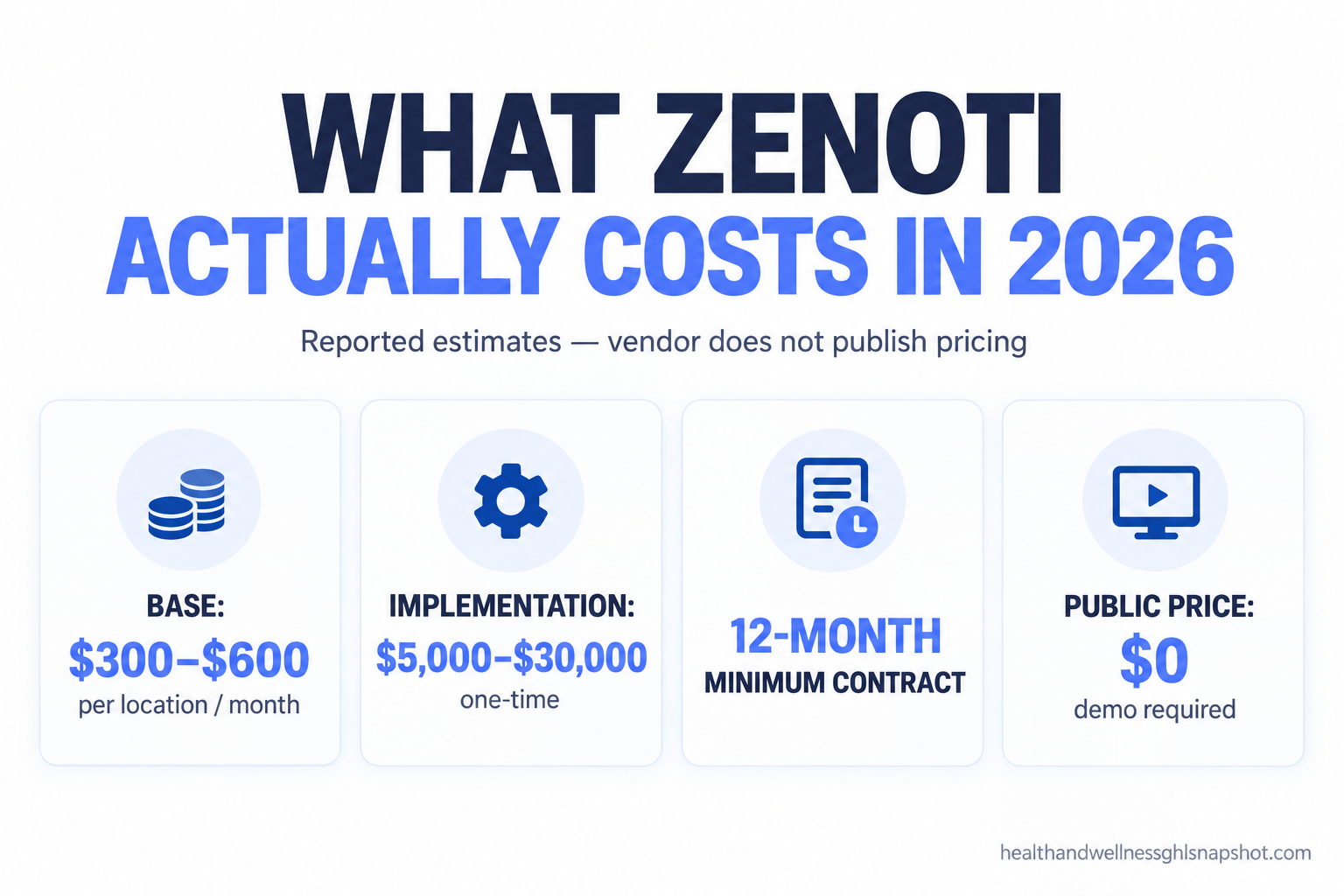
Table of contents
- Why the demo ends without a price
- What a leaking clinic loses
- What Zenoti is, and who it’s for
- The eight things that decide your bill
- The reported 2026 numbers
- What each clinic size pays
- Where Zenoti quietly breaks
- Steal this: checklist and sequence
- Compliance: HIPAA, FTC, and SMS
- Common objections, answered
- The bottom line
- FAQ
Why the demo ends without a price
When a vendor makes you book a call to learn the price, the price is a negotiation, not a number. Zenoti lists no pricing table anywhere. Pricing guides confirm it: every plan, single-location to multi-location to the AI enterprise tier, shows a “request a quote” button and no public dollar amount (SchedulingKit). Capterra shows contact-vendor-for-pricing with no free trial (Capterra).
That tilts the deal toward the rep. Your quote depends on locations, modules, contract length, and negotiated discount, none of it visible until you’re deep in the sales process. One buyer put it bluntly: the salesperson made $1,000 a month seem plenty, and it was not even close (SchedulingKit).
This piece is for the owner of an IV, hormone, or weight-loss clinic, often a nurse practitioner running one to three locations, being pitched enterprise software and wanting to know whether it fits before signing a year away. For the wider market, see what med spa software actually costs in 2026.
What a leaking clinic loses while you shop
The subscription is a cost. The revenue leaking out of your clinic is usually bigger, and that’s what software is supposed to fix.
The American Med Spa Association’s 2024 report puts the average single med-spa location at about $1,398,833 a year, up from $1,307,587 the year before, with an industry that has eclipsed $17 billion and grows by more than a billion dollars a year (AmSpa). The global IV hydration therapy market was valued near $3.0 billion in 2026 and is projected to grow 9.2% a year through 2033 (Grand View Research).
A clinic averaging $1.4 million that loses 10% of its would-be repeat visits to no follow-up leaves six figures on the table a year. The question is whether an enterprise all-in-one is the right-sized tool to plug that leak, or whether you’d pay enterprise money for a problem a focused automation system handles for far less. A one-time IV client who never rebooks is pure lost revenue, and we walked the reasons in why IV therapy clients only come once.
What Zenoti actually is, and who it’s built for
Zenoti is a cloud, all-in-one operating system for spas, salons, and med spas: booking, point of sale, memberships, inventory, payroll, marketing, a consumer app, and reporting, all under one login across many locations (Software Advice). It’s genuinely powerful and genuinely enterprise, rating about 4.4 on G2 and 4.5 on Software Advice, praised for breadth and dinged for complexity and setup (CostBench).
The key fact for a small clinic: Zenoti is priced and built for multi-location operators. ITQlick’s reported scaling runs from around $225 a month for a single user to $10,000 to $15,000 for roughly 100 users and past $50,000 for the largest organizations (Pabau). Run one IV bar or a small NP-owned group and you’re buying a platform whose whole shape assumes you’re bigger than you are, and that mismatch is where the money goes.
The eight things that decide your Zenoti bill
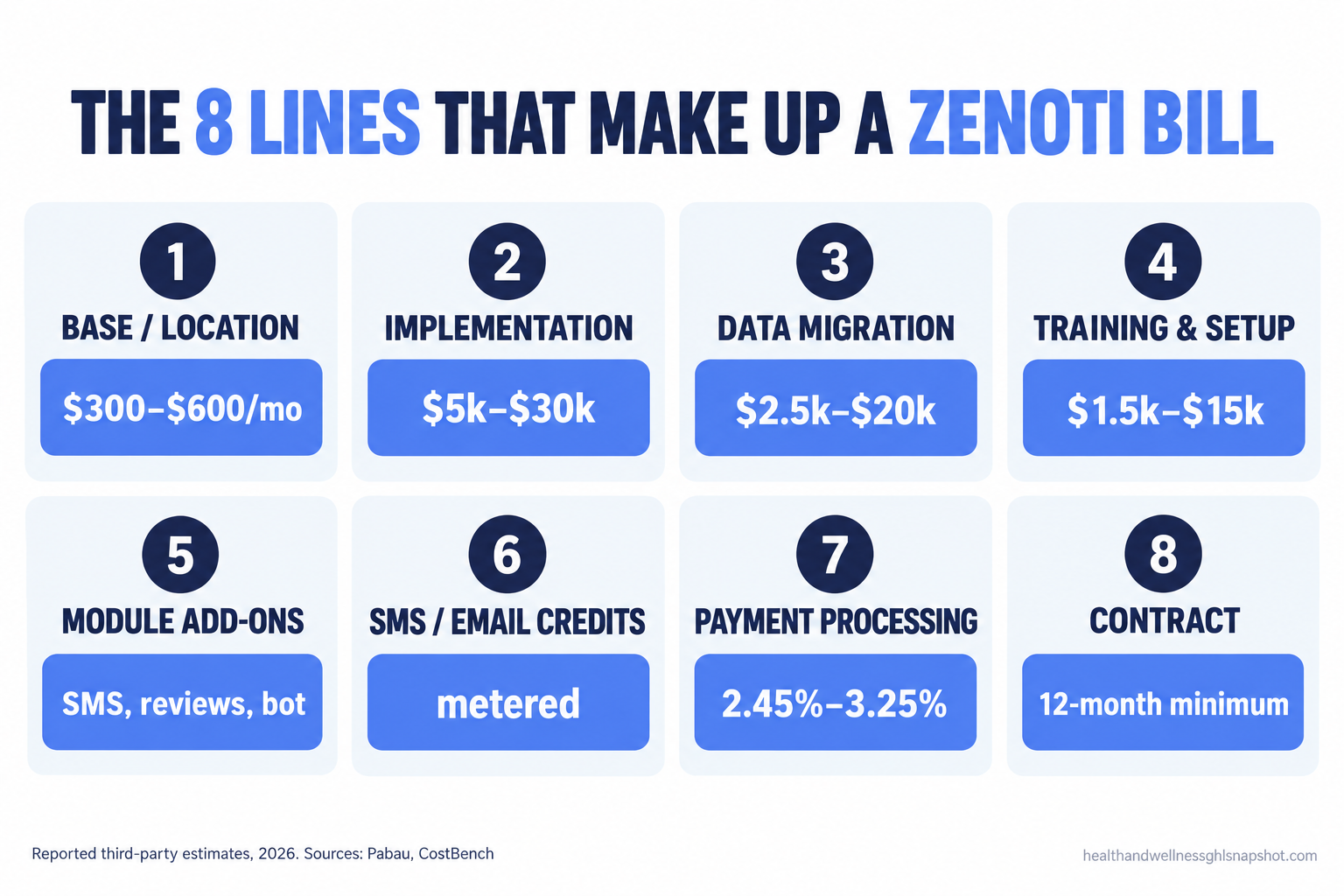
There’s no sticker price, so your quote is assembled from eight moving parts. Get a written number on each.
1. The base per-location subscription
The headline fee the demo talks about. Reported estimates cluster around $300 to $600 per location per month, charged per location, so a three-clinic group pays it three times before a single add-on (Pabau, Software Advice). How it breaks: owners anchor their budget on this number, the only one the rep volunteers, then the real total lands two or three times higher.
2. The one-time implementation fee
The line that ambushes small clinics. Independent estimates put implementation at $5,000 to $30,000 or more by location count and configuration, with smaller operators near $2,000 to $5,000 (CostBench, Pabau). How it breaks: budget the monthly fee alone and your first invoice is four figures bigger.
3. Data migration
Moving client history, packages, and memberships off your old system is its own quoted line, reported from $2,500 to $20,000 (CostBench). How it breaks: this is where go-live dates slip, and a bad import leaves you reconciling records in month one instead of seeing patients.
4. Training and configuration
Onboarding, training, and workflow build-out are quoted separately, reported at roughly $1,500 to $15,000 for training and $3,000 to $20,000 for customization, with a smaller “Professional Services” package near $1,000 (CostBench, Pabau). How it breaks: a platform nobody’s been fully trained on is an expensive way to do what your old software already did.
5. The module add-ons
These feel like core features but are billed on top of the base:
- Two-way text messaging (ezConnect): about $29 to $169 a month (Pabau).
- Reputation management (ezRepute Pro): about $189 a month (Pabau).
- AI chat and booking bot (Smart Bot): roughly $150 to $400 a month (Pabau).
How it breaks: the demo shows the texting and reviews as if they’re standard, then the proposal lists them as line items. Add a couple to a two-location clinic and you’ve quietly added $400 to $700 a month.
6. Metered SMS and email credits
Message volume is a meter on top of the module. Reported top-ups run about $180 for 5,000 SMS credits up to $1,000 for 50,000 (Pabau). How it breaks: the clinic that leans hardest on rebooking texts gets billed for following up with its own patients.
7. Payment processing
Run payments through Zenoti and that’s its own cut, reported around 2.45% plus $0.10 per transaction, up to 3.25% plus $0.10 (CostBench). How it breaks: on $1.4 million in annual card volume, the gap between 2.45% and 3.25% is more than $11,000 a year, easy to wave through as “standard.”
8. The contract
Zenoti’s standard commitment is reported as a 12-month minimum, with 12 to 24 month contracts and early-termination fees typical for enterprise platforms (SchedulingKit). How it breaks: you can’t try it for a quiet month and leave. If the fit is wrong, you pay the full term.
The reported 2026 numbers, charted
Here are the reported ranges side by side.
Reported monthly figures (USD), 2026, before one-time implementation and usage credits. Sources: Pabau, Software Advice.
The point the demo hides: for a clinic that wants the texting, reviews, and AI booking, the add-ons can rival the base subscription. “Starts at $300” is the floor of a room you don’t stay in.
What a solo IV bar, a three-location group, and a ten-location chain each pay
The same software is a different decision at different sizes. Here’s the honest math, using the reported ranges and assuming a clinic that wants the features worth having (two-way SMS, reviews, a bot).
Estimated first-year Zenoti cost by clinic size (reported ranges)
| Plan | Solo IV / weight-loss clinic | Three-location NP group recommended | Ten-location chain |
|---|---|---|---|
| Price | ~$9k–15k yr 1 | ~$30k–55k yr 1 | ~$90k–160k+ yr 1 |
| Feature 1 | Base: ~$300–600/mo | Base: ~$900–1,800/mo (3 sites) | Base: ~$3k–6k/mo (10 sites) |
| Feature 2 | Modules + setup stack on top | Modules + setup: ~$8k–20k to start | Setup: ~$15k–30k+ one-time |
| Feature 3 | Verdict: almost always overkill | Verdict: the real decision point | Verdict: this is who Zenoti is for |
| See a right-sized option | Compare the math | Out of our lane, go demo it |
The solo clinic. Running a platform built for 20 locations means nearly everything that justifies the price, multi-location reporting, payroll across sites, the consumer app, is weight you won’t lift. It’s almost always the wrong-sized tool.
The three-location group. The real decision point, where most readers of this piece sit. Year-one total is now $30,000 to $55,000, enough that the comparison deserves a spreadsheet, not a demo. Is one-login convenience worth two to three times a focused booking tool plus an owned automation system? Often not, because the pieces that actually retain clients, check-ins and renewals, don’t need the enterprise platform to run.
The ten-location chain. Here Zenoti earns its price: across ten sites the all-in-one beats stitching five tools together. This is who it’s for, so book the demo, just walk in with the checklist below.
Where Zenoti quietly breaks for a small clinic
Every platform has failure modes. These bite small clinics hardest.
The setup never fully finishes. Reviewers consistently describe a complex setup and migration (Software Advice). A small clinic without a dedicated ops person often goes live with half the workflows unconfigured, paying enterprise prices to run the software like a basic calendar.
The add-on creep. You sign for the base, then discover texting, reviews, and the bot are extra, so the monthly number drifts up quarter by quarter while the 12-month term means you can’t easily walk.
The credit meter punishes your best habit. The clinics that get the most from automation send the most messages, so metered credits make your reward for following up well a bigger bill (Pabau).
Steal this: the quote checklist and the rebooking sequence
Two things you can use today: the lines to force out of any rep, and a rebooking sequence you can run on a system you own.
And here’s a rebooking sequence for a one-time IV or injectable client, with real timing and copy. (Get SMS consent first, more below.)
None of that requires a $40,000 enterprise platform, just a booking calendar, a consented SMS channel, and a sequence that fires on its own, the retention engine you can run on GoHighLevel with the Wellness Snapshot. If membership billing is the goal, we showed how to run it without a $300-a-month add-on.
Compliance corner: HIPAA, the FTC, and SMS
Three rules follow you whatever software you pick.
HIPAA is not automatic, either way. A clinic that bills insurance or shares protected health information with a covered-entity partner like a lab or referring physician is a covered entity and needs a Business Associate Agreement with any vendor that touches that data (HHS). A pure cash-pay IV bar may fall outside HIPAA but still owes state privacy and breach-notification duties. Get the BAA in writing.
The FTC is watching health claims. It has warned roughly 700 weight-loss and wellness marketers to hold competent and reliable scientific evidence for their claims, and has sent letters to IV-therapy companies over immune and COVID claims (FTC). Your automated texts are marketing: copy that says “boosts immunity,” “melts fat,” or “detoxes” needs real evidence or softening. More in FTC health claims for wellness clinics in 2026.
Health SMS draws heavier carrier filtering. US carriers require 10DLC brand and campaign registration for business texting, and health messaging gets scrutinized harder, so your consent language and opt-out handling must be clean or messages get blocked (CTIA). Get explicit opt-in, honor STOP automatically, keep the records.
Common objections, answered honestly
“We’re growing fast, won’t we need Zenoti eventually?” Maybe, and at ten locations, probably. But buying enterprise software at two locations to prepare for ten is like leasing a 40-seat office for a team of four. Buy for the clinic you run this year.
“Isn’t one login better than stitching tools together?” It’s nicer, and at scale it’s worth real money. At one to three locations the convenience premium is large, and a focused booking tool plus an owned automation layer often does the job for a quarter of the all-in cost.
“We already have booking software. Do we need automation on top?” Your booking tool schedules. It usually doesn’t run a five-week rebooking sequence, a renewal pre-warm, or a review request on autopilot, and that gap is what actually moves retention.
“Do I need to be technical to run the alternative?” No. A done-for-you system is installed and configured for you; you approve the copy and watch it run. The Wellness Snapshot does the technical build for you.
The bottom line
Back to that Thursday demo. The software is real and good, and for a ten-location chain it’s probably the right call. But you run one, two, or three locations, and the proposal that lands a week later, base times locations, plus implementation, modules, credits, and a year’s commitment, is a number built for a business bigger than yours. Zenoti hides its price because the price is a conversation, and conversations favor whoever set the agenda. Now you can set it: walk in with the checklist, force the all-in number into writing, and compare it against the simpler path, a booking tool you already like plus a retention engine you own once. For most clinics under three locations, that path wins on cost and loses nothing that keeps clients coming back, and the check-ins, rebooking, renewals, and reviews come already built for a one-time $997 instead of a monthly enterprise seat.
Frequently asked questions
How much does Zenoti cost per month in 2026?
Zenoti does not publish pricing. Third-party listings put the base at roughly $300 to $600 per location per month, with one directory quoting a start near $225 for a single user. The real total adds one-time implementation, module add-ons, metered SMS and email credits, and payment processing. Get the all-in number in writing before you sign.
Does Zenoti charge a setup or implementation fee?
Yes. Independent estimates put one-time implementation at $5,000 to $30,000 or more by location count and configuration, with migration, training, and customization quoted separately, and smaller clinics reporting $2,000 to $5,000.
Are two-way texting and reviews included in Zenoti's base price?
Reportedly no. Pricing guides list two-way messaging (ezConnect) at about $29 to $169 a month, reputation management (ezRepute Pro) about $189 a month, and an AI booking bot (Smart Bot) roughly $150 to $400 a month, all on top of the base, plus metered credit packages.
Does Zenoti require a contract?
Reportedly yes. Independent sources describe a standard 12-month minimum, with 12 to 24 month contracts and early-termination fees typical for enterprise salon and spa platforms. Confirm the term in the signed agreement.
Is Zenoti worth it for a solo or small clinic?
For one or two locations, usually not. It's priced and built for multi-location operators, so a small clinic pays enterprise money for capabilities it won't use. The booking and retention features a small clinic needs can run on a focused tool plus an owned automation system for a fraction of the cost, with no per-location fee and no year-long lock-in.