
It’s 2:00 on a Thursday and the 2pm isn’t here. You drew up the injection, you prepped the room, your tech is standing by, and the chair that was booked is empty. You text the client. Nothing. You call. Voicemail. By 2:20 you accept it: that slot is gone, and so is the person who would have filled it, because you turned away a walk-in this morning to protect this exact appointment. Most owners look at that empty chair and see one lost visit. That is the mistake. One no-show costs you five or six different things at once, and almost none of them show up on the day’s deposit report.
Here is the honest answer up front: a single no-show at a wellness clinic rarely costs you “one visit.” It costs you the visit, the prepped and perishable supplies, the staff and room you paid for anyway, the client you turned away to hold the slot, the lifetime value of a relationship that may never start, and the admin time your team burns chasing it. Add those up and a $200 IV appointment that no-shows can quietly cost you $400 to $600 in real terms, and far more if it was a membership-shaped client. That is why clinics with the same price list end the year with wildly different numbers. This piece does the full math, runs it for three real clinic shapes, and then shows the recovery system that gets most of that money back, with the exact message copy you can steal.
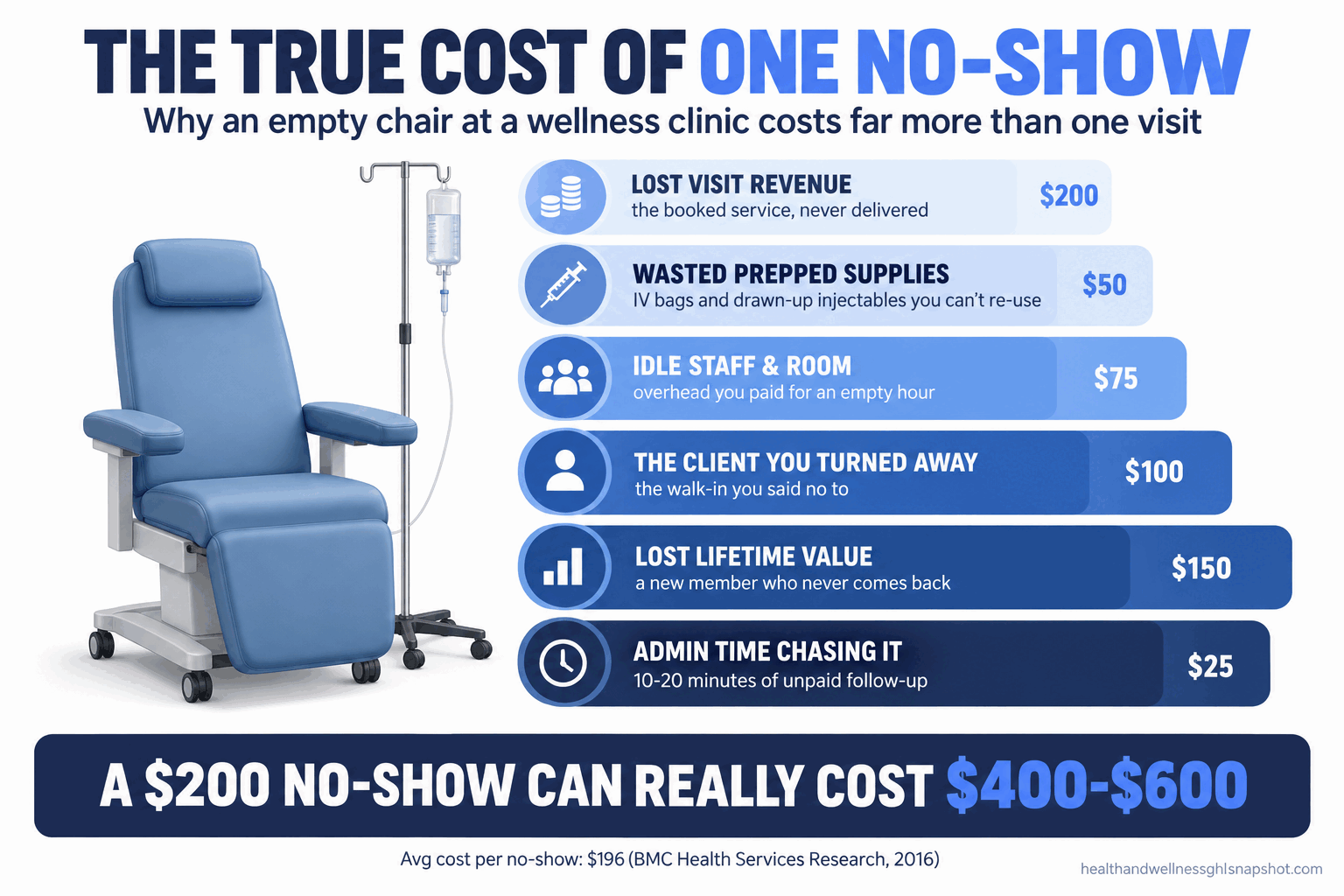
Table of contents
- What a no-show really costs (the headline math)
- The six hidden costs behind one empty chair
- Three clinics, three real annual no-show bills
- Getting the money back: the recovery system
- The compliance rules before you charge for a no-show
- Common objections, answered honestly
- Frequently asked questions
What a no-show really costs (the headline math)
Start with the number everyone uses and why it’s wrong. When your front desk logs a no-show, the note usually reads like a single lost appointment: a $200 IV drip, gone. That is the floor, not the cost. It ignores everything you already spent to make that slot happen and everything that slot was supposed to lead to.
No-shows are not a rounding error in this industry. A peer-reviewed 12-year review of outpatient clinics found a mean no-show rate of 18.8%, ranging from 12.6% in one department to 25.7% in another, at an average cost of $196 per missed appointment (NIH / NCBI). Elective, cash-pay clinics that screen well and take a card tend to run lower; one platform-wide benchmark put med spas near 4% on a median ticket of $216 (Zenoti). The honest range for most IV, hormone, and weight-loss clinics sits somewhere between those poles. Say your clinic runs a conservative 10% to 15%. On a schedule of 40 appointments a week, that is four to six empty chairs every week that you planned and staffed for.
Now attach real money. A single IV drip visit typically runs a client somewhere around $150 to $250. A weight-loss client on monthly GLP-1 injections is worth several hundred dollars a month. And a membership client, the kind that keeps your calendar full, can be worth well over $1,500 across a year. The med spa industry runs on exactly those repeat relationships: returning patients make up about 73% of visits (AmSpa). So the appointment that didn’t happen is rarely just a transaction. It is often the first visit of a relationship that was supposed to repeat.
Illustrative cost of a single $200 IV no-show. The logged figure is the visit alone; the true cost adds wasted supplies, idle staff and room, the displaced client, and admin time; the third bar is the lost first-year value if that no-show ends a would-be $149/month membership. Figures are simple arithmetic to show the shape of the loss, not a guarantee.
This is a big-dollar backdrop, not a small one. Average annual revenue per med spa location rose to about $1,398,833, up from $1,307,587 in AmSpa’s prior report, on an average spend of $527 per visit (AmSpa), and the IV hydration segment alone is projected near $3.0 billion in 2026 at a 9.2% CAGR (Grand View Research). On a seven-figure location, a no-show rate you never measured is a five-figure leak you never fixed.
The six hidden costs behind one empty chair
Break one no-show into its parts and the real bill appears. Here are the six costs stacked inside a single missed appointment, each with the math and, just as important, the way clinics underestimate it. If you only fix the first one, you leave the other five on the table.
Cost 1: The lost visit revenue (the only one you count)
This is the floor, and it’s the smallest piece. The booked service didn’t get delivered, so the revenue didn’t land. A $200 drip, a $350 hormone follow-up, a $500 GLP-1 month. Simple, visible, and the only line most clinics track.
How clinics underestimate it: they treat it as the whole story and stop there. The visit price is the one cost you would recover completely just by rebooking the client next week. The costs below are the ones you usually never get back, which is exactly why they matter more.
Cost 2: The wasted prepped and perishable supplies
In a procedure clinic, you spend before the client arrives. Unlike a haircut or a coaching call, your appointments often consume real goods the moment you prep. An IV bag mixed with a vitamin cocktail, a syringe drawn up with a peptide or a GLP-1 dose, a numbing agent opened. If the client no-shows after you’ve prepped, some of that is gone. Single-dose vials you’ve drawn from, a mixed bag past its stable window, anything you can’t legally or safely re-shelf.
Put a number on it. If a no-show wastes even $20 to $60 of prepped product on an injectable or IV visit, that is a direct hard-cost loss on top of the missing revenue. Over a year of no-shows, perishable waste alone can run into the thousands.
How it breaks: the fix is sequencing, not just reminders. Clinics that prep the moment the appointment is booked waste the most. The move is to prep only after same-day confirmation, so a no-show costs you a chair but not a vial. If your workflow can’t tell you who has confirmed for the next hour, you’re prepping blind.
Cost 3: The staff and room you paid for anyway
Your overhead doesn’t care that the chair was empty. You staffed that hour. The nurse or tech is on the clock, the rent is running, the room was reserved and not rented to another service. Those are fixed costs you incurred to be ready for an appointment that evaporated.
Here’s the honest version: idle staff cost is only a true loss if the slot stays empty. If you can backfill it from a waitlist, the staff time gets used and the loss shrinks to almost nothing. That single fact is why the recovery system later leans so hard on a waitlist. The cost of a no-show is largely the cost of not filling the gap in time.
How it breaks: without an instant waitlist and a way to text standby clients the moment a slot opens, that hour is unrecoverable. By the time your front desk notices the gap and starts calling around, the hour is half over and nobody can get there.
Cost 4: The client you turned away to hold the slot
This is the cost nobody logs: the appointment you said no to. You protected the 2pm, so when someone called at noon wanting a drip that afternoon, you told them you were booked. They went elsewhere. Then your 2pm no-showed. Now you’ve lost both: the one who didn’t come and the one you turned away to make room for them.
This opportunity cost is invisible because it never appears on your schedule. But it’s real money, and it’s double. On a busy day for a popular IV bar or a weight-loss clinic with a packed injection calendar, the slot you held was a slot someone else wanted.
How it breaks: overbooking blindly to compensate creates its own disaster, double-booked clients and angry waits. The answer is a managed waitlist that converts a no-show into a filled slot, not a guess that two people won’t show.
Cost 5: The lost lifetime value, not the lost visit
This is the one that actually hurts, and it’s the one you can’t see on the day. A no-show on an established member is an annoyance. A no-show on a brand-new client who was testing you out can be the end of a relationship worth thousands. They didn’t just miss a drip. They never started the membership, never came back monthly, never referred their sister.
The math here dwarfs everything above. Returning patients make up roughly 73% of med spa visits (AmSpa), so your business is literally built on people coming back. A new client who no-shows and ghosts is a repeat relationship that never got off the ground. If that person would have been a $149-a-month membership, the true cost of their no-show isn’t $200. It’s closer to $1,800 over a year, plus the referrals you’ll never trace.
How it breaks: most clinics treat a first-visit no-show the same as any other, a quick “sorry we missed you” and a dropped thread. The relationship dies from neglect. A new-client no-show needs a warmer, more persistent rescue than a regular’s, because you’re not rebooking a visit, you’re saving a customer. We go deep on this exact failure in why IV therapy clients only come once.
Cost 6: The admin tax of chasing, rebooking, and morale
Every no-show creates work that pays you nothing. Someone has to notice the gap, try to reach the client, update the schedule, decide whether to charge a fee, process it, and rebook. On a manual front desk that is 10 to 20 minutes of real labor per no-show, and it lands on the exact person who is already underwater. Multiply by a handful of no-shows a week and you’ve bought a part-time job you never wanted.
There’s a softer cost here too. A schedule full of gaps and chase-ups wears your team down and makes the day feel out of control. The clinics that automate this part don’t just save the minutes, they give the front desk back a sense that the schedule is holding together.
How it breaks: when the chasing is manual, it gets skipped the moment the clinic gets busy, which is exactly when no-shows cluster. The follow-up that would have rebooked the client never goes out, and the loss becomes permanent.
Three clinics, three real annual no-show bills
The six costs are the same everywhere. The annual bill is not. How much no-shows cost you depends on your volume, your average ticket, and how much of your revenue is repeat. Here’s the honest version for three real clinic shapes, with round numbers you can swap for your own.
The solo RN running an IV bar. Say you run 30 appointments a week at an average ticket of $200, and your no-show rate is 12% because you take walk-ins and don’t always confirm. That’s about 3.6 no-shows a week, or roughly 187 a year. At the logged visit price alone that’s about $37,000 of unbilled appointments. Add perishable waste, the occasional turned-away walk-in, and the first-visit relationships that never started, and the true drag is comfortably higher. For a solo owner, even recovering half of this is a meaningful raise.
The three-location hormone and weight-loss clinic. Higher tickets, more repeat revenue, more at stake. Say 120 appointments a week across locations at a $350 blended average, with a 10% no-show rate. That’s 12 no-shows a week, around 624 a year, roughly $218,000 in logged visit value before you count lifetime value. Because so much of this clinic’s revenue is monthly GLP-1 and hormone follow-ups, the lifetime-value leak is the real story: a no-show that breaks a monthly cadence can end a client who was worth thousands.
The larger med spa with a front-desk team. You have staff, so the chasing cost is absorbed, but the opportunity cost climbs because your slots are in demand and your ad spend runs constantly. At 250 appointments a week, a $300 average, and an 8% no-show rate even with a good team, that’s 20 no-shows a week and over 1,000 a year. The visit value alone clears $300,000. Here the fix isn’t effort, it’s consistency: every slot backfilled from a waitlist, every deposit enforced the same way, every rescue sent automatically.
Illustrative annual lost visit revenue from no-shows at three clinic sizes, using the example volumes, average tickets, and no-show rates described above. These count only logged visit value, not perishable waste, opportunity cost, or lost lifetime value, so they are a floor, not a ceiling. Swap in your own numbers to size your real leak.
Getting the money back: the recovery system
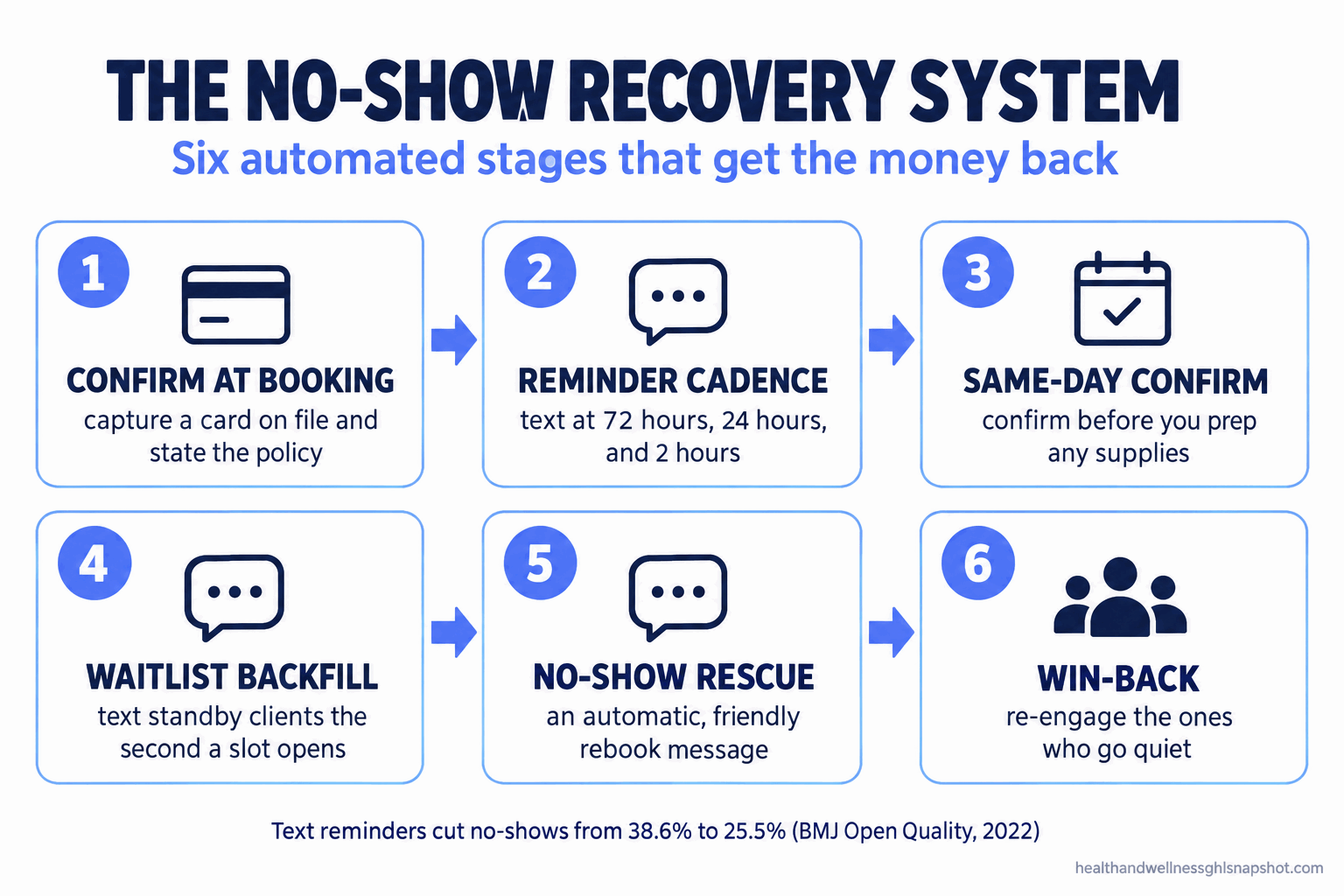
You don’t fix no-shows with willpower. You fix them with a sequence. The good news in all six costs is that almost every one of them shrinks when you add a few automated steps between booking and the appointment. Here is the system, stage by stage, with the exact copy you can lift. In one study, SMS reminders alone cut no-shows from 38.6% to 25.5% (NIH / NCBI), and the other stages compound on top.
Stage 1: Confirm at booking, with a card on file or deposit
The single biggest lever is a card on file. The moment someone books, you capture a card and set a clear cancellation policy, for example a fee or a forfeited deposit for a no-show or a late cancel. This does two things: it filters out the least committed bookings before they ever clog your calendar, and it gives you a real recovery when someone ghosts. Keep it fair and stated up front, never a surprise.
Stage 2: The reminder cadence (72 hours, 24 hours, 2 hours)
Most no-shows are forgetfulness, not flaking. A spaced reminder cadence catches the people who simply lost track, on the channel they actually use. Remember, 48% of patients prefer a text reminder over a phone call or email (Phreesia). Send a friendly confirm-request at 72 hours, a nudge at 24 hours, and a short “see you soon” at 2 hours with directions.
How it breaks: one reminder isn’t a cadence. A single text three days out gets forgotten by the day of. And a cadence with no reply path just talks at people. Every reminder needs a one-tap confirm or reschedule, so the client can act in the two seconds they’re looking at it.
Stage 3: Same-day confirmation before you prep
This is the stage that saves your supplies. Tie your prep to confirmation, not to the calendar. The 2-hour reminder asks for an explicit confirm, and your workflow flags who has and hasn’t. Your clinical team prepares product for confirmed appointments first. A no-show then costs you a chair, not a drawn-up vial or a mixed bag you have to discard.
Stage 4: The waitlist backfill
A filled slot has almost no no-show cost. Keep a standing waitlist of clients who wanted an earlier time. The second a slot opens, whether from a cancel or an unconfirmed appointment, fire a text to the waitlist offering it first-come. This is how you turn an idle hour back into revenue and rescue the opportunity cost from Cost 4.
Stage 5: The automatic no-show rescue
When someone does miss, the follow-up decides whether they come back. A no-show isn’t the end if you reach back out warmly and fast. Fire an automatic message that assumes the best, offers an easy rebook, and applies your policy without a lecture. For a brand-new client, make it warmer and try twice, because you’re saving a relationship, not a slot.
Stage 6: The win-back for the ones who ghost
Some won’t reply, and they’re still worth money. A client who no-showed and went quiet isn’t gone, they’re dormant. A short win-back a week or two later, with a reason to return, recovers a surprising share of them. This is the same muscle as our full client reactivation and win-back playbook, pointed at your no-show list.
How it breaks: if the rescue and win-back are manual, they don’t happen. The front desk means to send them, then a busy afternoon swallows the intention, and the client who was one text away from rebooking never hears from you again.
The compliance rules before you charge for a no-show
The moment you text clients and charge fees, three rules apply, and this niche is watched closely. None are hard to follow. All are expensive to ignore.
SMS consent (TCPA and 10DLC). Automated appointment texts are business messaging. US carriers route them through A2P 10DLC brand and campaign registration, and health-related messaging is filtered more heavily than retail, so registration matters more here. Capture explicit opt-in when someone books, include a clear opt-out in your messaging, and honor STOP immediately. Our HIPAA-aware SMS guide covers the consent language in detail.
No-show fees and card-on-file rules. Charging a cancellation or no-show fee is legal and common, but it has to be disclosed clearly before you book the client and applied consistently. Keep the policy in writing, state it at booking, and store cards with a PCI-compliant processor, never in a spreadsheet. Check your state and your processor’s rules on holding and charging a card for a no-show, since the details vary.
HIPAA and FTC, kept simple. If you bill insurance or share information with covered partners like labs, you’re a covered entity and your texts must be handled accordingly. A pure cash-pay IV bar may sit outside HIPAA but still owes state privacy duties, so never assume the exemption. Keep automated texts about logistics, not clinical detail. And because your reminder copy is marketing, keep it about the appointment, not health promises the FTC would make you substantiate, a topic we cover in the 2026 FTC health-claims guide.
Common objections, answered honestly
“Won’t a no-show fee scare clients away?” A clear, fair policy stated up front does the opposite. It signals you run a real practice, and it filters out the least committed bookings that were going to no-show anyway. The clients you want, the ones who become members, expect a card on file. The ones a deposit scares off were rarely going to show.
“I feel bad charging someone who had a real emergency.” Then don’t, and build that into the system. A good setup lets you waive a fee with one tap when someone has a genuine reason, while still enforcing it by default. The policy protects your calendar; your judgment handles the exceptions. Automating the default is what frees you to be generous on the real cases.
“I already pay for Boulevard (or Jane, or Mangomint). Doesn’t it remind clients?” Your booking software sends a reminder. What it usually doesn’t do is run a full recovery system: a card-on-file policy enforced consistently, a same-day confirm tied to your prep, an instant waitlist backfill, and a warm, persistent rescue that treats a new client differently from a regular. Those are retention jobs, not scheduling jobs. We compare the clinical platforms directly in Boulevard vs Mangomint and the broader market in what med spa software actually costs.
“Do I need to be technical to run this?” No. The workflows get built once, correctly, then they run on their own. Your daily job becomes glancing at who’s confirmed and replying to the few conversations that need a person. The build is the technical part, and it’s a one-time job.
Frequently asked questions
What is the real cost of a single no-show at a wellness clinic?
Far more than the price of the visit. One no-show stacks six costs: the lost visit revenue, any prepped and perishable supplies you can't re-use, the staff and room you paid for anyway, the client you turned away to hold the slot, the lost lifetime value if it ends a new relationship, and the admin time spent chasing and rebooking. A $200 IV no-show can realistically cost $400 to $600 in true terms, and far more if the client would have become a member worth over a thousand dollars a year.
What is a typical no-show rate for an IV or med spa clinic?
A peer-reviewed study of outpatient clinics found a mean no-show rate of 18.8%, ranging from 12.6% to 25.7% by department. Elective, cash-pay clinics that screen well and take a card on file often run lower, with one platform benchmark putting med spas near 4%, while clinics that don't confirm or hold a card run higher. The point isn't the exact rate, it's that you should measure yours, because it's almost certainly costing more than you think.
Do text reminders actually reduce no-shows?
Yes. In one study, SMS appointment reminders cut no-shows from 38.6% to 25.5%, and text is also what patients prefer: 48% choose a text reminder over a phone call or email. The strongest results come from a cadence with a one-tap confirm or reschedule, not a single text, combined with a card on file for the clients who still don't commit.
Can I legally charge a no-show or late-cancellation fee?
Generally yes, as long as you disclose the policy clearly before the client books, apply it consistently, and store any card with a PCI-compliant processor. The specifics of holding and charging a card can vary by state and by your processor's rules, so confirm both. A fair, stated policy is standard practice at serious clinics and is one of the single biggest levers on your no-show rate.
How does a waitlist help with no-shows?
A no-show mostly costs you because the slot stays empty. A standing waitlist of clients who wanted an earlier time lets you backfill an opening the moment it appears, turning an idle, pre-staffed hour back into revenue. It's the most direct fix for the opportunity cost of a no-show, and it's nearly impossible to run manually because the window to fill a slot is short.
What should I do differently for a new client who no-shows versus a regular?
Treat a first-visit no-show as a relationship to save, not a slot to rebook. New clients make up the lifetime-value risk, since returning patients drive about 73% of med spa visits and a new no-show may be a membership that never starts. Use a warmer rescue, reach out twice, and make rebooking effortless. For a known regular, a single friendly rebook link and the stated policy is usually enough.
Won't automating all this make my clinic feel impersonal?
Only if you write it coldly. The copy above uses first names, sounds human, and always offers a real person and an easy out. Clients don't experience a prompt, friendly confirmation as automation, they experience it as a clinic that's organized and respects their time. The impersonal version is the one that forgets to remind them, then charges a surprise fee.
By 2:30 that Thursday, a different version of the day is possible. The client who was going to no-show got a same-day confirm text at noon, didn’t reply, so you held the prep. At 2:05 your waitlist fired an opening to three standby clients, and one of them is already in the chair you’d have left empty. The no-show got an automatic rescue and rebooked for Friday, card-on-file fee applied without an awkward phone call. You didn’t chase anyone. The gap filled itself, the supplies weren’t wasted, and the relationship didn’t die. That’s the whole point of doing the math on no-shows: once you can see all six costs, you can see that almost every one of them is recoverable, if the system catches the gap before you do.
Keep reading: How to reduce appointment no-shows · Why IV therapy clients only come once · Turn one-time IV clients into members · Client reactivation and win-back
This article is for general informational purposes and is not legal, medical, tax, or compliance advice. Statistics are as published or reported at the time of writing and change frequently; confirm the current figure on each source’s own page before relying on it. Each practice is responsible for its own HIPAA, TCPA, FTC, and state privacy obligations.