A prospective client in Los Angeles just found your wellness practice. It’s 7:40 p.m., they’re scrolling on the couch after work, and they tap “call” on the first weight-loss clinic, hormone specialist, or nutrition coach that looks credible. Your line rings out to voicemail — you’re with family, or mid-session, or simply closed. They don’t leave a message. They tap back to the map and call the next practice on the list. You never learn their name, and you never knew they were lost.
An AI receptionist is a 24/7 voice agent that answers every one of those calls in your practice’s tone, qualifies the caller, and books the consult directly into your calendar — even after hours — so the client your competitor missed becomes the client you keep. This guide covers what an AI receptionist actually is, why Los Angeles wellness practices lose so much revenue on the phone, the honest math on a single missed call, and how the whole system runs without adding a person to your payroll. Every statistic below is sourced, and the realistic caveat runs throughout: results depend on your call volume, your offer, and how fast you follow up.
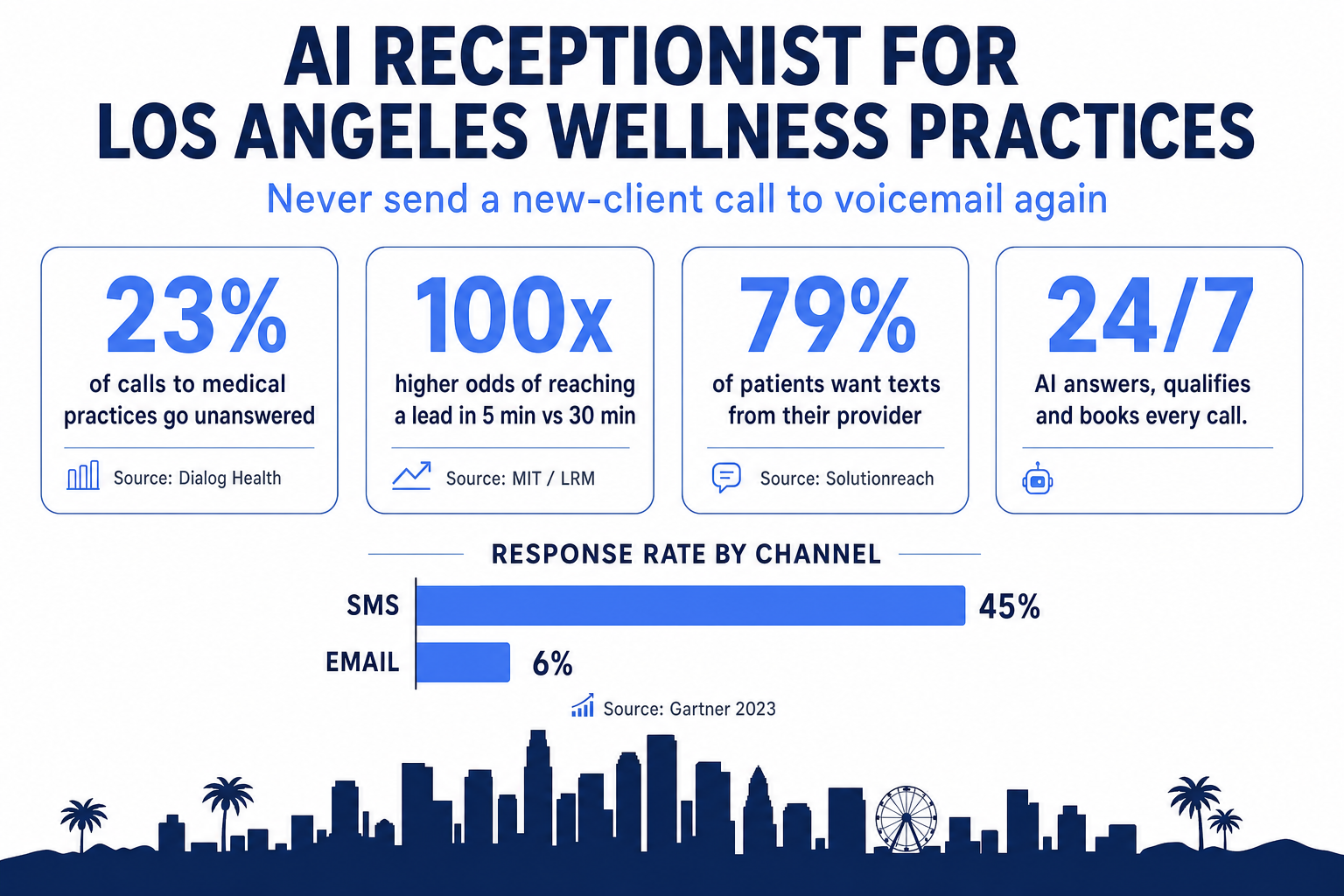
Table of contents
- What is an AI receptionist for a wellness practice?
- Why Los Angeles wellness practices lose clients on the phone
- The honest math on a single missed call
- Why callers don’t wait: the speed-to-lead reality
- How an AI receptionist works, step by step
- AI receptionist vs voicemail vs answering service vs front desk
- Is it HIPAA- and TCPA-safe?
- What to look for in an AI receptionist for a California practice
- Frequently asked questions
What is an AI receptionist for a wellness practice?
An AI receptionist is a natural-voice AI agent that answers your practice’s phone around the clock, greets callers in your brand’s tone, asks qualifying questions, checks your live availability, and books the consult or first session — then logs the whole interaction to the client record. Think of it as a front desk that never sleeps, never takes lunch, and never sends a motivated new client to voicemail.
It is not a robotic phone tree (“press 1 for hours”). A modern AI receptionist holds a real conversation: it can explain that you offer 12-week weight-loss programs, answer “do you take my situation?” style questions from a script you approve, capture the caller’s name and goal, and drop a booking straight onto your calendar. If the caller would rather text, it hands off to SMS. If a call is ever missed during overflow, it texts back within seconds so the thread stays warm until a human can pick it up.
For a Los Angeles wellness practice — where a single new coaching package, hormone consult, or functional-medicine intake can be worth thousands over its lifetime — the difference between “answered in one ring at 9 p.m.” and “reached voicemail” is the difference between a booked client and a lost one.
Why Los Angeles wellness practices lose clients on the phone
Los Angeles is one of the most competitive wellness markets in the country, which means a missed call rarely goes unanswered — it just gets answered by someone else. The U.S. wellness economy reached roughly $2.1 trillion in 2024 — the largest in the world (Global Wellness Institute, 2024) — and Los Angeles sits near the center of it, with one of the densest concentrations of med spas, coaches, and clinics anywhere in the country (the U.S. now has more than 11,000 med spas alone, averaging about $1.4M in annual revenue — AmSpa, 2024). A searcher looking for a “nutritionist near me” or “hormone doctor in LA” is presented with a dense list of options, and behavior on high-intent local searches is fast: about 76% of people who run a nearby search on their phone visit or contact a business within a day (Backlinko). When your practice is one tap in a long list, the one that picks up wins.
The problem is that wellness practitioners are, by design, unavailable during the exact hours prospects call. You’re in session, running a class, or off the clock — and yet roughly 23% of calls to medical practices go unanswered (Dialog Health, 2025). Meanwhile, patients have made it clear they will leave over friction: about 30% switched providers in a single year, with access and administrative hassle among the top drivers (Accenture via Healthcare Dive, 2022). In a market as saturated as LA County, that churn flows straight to whichever competitor answered first.
The honest reality: you don’t lose these clients because you’re a worse practitioner. You lose them because nobody answered, and nothing answered for you.
The honest math on a single missed call
The cost of a missed call isn’t the call — it’s the lifetime value of the client behind it, multiplied by how often it happens. Wellness relationships are long: a nutrition-coaching client on a multi-month package, a hormone patient on quarterly retests, or a weight-loss member on a recurring program can represent well over a thousand dollars in value across the engagement. Lose one motivated caller a week to voicemail and the annual number gets uncomfortable fast.
Zoom out and the systemic waste is staggering. Missed and no-show appointments alone cost the U.S. healthcare system an estimated $150 billion a year (Healthcare Finance News). For an individual LA practice, the leak is smaller but the mechanics are identical: every unanswered ring during a session, every after-hours call that hit voicemail, is a prospect who was ready to act and found no one home.
The point isn’t to guilt you into answering your phone at 9 p.m. — it’s to show that a system which answers for you pays for itself off a single recovered client a month.
Why callers don’t wait: the speed-to-lead reality
Speed to lead — the time between a prospect reaching out and you responding — is one of the highest-leverage numbers in a practice, and after-hours calls make it brutal. The classic research is unambiguous: the odds of contacting a new lead are up to 100× higher, and the odds of qualifying them 21× higher, when you respond within 5 minutes versus waiting 30 minutes (Lead Response Management / MIT, 2007). A voicemail you return the next morning is competing against practices that answered on the first ring.
Relative odds of qualifying a new lead by response time (30-minute response indexed to 1). Source: Lead Response Management / MIT, 2007.
And yet most businesses are slow. In a landmark study of web-lead response, the average firm took about 42 hours to respond, only 37% responded within an hour, and 23% never responded at all (Harvard Business Review, 2011). For a wellness practice, “slow” usually means “closed” — the call came in after hours and there was simply no one there.
When you do reconnect, text wins. SMS carries roughly a 98% open rate and ~45% response rate, against about 20% and 6% for email (Gartner, 2023), and 79% of patients say they want to receive texts from their provider (Solutionreach, 2023). An AI receptionist wins the first five minutes on voice, then keeps the conversation alive over the channel people actually respond to.
Average response rate by channel (%). Source: Gartner, 2023.
This is the same logic behind missed-call text-back for wellness practices and the broader speed-to-lead playbook — an AI receptionist is the version that also answers the phone before the text ever has to fire.
How an AI receptionist works, step by step
The workflow is simple on the surface and does a lot of quiet work underneath. Here is what happens from the moment a Los Angeles prospect dials your number:
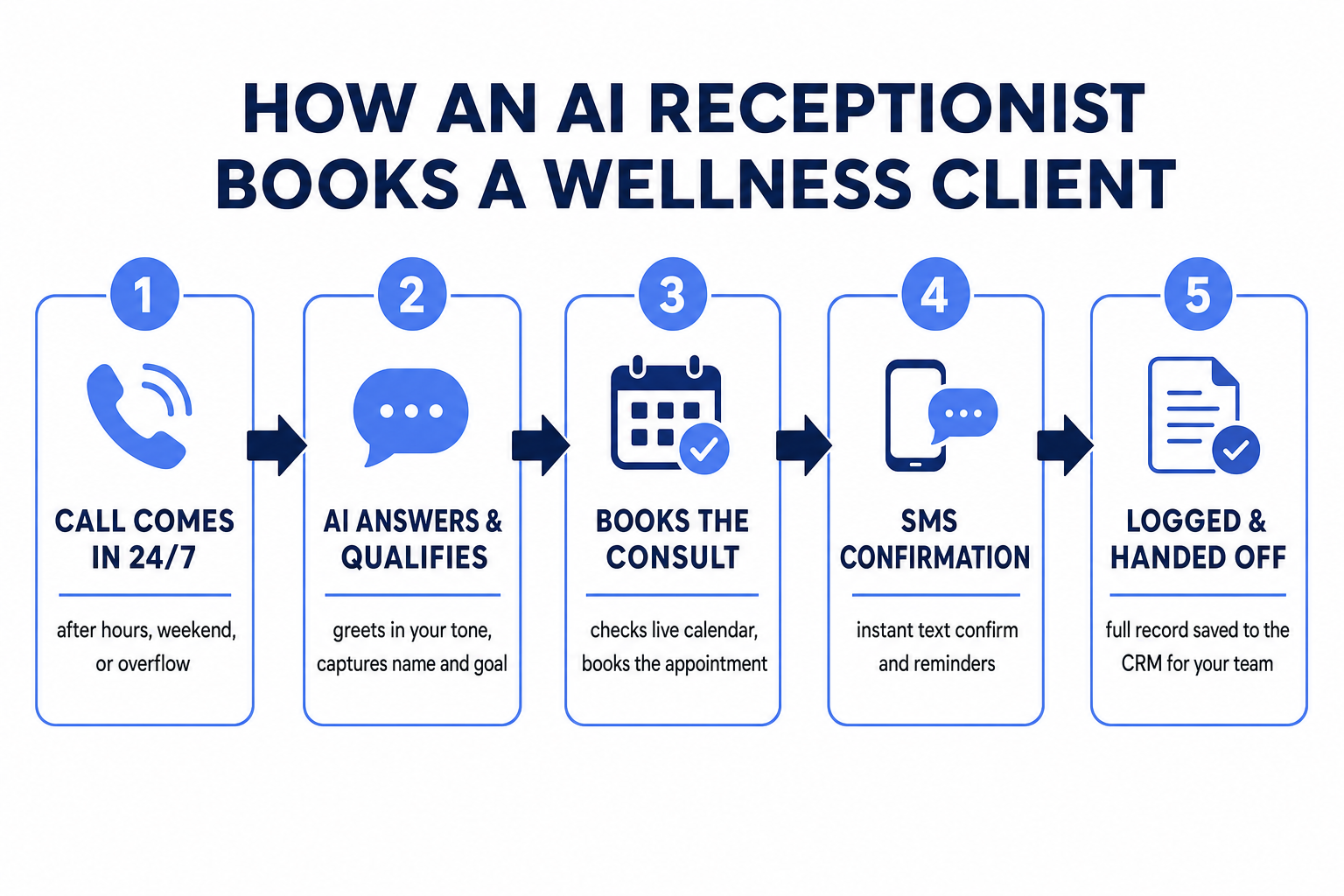
- A call comes in — 24/7. Daytime overflow, a 9 p.m. inquiry, a Sunday-morning “do you have openings?” — every call is answered on the first or second ring instead of rolling to voicemail.
- The AI answers and qualifies. It greets the caller in your practice’s tone, answers approved questions about your programs and hours, and captures the essentials: name, goal, and what they’re looking for.
- It checks your live calendar and books. Instead of “someone will call you back,” the AI offers real open slots and books the consult or first session directly — while the caller is still motivated.
- It confirms by SMS. A text confirmation lands immediately, with reminders scheduled to cut no-shows — the channel patients actually read.
- If a call is ever missed, it texts back in seconds. Overflow or a dropped call triggers an instant “Sorry we missed you — this is [Practice], how can we help?” so the lead stays warm.
- Everything is logged and handed off. The full interaction is written to the client record in the CRM, so your team picks up with context instead of starting cold.
The result: your phone line stops being a leak and starts being a booking engine, and your team focuses on the clients in front of them instead of chasing the ones who called while they were busy.
AI receptionist vs voicemail vs answering service vs front desk
Most practices default to voicemail, upgrade to a human answering service, or hire front-desk staff — each of which trades one problem for another. Here’s how the options actually compare for a wellness practice:
| Capability | Voicemail | Human answering service | In-house front desk | AI receptionist |
|---|---|---|---|---|
| Answers 24/7 (nights, weekends) | Records only | Usually, at a premium | No — office hours only | Yes, always |
| Books directly into your calendar | No | Sometimes | Yes | Yes, instantly |
| Knows your programs & script | No | Generically | Yes | Yes, trained on you |
| Instant SMS follow-up on misses | No | Rarely | Manual | Yes, in seconds |
| Scales with call volume | N/A | Costs rise per call | Hire more people | Handles spikes flat |
| Logs every call to the CRM | No | Varies | Manual | Yes, automatically |
| Typical ongoing cost | Free (and costly) | Per-minute / per-call | Salary + benefits | Flat, predictable |
Voicemail is free and expensive — it “works” and loses you clients at the same time. A human answering service can be excellent but rarely knows your programs, and per-call pricing punishes exactly the volume you want. Front-desk staff are invaluable during office hours, but they go home — and after-hours is when a huge share of high-intent wellness calls actually land. An AI receptionist covers the gap none of the others do: it’s on at 9 p.m. and on Sundays, it’s trained on your offer, and its cost doesn’t spike when you get busy.
If you’d rather not run any of it yourself, a dedicated wellness VA can operate the whole system for you — or you can have our team build and customize the automation around your existing tools.
Is it HIPAA- and TCPA-safe?
Compliance is exactly where a wellness AI system has to be conservative, so a well-built AI receptionist is designed to capture lead and scheduling details only — not clinical PHI in plain channels. The AI Caller in the Wellness Snapshot is built TCPA-aware: outbound re-engagement calls and SMS respect quiet hours and opt-out preferences, and the system honors STOP requests on the texting side.
A few honest guardrails to hold yourself to:
- Consent first. Text callers on a TCPA-aware basis and make opt-out effortless (reply STOP). The HIPAA-aware SMS guide walks through the specifics for wellness practices.
- Keep PHI out of plain channels. The receptionist should collect name, goal, and scheduling — not diagnoses or sensitive health details over unencrypted SMS.
- You own the clinical claims. We are not a healthcare provider and the automation does not diagnose, treat, or advise. Your license, your HIPAA obligations, and your FTC health-claim compliance remain yours — the AI is your lead-capture and communication layer, nothing more.
Built this way, an AI receptionist reduces compliance risk versus ad-hoc staff texting from personal phones, because every interaction runs through one consistent, logged, consent-aware system.
What to look for in an AI receptionist for a California practice
Not every “AI phone answering” tool is built for a regulated, relationship-driven wellness practice. If you’re evaluating one for a Los Angeles or wider California practice, insist on:
- Real calendar booking, not just message-taking — the whole value is booking the consult while the caller is hot.
- Trained on your programs and tone, so it sounds like your front desk, not a generic bot.
- Built-in missed-call SMS recovery, because even the best system will have overflow moments.
- TCPA-aware messaging with quiet-hours and STOP handling baked in.
- CRM logging and handoff, so your team continues with full context.
- A flat, predictable cost that doesn’t punish you for getting busy.
The phone line, before and after
Evening and weekend calls roll to voicemail. Callers hang up without a message and book the next LA practice on the list. You never learn who called, and follow-up is a next-morning scramble.
Every call answered in one ring, 24/7. New clients qualified and booked into the calendar on the spot, missed calls recovered by SMS in seconds, and every interaction logged to the CRM for your team.
The AI Caller is one of 11 automation features in the Wellness Snapshot — a done-for-you GoHighLevel system installed in about 24 hours that you own outright. It answers the calls you can’t, so the clients your competitors miss become yours.
Frequently asked questions
AI receptionist for wellness practices — FAQ
What is an AI receptionist for a wellness practice?
It's a 24/7 natural-voice AI agent that answers your practice's phone, greets callers in your tone, answers approved questions about your programs, qualifies the caller, and books the consult directly into your calendar — then logs the interaction to your CRM. It's built to capture lead and scheduling details, not clinical PHI in plain channels.
How does it help a Los Angeles practice specifically?
Los Angeles is a dense, competitive wellness market where a missed call is usually answered by a competitor within minutes — about 76% of people who run a nearby search contact a business within a day. Because roughly 23% of calls to medical practices go unanswered, an AI receptionist that picks up at 9 p.m. or on a Sunday captures the high-intent LA callers who would otherwise book elsewhere.
Is an AI receptionist HIPAA- and TCPA-compliant?
A well-built one is designed to be conservative: it collects name, goal, and scheduling — not sensitive PHI over unencrypted channels — and its SMS respects quiet hours and honors STOP opt-outs on a TCPA-aware basis. We are not a healthcare provider; your clinical claims, HIPAA obligations, and FTC compliance remain your responsibility. See our HIPAA-aware SMS guide for specifics.
Will it replace my front desk?
No — it complements them. Your front desk is invaluable during office hours; the AI receptionist covers the nights, weekends, and overflow moments when calls would otherwise hit voicemail. Together they mean no motivated caller ever goes unanswered, and your team works with full context because every call is logged.
How fast can I get one running?
The AI Caller ships as feature #1 of 11 in the Wellness Snapshot, a done-for-you GoHighLevel system installed in about 24 hours. You can also book a free 30-minute demo to watch it answer and book a real consult before you decide, or have a wellness VA run the whole system for you.
Written by Kwame Adeyemi, GHL Snapshot Engineer. Kwame builds and stress-tests the workflows that ship inside the Wellness Snapshot — including the AI Caller, its missed-call SMS recovery, and the consent gates behind them. He translates technical GoHighLevel mechanics into language a busy practitioner can act on. Kwame is a GoHighLevel automation specialist, not a licensed healthcare provider; nothing here is medical advice.
Keep reading: Missed-Call Text-Back for Wellness Practices · Speed to Lead: Why the First 5 Minutes Decide the Client · Reduce Appointment No-Shows · Local SEO for Wellness Practitioners