
A prospective client in Scottsdale finishes a Reel about hormone testing at 8:40 p.m., taps your profile, and calls. You’re mid-session, at dinner, or asleep — so the call rings out. Now you have a choice every growing wellness practice eventually faces: pay a live answering service to pick up, or install an AI receptionist that answers, qualifies, and books the consult on its own. Both beat a missed call. They are not the same purchase.
For most Scottsdale wellness practices in 2026, a 24/7 AI receptionist wins on cost, speed, and booked appointments — because it answers in seconds, drops the consult straight into your calendar, and charges a flat rate instead of billing by the minute. A live answering service still earns its place for high-touch, complex, or crisis-sensitive calls where a human voice matters more than speed. This is the honest, sourced comparison — what each one actually does, what each costs, and how to decide. Every statistic below carries its source, and the caveats are called out throughout.
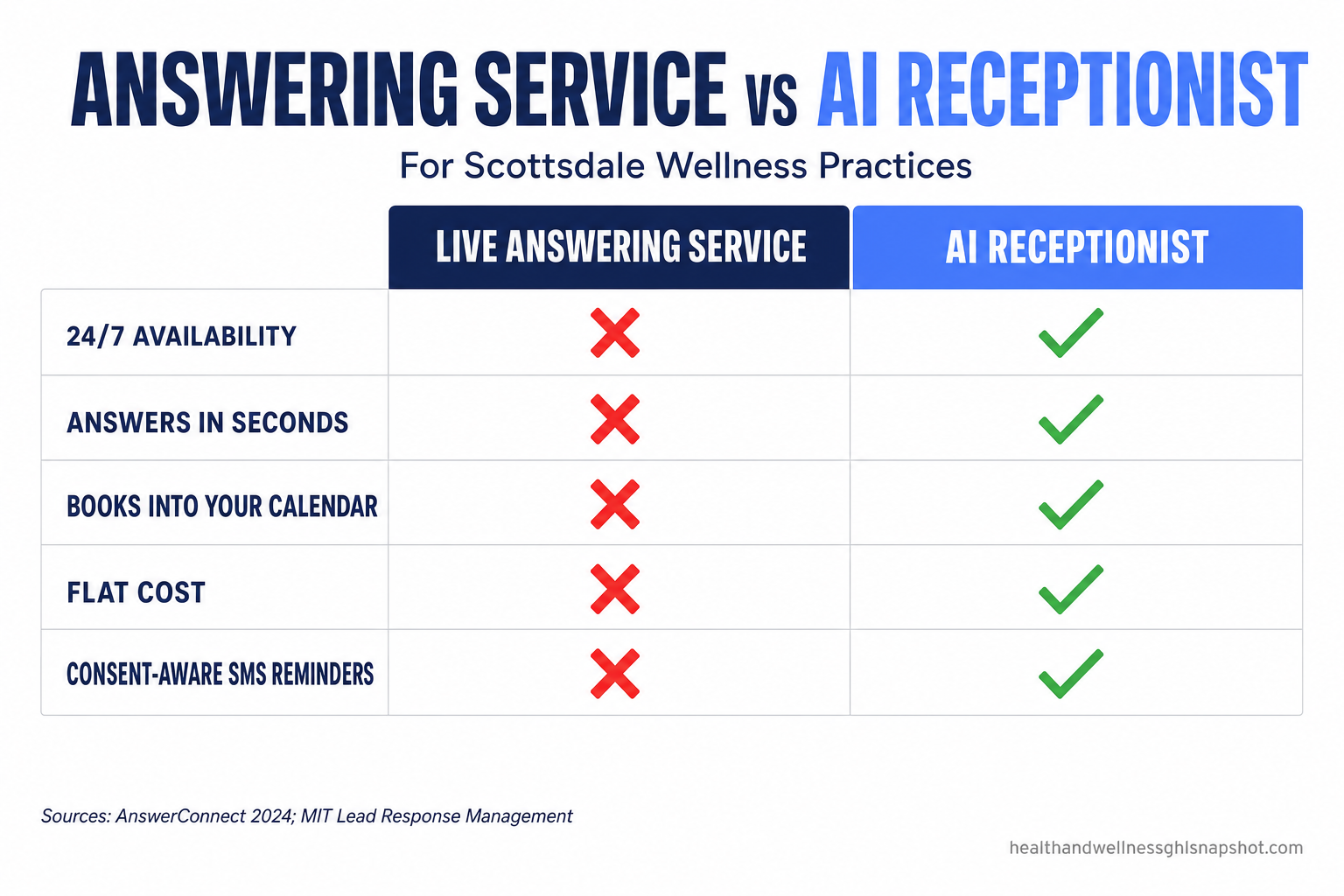
Table of contents
- Why answering the phone still matters for a Scottsdale wellness practice
- The real cost of a slow or missed response
- What a live answering service actually does — and where it falls short
- What an AI receptionist does differently
- Answering service vs. AI receptionist, side by side
- When a live answering service is still the right call
- Compliance: HIPAA, TCPA, and health claims
- Frequently asked questions
Why answering the phone still matters for a Scottsdale wellness practice
Before you compare who should answer the phone, it’s worth remembering how valuable that phone call is. Despite a decade of “nobody calls anymore,” the inbound phone call remains the most convertible lead a local wellness business gets. BIA/Kelsey’s research found phone calls are 10–15× more likely to convert than inbound web leads, with 25–40% of calls to local businesses becoming customers (BIA/Kelsey, 2014). Someone who dials your Scottsdale clinic has already decided they want to talk — that’s a far warmer signal than a form-fill.
And Scottsdale is a crowded, affluent market for exactly this kind of business. The US wellness economy reached roughly $2.1 trillion in 2024 — the largest in the world, at about $6,293 per person, growing ~7.9% a year (Global Wellness Institute, 2024). The aesthetics slice is booming too: the number of US medical spas grew from 8,841 at the end of 2022 to more than 10,000 in 2023, generating roughly $15.8 billion in revenue at an average of ~$1.4 million per location (American Med Spa Association, 2024). Scottsdale — dense with med spas, hormone and longevity clinics, functional-medicine practices, and nutrition coaches — sits right in the middle of that growth.
US medical spa locations by year — the aesthetics market Scottsdale competes in keeps expanding, which means more practices chasing the same after-hours callers. Source: American Med Spa Association, 2024 (2023 figure is “10,000+”).
More practices means more competition for the same motivated caller. When someone rings three Scottsdale clinics about hormone testing, the one that answers — or answers first — usually wins the consult. Which brings us to the real problem a solo or small practice faces: you cannot personally answer every call, and the cost of not answering is higher than it looks.
The real cost of a slow or missed response
The issue isn’t that you ignore calls on purpose — it’s that new leads go cold faster than any busy practitioner can keep up with. The most-cited study on response speed, run through MIT by Dr. James Oldroyd, analyzed nearly 15,000 leads and over 100,000 call attempts. It found that contacting a new lead within 5 minutes instead of 30 minutes made a business about 21× more likely to qualify that lead — and the odds of even reaching the person dropped roughly 100× across that same half hour (MIT / Lead Response Management). A wellness prospect calling at 8 p.m. is anxious, motivated, and shopping right now. Their patience is measured in minutes.
Now look at how businesses actually perform against that clock. Harvard Business Review’s audit of 2,241 US companies found the average response time to an online lead was a staggering 42 hours. Only 37% responded within an hour, 24% took more than a full day, and 23% never responded at all (Harvard Business Review, 2011). Firms that did reach out within an hour were about 7× more likely to qualify the lead than those that waited even 60 minutes longer.
How fast businesses actually respond to an inbound online lead (% of 2,241 companies audited). Nearly a quarter never reply at all — and the average reply lands 42 hours late. Source: Harvard Business Review, 2011.
That gap — between how fast a lead needs a response and how fast a human can deliver one — is the entire reason answering services and AI receptionists exist. Both promise to close it. They just do it very differently. (If speed-to-lead is your bottleneck, we go deeper in Speed to Lead: Why the First 5 Minutes Decide the Client.)
What a live answering service actually does — and where it falls short
A live answering service is a team of remote agents who pick up your calls under your business name, take a message or follow a basic script, and pass the details to you. For decades this was the only way a small practice covered its phone after hours. It still has real strengths: a human voice, genuine empathy on a hard call, and the flexibility to handle something unusual. For a wellness practice, though, three limitations matter.
First, the cost scales with every minute you use. Industry price sheets put per-minute rates at roughly $0.75–$1.50, with premium services up to ~$3.00, and per-call pricing around $1.25–$2.50 (Housecall Pro; Continental Message Solutions). Monthly plans commonly run $135–$400 for entry-to-mid volume and $1,000–$2,900+ for higher volume (AnswerConnect). A busy Scottsdale practice with a strong social presence can burn through minutes fast — and the better your marketing works, the bigger the bill.
Second, most answering services take a message; they don’t close the loop. The agent rarely has access to your live booking calendar, your program details, or your intake logic. So the “win” is usually a message that lands in your inbox — after which you still have to call back, and you’re back to fighting the 5-minute clock the next morning. The lead has often already booked elsewhere.
Third, the agents don’t know wellness. They’re generalists covering plumbers, lawyers, and clinics from the same script. They can’t speak to the difference between your 12-week metabolic program and a single hormone consult, can’t answer “do you take my situation?” with any nuance, and — critically — aren’t set up to handle protected health information the way a HIPAA-aware workflow should. That’s fine for taking a name and number. It’s thin for converting a high-intent wellness caller.
What an AI receptionist does differently
An AI receptionist is a voice agent that answers the phone in seconds, speaks naturally, qualifies the caller against your real intake questions, and books the consult directly into your calendar — 24/7, at a flat cost. Instead of taking a message for you to act on later, it completes the booking while the caller is still on the line and the intent is still hot.
This isn’t fringe technology anymore. The voice-AI-agents market is projected to grow from $2.4 billion in 2024 to $47.5 billion by 2034, a ~34.8% compound annual growth rate (Market.us), while the broader conversational-AI market is forecast to climb from $11.58 billion in 2024 to $41.39 billion by 2030 (Grand View Research). Consumers have caught up to it too: 64% say 24/7 availability is the most helpful feature of an automated agent, and 59% expect a response within five seconds (Chatbot.com, 2024).
For a wellness practice, four things separate an AI receptionist from a message-taking service:
- It books, not just notifies. The AI checks your live availability and reserves the consult, then fires an SMS confirmation — the same appointment automation that runs inside the snapshot.
- It never sleeps and never queues. No hold music, no “all our agents are busy,” no after-hours voicemail. The 9 p.m. call gets the same instant, on-brand answer as the 9 a.m. one.
- It recovers no-shows. Because it’s wired into your CRM, it sends automated reminders and reschedule offers. That matters: average outpatient no-show rates run around 23.5% (NCBI/PMC), and automated reminder systems are shown to reduce them — one clinic cut no-shows from 38.1% to 23.5% after adding automated reminders (American Journal of Medicine; Curogram). More on that in How to Reduce Appointment No-Shows.
- Its cost is flat. Answer 30 calls or 300, the price doesn’t move — the opposite of a per-minute service.
Pair it with a missed-call text-back so that even a caller who hangs up before the AI answers gets an instant text with a booking link, and almost nothing leaks.
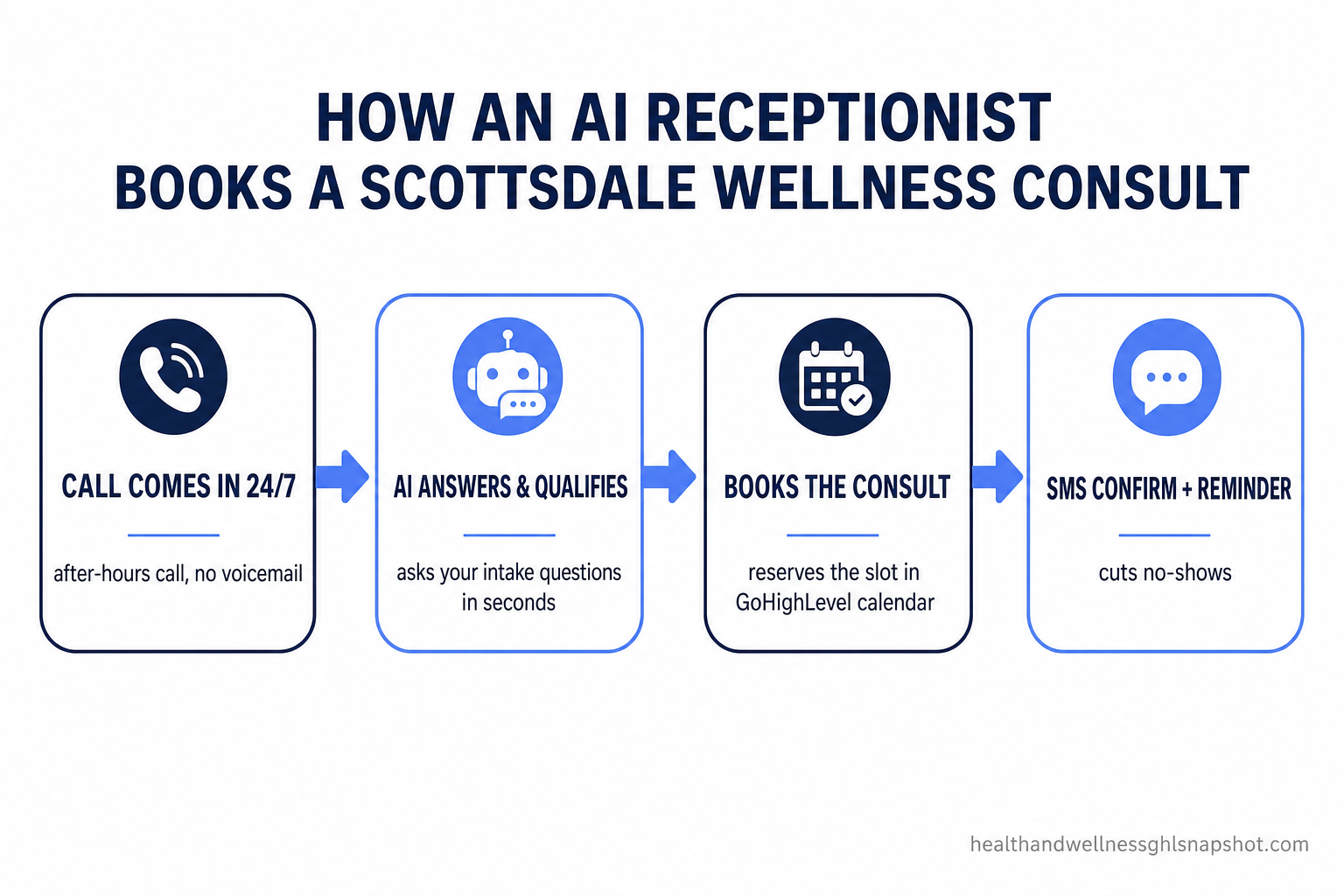
How a single after-hours call becomes a booked, confirmed consult — without you touching the phone.
Answering service vs. AI receptionist, side by side
Here’s the honest, feature-by-feature comparison for a Scottsdale wellness practice:
| What you’re comparing | Live answering service | AI receptionist (Wellness Snapshot) |
|---|---|---|
| Availability | ⚠️ Business hours, or 24/7 at premium rates | ✅ True 24/7/365, built in |
| Speed to answer | ⚠️ Ring queue + possible hold at peak | ✅ Answers in seconds, no hold |
| Cost model | ❌ Per-minute (~$0.75–$1.50) or $135–$2,900+/mo, rises with volume (AnswerConnect) | ✅ Flat — doesn’t rise with call volume |
| Books into your calendar | ❌ Usually takes a message; you call back | ✅ Reserves the consult live, sends SMS confirm |
| Wellness/program knowledge | ❌ Generalist agents, generic script | ✅ Trained on your programs and intake |
| No-show recovery | ❌ None | ✅ Automated reminders + reschedule offers |
| HIPAA/TCPA handling | ⚠️ Varies; often not built for PHI | ✅ Consent-aware SMS, PHI kept out of channels |
| Consistency | ⚠️ Varies by agent and shift | ✅ Same qualified answer every time |
| Scales with your marketing | ❌ Costs climb as calls climb | ✅ Flat as volume grows |
The pattern is clear: a live service is a safety net for calls you’d otherwise miss, while an AI receptionist is a conversion system that turns the call into a booked consult without your involvement. For a practice whose marketing is working — more Reels, more ads, more inbound — the per-minute model quietly penalizes your own growth.
A Scottsdale hormone-and-longevity practice, before and after
Evening calls go to a generalist agent who takes a name and number. The owner calls back at 8 a.m. — 12 hours later. Two of the five callers already booked with a competitor. The monthly bill climbs every time a Reel does well, because every extra call is more billed minutes.
Every call is answered in seconds, day or night. The AI qualifies each caller against the real intake questions, books the consult into the calendar, and texts a confirmation. No-show reminders go out automatically. The cost is flat no matter how many calls come in — so a viral Reel fills the calendar instead of the invoice.
When a live answering service is still the right call
An AI receptionist wins for most Scottsdale wellness practices, but pretending it’s always the answer would be the hype this brand avoids. A live human service — or a hybrid — is the better fit in a few honest cases:
- Emotionally sensitive or crisis-adjacent calls. Mental-wellness practices and any line where a caller may be in distress need a trained human, immediately. Automate the routine booking, but route anything sensitive to a person — and make sure your intake copy and escalation path are built with that in mind.
- Highly complex, high-ticket consultations where every caller expects a bespoke human conversation before they’ll book. If your average client is a $15,000 concierge-medicine relationship, a warm human intake may convert better than efficiency.
- You’re not ready to systematize. If your calendar, intake questions, and programs aren’t defined yet, an AI receptionist has nothing accurate to book against. Get the operations clear first — a dedicated wellness VA can run the phone, the calendar, and the follow-up while you build the system.
For the large majority — a growing Scottsdale practice losing warm callers after hours and watching a per-minute bill rise with every good marketing month — the AI receptionist (with a human on standby for the rare complex call) is the stronger, cheaper, faster choice.
Compliance: HIPAA, TCPA, and health claims
Any system that answers calls and sends texts for a wellness practice has to be built consent-aware, and neither an answering service nor an AI receptionist changes who’s responsible. A well-built AI receptionist keeps the conversation to scheduling and general information, keeps protected health information out of SMS and other unsecured channels, and captures messaging consent before any follow-up text goes out — the TCPA baseline. Our SMS automation is designed around that consent gate, and we cover the details in HIPAA-Aware SMS for Wellness Practices.
To be explicit: the Wellness Snapshot is a marketing and operations tool. We are not a healthcare provider and do not diagnose, treat, cure, or prevent any disease. Each licensed practitioner remains responsible for their own HIPAA obligations, state licensing, and FTC health-claim compliance in every client communication — whether a human or an AI answers the phone.
Who should switch — and who shouldn’t
The decision comes down to what your phone is doing today:
- You’re missing after-hours calls and your marketing is working. This is the clearest case for an AI receptionist. Every missed call is a warm, high-converting lead (BIA/Kelsey), and a flat-cost system that books them 24/7 pays for itself the moment it saves one consult.
- You pay a per-minute service and your call volume is climbing. You’re being taxed for growth. Model your last three months of minutes against a flat AI cost — the crossover usually arrives sooner than owners expect.
- Your calls are emotionally sensitive or deeply bespoke. Keep a human in the loop, and automate only the routine scheduling around them.
- Your bigger leak is no-shows or renewals, not missed calls. Fix that first. The same automation layer that answers the phone also runs your reminders and renewal nudges — see the full AI Caller feature.
Frequently asked questions
Answering service vs. AI receptionist for Scottsdale wellness practices — FAQ
What is an AI receptionist for a wellness practice?
It's a voice AI agent that answers your practice's phone 24/7, speaks naturally, asks your real intake questions to qualify the caller, and books the consult straight into your GoHighLevel calendar — then sends an SMS confirmation and reminders. Instead of taking a message for you to act on later, it completes the booking while the caller is still on the line. Anything sensitive or complex can be routed to a human.
Is an AI receptionist cheaper than a live answering service?
Usually, once your call volume is meaningful. Answering services bill per minute (about $0.75–$1.50, up to ~$3.00) or $135–$2,900+/month, and the cost rises every time you get more calls (AnswerConnect; Housecall Pro, 2024). An AI receptionist inside the Wellness Snapshot is a flat cost that doesn't climb with volume — so the more your marketing works, the bigger the gap in your favor.
Will an AI receptionist actually book the appointment, or just take a message?
It books. Because it's connected to your live calendar and intake logic, it reserves the consult during the call and sends a confirmation text — closing the loop while intent is high. That's the key difference from most answering services, which take a message and leave you to call back the next morning, by which time the lead may have booked elsewhere (reaching a lead in 5 minutes vs 30 makes you ~21× more likely to qualify it — MIT / Lead Response Management).
Is an AI phone system HIPAA and TCPA compliant?
A well-built one keeps calls to scheduling and general information, keeps protected health information out of SMS and unsecured channels, and captures messaging consent before any follow-up text (the TCPA baseline). That said, the Wellness Snapshot is a marketing and operations tool, not a healthcare provider — each licensed practitioner remains responsible for HIPAA, state licensing, and FTC health-claim compliance in their own communications.
Do I still need a human if I have an AI receptionist?
For most routine booking calls, no. But the best setup is a hybrid: the AI answers, qualifies, and books 24/7, while emotionally sensitive, crisis-adjacent, or highly complex calls are routed to a person. You get the AI's speed and flat cost on the volume, and a human where empathy or nuance genuinely matters.
How fast can a Scottsdale practice get an AI receptionist running?
The AI receptionist ships inside the Wellness Snapshot and is designed to install in about 24 hours, wired to your calendar, intake questions, and SMS reminders. You can see pricing on the pricing page or book a free walkthrough to have it set up for your practice.
Written by Anjali Mehta, Wellness Growth Editor. Anjali covers the business of wellness — pricing, unit economics, and the operational decisions that determine whether a great practitioner stays small or scales. She has a low tolerance for hype and a preference for honest math over motivational fluff. Anjali writes about marketing and practice operations; she is not a licensed healthcare provider, and nothing here is medical advice.
Keep reading: AI Receptionist for Wellness Practices in Los Angeles · Speed to Lead: Why the First 5 Minutes Decide the Client · Missed-Call Text-Back for Wellness Practices · How to Reduce Appointment No-Shows