
A New Yorker looking for a nutrition coach, a hormone clinic, or a functional-medicine practice does the same thing everyone does: they open Google Maps, type “wellness clinic near me,” and look at the three businesses in the box at the top. In New York City, the practice that wins that map pack isn’t the one with the nicest website — it’s the one with more recent, higher-rated Google reviews, because review signals are one of the heaviest factors Google uses to rank the local 3-pack, and reviews are also what the person actually reads before they book. Review signals account for roughly 20% of Google’s local-pack ranking algorithm (Whitespark, Local Search Ranking Factors 2026), and separately, 82% of patients use online reviews to evaluate a provider (Software Advice). Ranking and trust run on the same fuel.
This is a plain-language, sourced look at why reviews decide the NYC wellness map pack, what “review signals” actually means, and how a practice or its agency can collect fresh five-star reviews on autopilot — compliantly — instead of hoping happy clients remember to post. Every statistic below carries its source, and the honest caveats run throughout: results vary by your neighborhood, your category, and how consistently you run the system.
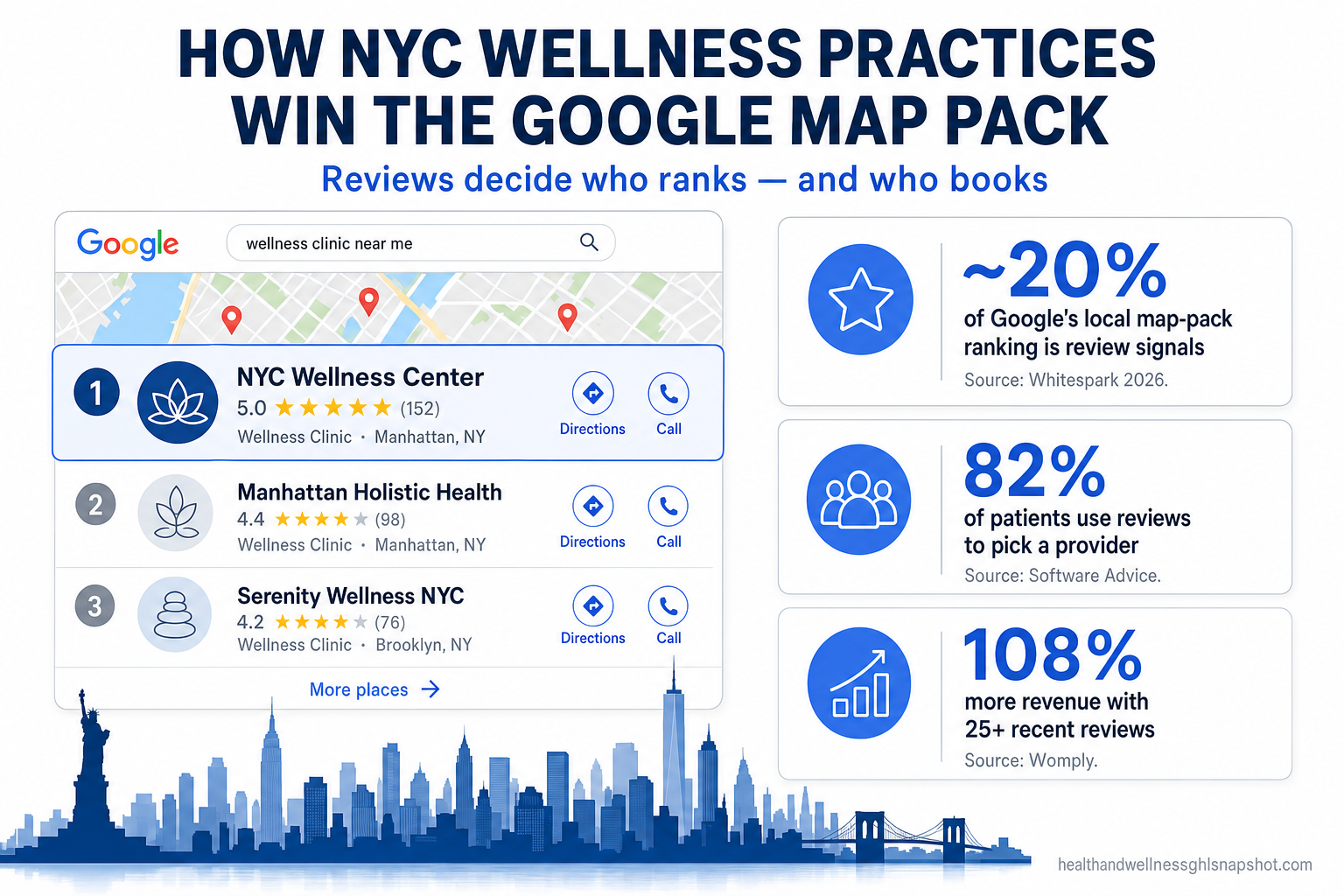
Table of contents
- What the Google Map Pack is — and why it decides NYC wellness clients
- How much do reviews actually weigh in local ranking?
- Why New York City raises the stakes
- The three review signals that move the map pack
- Reviews as the deciding factor for wellness clients
- Why most NYC wellness practices have a thin review profile
- How automated review harvesting fixes it
- Respond to every review — it ranks and it converts
- Compliance: FTC, Google, and HIPAA
- Frequently asked questions
What the Google Map Pack is — and why it decides NYC wellness clients
The “map pack” (also called the local pack or local 3-pack) is the boxed set of three local businesses Google shows at the top of the results — above the regular blue links — whenever someone searches with local intent. For a wellness practice, that’s queries like “functional medicine near me,” “hormone specialist Upper East Side,” or “nutritionist Brooklyn.” Those three slots, plus the map beside them, are the most valuable real estate in local search, because they sit above everything else and answer the searcher’s question — who’s near me, and are they any good? — without a single extra click.
Google decides who fills those three slots using a blend of three broad things: relevance (does your profile match the search), proximity (how close you are to the searcher), and prominence (how well-known and well-reviewed you are). You can’t change your address to be closer to every New Yorker, and your category is what it is. Prominence — driven heavily by your reviews — is the lever you can actually pull. That’s why two hormone clinics on the same block in Midtown can rank completely differently: same proximity, same relevance, but one has 140 recent five-star reviews and the other has 11 from two years ago.
How much do reviews actually weigh in local ranking?
Reviews are not a minor tie-breaker — they’re one of the single heaviest inputs into the local map pack. Whitespark’s annual Local Search Ranking Factors study, the most-cited survey of local SEO practitioners, puts review signals at roughly 20% of the local-pack algorithm in 2026 — behind only Google Business Profile signals (~32%) and ahead of on-page factors, links, and citations. Review signals have grown as a factor, from about 16% a few years earlier, as Google leans harder on real-world reputation (Whitespark, 2026; BrightLocal’s local algorithm guide).
Approximate weight of each factor group in Google’s local map-pack ranking (%). Source: Whitespark, Local Search Ranking Factors 2026.
“Review signals” is broader than your star average. It includes your review quantity (how many you have), velocity and recency (how often new ones arrive), rating, the keywords and location terms reviewers naturally use, and how you respond. That’s good news for a small NYC practice: you don’t need a national brand’s link profile to win prominence locally — you need a steady stream of authentic, recent reviews, which is exactly the thing automation is good at producing. For the full picture of everything that feeds local rank, our local SEO guide for wellness practitioners breaks down the other factors.
Why New York City raises the stakes
Everything about reviews matters more in New York City, because NYC is the densest, most competitive wellness market in the country. The US wellness economy reached $2.1 trillion in 2024 — the largest in the world, at about $6,293 per person (Global Wellness Institute, 2024), and that demand is concentrated hardest in metros like New York. The supply has exploded to match it: the US medical-spa segment alone reached more than 10,000 locations, averaging roughly $1.39 million in annual revenue each (American Med Spa Association, 2024) — and NYC neighborhoods like the Upper East Side, Flatiron, Williamsburg, and Park Slope are wall-to-wall with nutrition coaches, integrative clinics, and longevity practices competing for the same searches.
When a New Yorker searches “gut health specialist near me,” Google may have dozens of qualified practices within a mile to choose three from. Proximity gets you into the running; reviews are the differentiator that decides which three actually appear. In a small town you might rank in the pack almost by default. In Manhattan, a thin or stale review profile means you’re invisible — not because you’re a worse practitioner, but because the algorithm and the searcher both read reviews as the proxy for trust, and you gave them nothing recent to read.
The three review signals that move the map pack
If review signals are ~20% of the algorithm, the three levers inside that number are volume, recency, and rating — in that order of “most practices get this wrong.” Here’s what each one does and what the data says New Yorkers expect.
Volume. More reviews mean more prominence and more trust. The revenue link is stark: an analysis of 200,000+ US small businesses found those with 25+ recent reviews earned about 108% more revenue than average, and even reaching 9+ fresh reviews correlated with ~52% more (Womply, via Search Engine Land). Consumers set volume floors, too: 47% won’t use a business with fewer than 20 reviews (BrightLocal).
Revenue lift vs. the average business, by review behavior (%). Source: Womply, “Impact of Online Reviews on Small Business Revenue,” via Search Engine Land.
Recency. A wall of reviews from 2022 barely counts. 74% of consumers look for reviews written within the last three months, and a large share want them from the last two weeks (BrightLocal). Recency is also a ranking signal — a steady drip of new reviews tells Google you’re an active, current business. This is precisely why one-time “review pushes” fail: they spike your count, then go stale. You need a system that asks every week, forever.
Rating. Your average has to clear a bar before anyone considers you. Roughly 38% of consumers expect a local business to average at least 4.0 stars before they’ll use it, and about a third now hold out for 4.5+ (BrightLocal). And the revenue math on rating is real: Harvard Business School’s landmark study found a one-star increase in rating drives a 5–9% increase in revenue (Michael Luca, HBS).
Reviews as the deciding factor for wellness clients
Ranking in the pack only matters if the reviews then convince the person to book — and in wellness, reviews carry more weight than in almost any other category, because clients are trusting you with their health. In a Software Advice survey of how patients use online reviews, 82% used reviews to evaluate a provider, 72% used them as the first step in finding a new one, and — most telling — 48% said they’d go out of their insurance network for a provider with better reviews (Software Advice; Becker’s). For a cash-pay NYC wellness practice, that last number is the whole ballgame: people will pay more and travel farther for the provider the reviews vouch for.
How patients use online reviews when choosing a provider (% of respondents). Source: Software Advice, “How Patients Use Online Reviews.”
Put the ranking data and the trust data together and you get a compounding loop New York practices can’t afford to ignore: more recent reviews → higher in the map pack → seen by more high-intent searchers → more of them book and later leave their own reviews → higher still. The practice that starts that flywheel first, and keeps it turning, pulls away from competitors who are still asking for reviews by hand once a quarter.
Why most NYC wellness practices have a thin review profile
Here’s the uncomfortable truth: the practice with 14 reviews and the one with 200 usually don’t differ in how good they are — they differ in whether the ask is automated. About 70% of people leave a review when they’re actually asked (Search Engine Land). The reviews aren’t missing because your clients are unhappy or ungrateful. They’re missing because:
- Nobody asks, or asks once and forgets. A busy solo practitioner in Manhattan finishes a great session, means to text the client a review link that night, and never does. Multiply that by every client, every week.
- The ask comes at the wrong time. A request sent weeks later, when the client has moved on, converts far worse than one sent right after a win or a milestone — when they actually feel the result.
- It’s too many taps. “Search us on Google and leave a review” loses people. A one-tap direct link converts; anything longer leaks.
- Front-desk turnover. Whoever “owns” review requests leaves, and the habit leaves with them.
None of these are practitioner-quality problems. They’re process problems — and process problems are exactly what automation solves permanently. For the copy, timing, and channel mechanics of the ask itself, see our companion playbook, how to get more Google reviews for your wellness practice.
How automated review harvesting fixes it
Review harvesting automation turns “ask for reviews” from a task someone has to remember into a workflow that fires on its own, at the best possible moment, for every single client. Inside a GoHighLevel system, the review-harvesting automation that ships in the Wellness Snapshot works like this:
- A trigger fires at peak satisfaction. When a session, package milestone, or program completes in your CRM, the automation starts — right when the client feels the result, not weeks later.
- A request goes out by text and email. SMS is the workhorse here: text messages are opened and read within minutes, dramatically faster than email (SMS vendors report open rates around 98% versus roughly 20% for email — treat those as vendor benchmarks, not gospel, but the direction is not in doubt). The message references the experience, never private health details.
- Happy clients get a one-tap path to Google. The link drops them straight onto your Google Business Profile review box — no searching, no friction.
- Quiet clients get a gentle reminder. Most reviews come after a second nudge, so the sequence follows up once or twice, then stops, honoring opt-outs.
- Everything is logged. Every request and outcome sits in the CRM, so you can see your review velocity as a number instead of a guess.
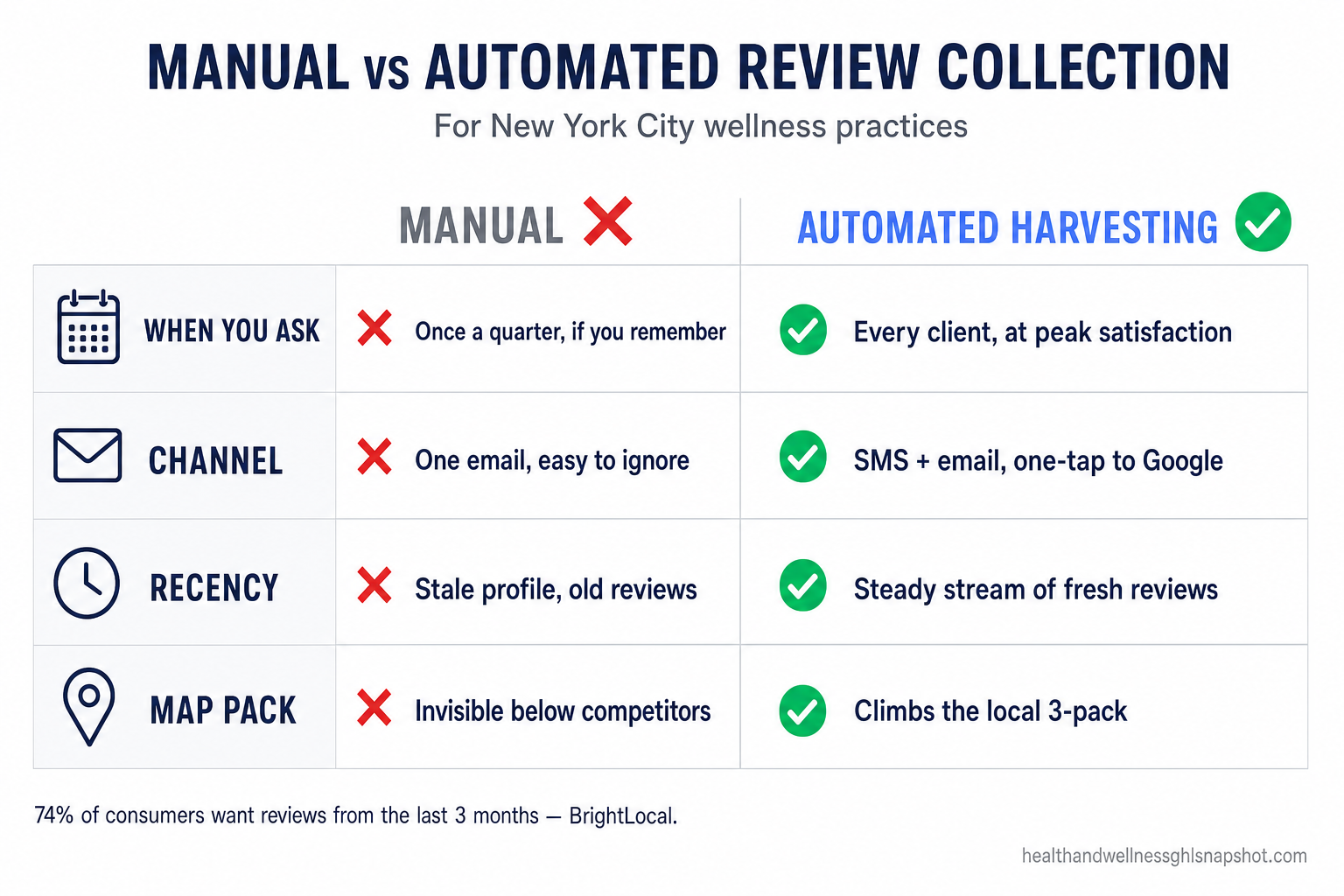
The result is what New York practices actually need to win the map pack: volume and recency, produced consistently, without anyone having to remember. Prefer not to touch it at all? A dedicated wellness VA can run the whole review engine — plus your inbox and calendar — for you, or you can start the whole snapshot at the current founding-practitioner price.
Respond to every review — it ranks and it converts
Collecting reviews is half the system; responding to them is the free half almost everyone skips. Responses are part of Google’s review signals, and they move clients: 88% of consumers would use a business that responds to all of its reviews, versus just 47% for a business that never responds (BrightLocal). Yet 63% of consumers say a business has never responded to their review (ReviewTrackers) — which means simply replying makes you stand out. Businesses that reply to at least a quarter of their reviews even average about 35% more revenue (Womply, via Search Engine Land).
For a busy NYC practice, responding to every review by hand is another task that slips. Automating the acknowledgment — a warm, on-brand reply to positive reviews and an instant alert routing negative feedback to you privately first — closes the loop. That’s what our Google Business Profile reply automation handles alongside harvesting. A thoughtful response to a critical review, handled fast and offline, often does more for prospective clients than the five-star reviews do, because it shows how you treat people when something goes wrong.
Compliance: FTC, Google, and HIPAA
Automating reviews the wrong way can get your listing suspended or draw a federal penalty — so the compliant path matters as much as the results. Three lines you cannot cross:
- Don’t fake reviews. The FTC’s final rule on consumer reviews and testimonials took effect in October 2024 and bans fake or AI-generated reviews, undisclosed insider reviews, and review suppression — with civil penalties up to $51,744 per violation (Federal Register, 16 CFR Part 465). Every review must be from a real client describing a real experience.
- Don’t gate reviews. “Review gating” — selectively asking only happy clients to post publicly while diverting unhappy ones — violates Google’s review policies and the FTC rule. The compliant version asks everyone; the “smart routing” you’re allowed to do is giving unhappy clients an additional private channel to reach you, not blocking their public review.
- Stay HIPAA-aware. Review requests should reference the experience, not any protected health information, and honor SMS consent and opt-outs on a TCPA-aware basis. Our HIPAA-aware SMS guide covers the specifics. Remember: we’re a marketing and operations tool, not a healthcare provider — your clinical claims, HIPAA obligations, and FTC health-claim compliance remain yours.
A well-built harvesting automation is designed around these lines from the start: it asks every client, references only the experience, routes dissatisfaction to a private path in addition to (never instead of) the public option, and logs consent.
Frequently asked questions
Reviews and the Google Map Pack for NYC wellness practices — FAQ
How important are Google reviews for ranking in the New York City map pack?
Very. Review signals make up roughly 20% of Google's local-pack ranking algorithm — the second-heaviest factor group after Google Business Profile signals, according to Whitespark's 2026 Local Search Ranking Factors study. In a dense market like NYC, where many practices share the same proximity and category, review volume, recency, and rating are often the deciding factor for which three businesses appear in the map pack.
How many Google reviews does a wellness practice need?
There's no fixed number, but the data points to thresholds: about 47% of consumers won't use a business with fewer than 20 reviews, and businesses with 25+ recent reviews earn roughly 108% more revenue than average. More important than any single total is recency — 74% of consumers look for reviews from the last three months — so a steady stream of new reviews matters more than a big pile of old ones.
Is it against the rules to automate review requests?
No — automating the request is fine and encouraged. What's against the rules is faking reviews or 'gating' them (only routing happy clients to Google while blocking unhappy ones), which violates the FTC's 2024 fake-reviews rule and Google's policies. A compliant automation asks every client, references only their experience, and gives dissatisfied clients a private feedback path in addition to — never instead of — the public option.
SMS or email for review requests?
Text usually wins for speed: SMS messages are opened and read within minutes, far faster than email, so a request sent right after a session tends to convert better by SMS. The strongest setups send both — an SMS first, then an email reminder — while honoring opt-outs and quiet hours on a TCPA-aware basis. The review-harvesting automation in the Wellness Snapshot runs both channels for you.
How fast can a NYC practice get review automation running?
Review Harvesting is 1 of 11 automation features in the Wellness Snapshot, a done-for-you GoHighLevel system installed in about 24 hours that you own outright. You can also book a free demo to watch it request, route, and log a real review before you decide, or have a dedicated wellness VA run the whole review engine for you.
Written by Anjali Mehta, Wellness Growth Editor. Anjali covers the business of wellness — pricing, referral and review systems, and the marketing decisions that decide whether a great practitioner stays small or scales. She has a low tolerance for hype; expect honest math, not motivational fluff. Anjali is a GoHighLevel automation and marketing specialist, not a licensed healthcare provider, and nothing here is medical advice.
Keep reading: How to Get More Google Reviews for Your Wellness Practice · Local SEO for Wellness Practitioners · HIPAA-Aware SMS for Wellness · Reduce Appointment No-Shows